The Effect of Artificial Intelligence-Based Learning on Emotional Creativity among High School Students
Keywords:
AI-based learning, Emotional creativity, Novelty, Effectiveness/Authenticity, High school studentsAbstract
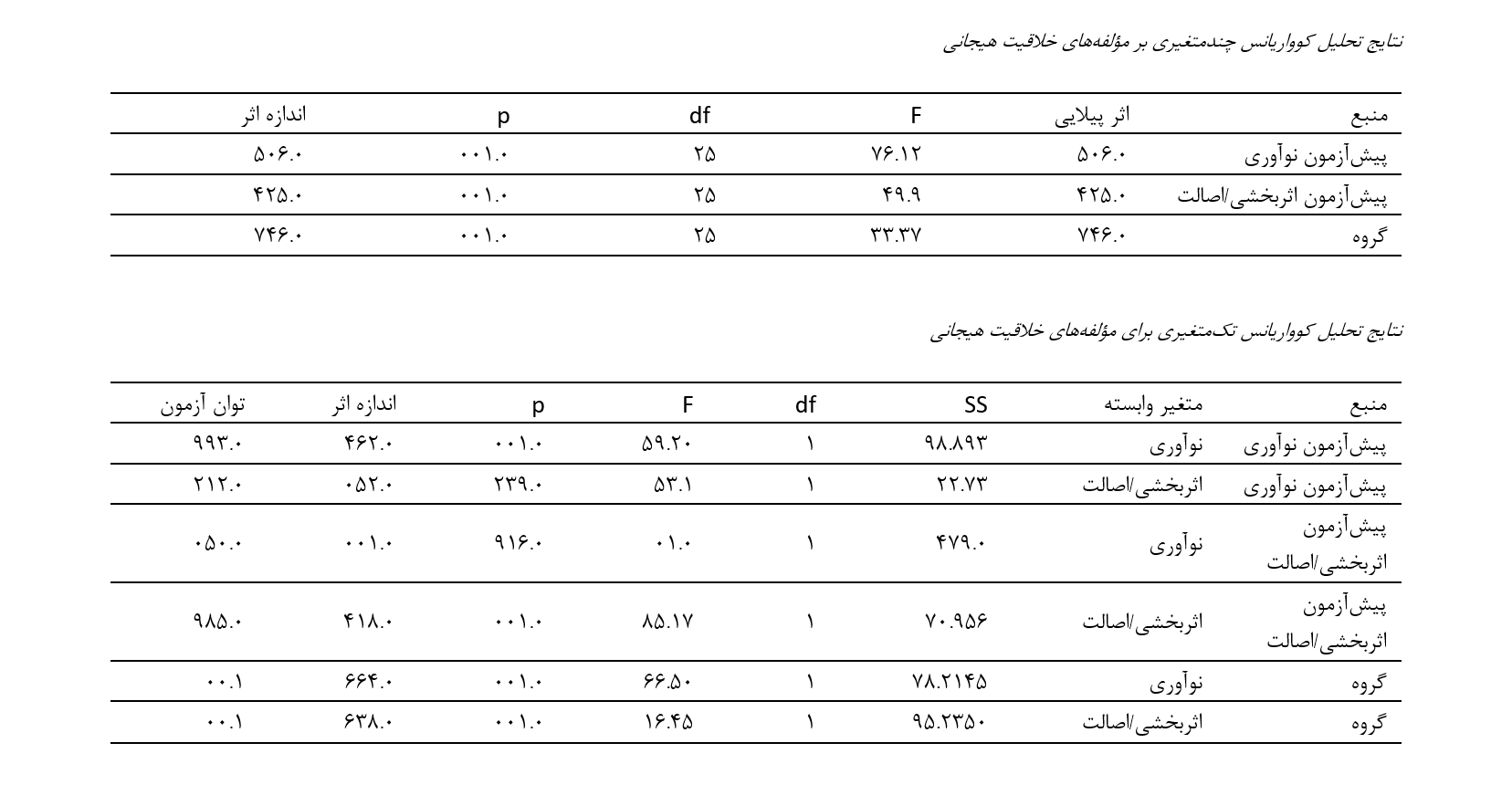
The present study aimed to examine the effect of artificial intelligence-based learning on emotional creativity among high school students. Methodologically, this study was quasi-experimental and used a pretest–posttest design with a control group. The statistical population consisted of male high school students who were studying during the 2024–2025 academic year. After initial screening using the Emotional Creativity Scale, 30 students who had obtained lower scores in emotional creativity were selected and randomly assigned to an experimental group and a control group, with 15 participants in each group. The experimental group participated in an artificial intelligence-based learning program over eight 90-minute sessions, whereas the control group received no intervention during this period. The research instrument was Averill’s Emotional Creativity Scale, and the data were analyzed using multivariate and univariate analysis of covariance. The results of the multivariate analysis of covariance showed that, after controlling for the effect of pretest scores, there was a significant difference between the two groups in the linear combination of the components of emotional creativity; specifically, Pillai’s trace for the group variable was 0.746, with F = 37.33, p = 0.001, and an effect size of 0.746. The results of the univariate analyses also indicated that artificial intelligence-based learning had a significant effect on increasing the novelty component; the adjusted mean of novelty was 86.24 in the experimental group and 70.05 in the control group, and the group effect was statistically significant, F = 50.66, p = 0.001, η² = 0.664. In addition, for the effectiveness/authenticity component, the adjusted mean was 100.31 in the experimental group and 82.44 in the control group, and the difference between the two groups was reported to be significant, F = 45.16, p = 0.001, η² = 0.638. Based on the findings, the purposeful and ethical use of artificial intelligence tools can be considered a novel approach to strengthening the creative and emotional aspects of learning among students. However, due to the limited sample size, the use of a self-report instrument, and the absence of a follow-up phase, the results should be interpreted with caution.
References
Alzoubi, A. M. A., Al-Qudah, M. F., Albursan, I. S., Bakhiet, S. F. A., & Alfnan, A. A. (2021). The predictive ability of emotional creativity in creative performance among university students. SAGE Open, 11(2). https://doi.org/10.1177/21582440211008876
Averill, J. R. (1999). Individual differences in emotional creativity: Structure and correlates. Journal of Personality, 67(2), 331-371. https://doi.org/10.1111/1467-6494.00058
Averill, J. R., & Thomas-Knowles, C. (1991). Emotional creativity. In International review of studies on emotion (Vol. 1, pp. 269-299). Wiley. https://www.researchgate.net/publication/247807746_Emotional_Creativity_Alexithymia_and_Styles_of_Creativity
Gligorea, I., Cioca, M., Oancea, R., Gorski, A. T., Gorski, H., & Tudorache, P. (2023). Adaptive learning using artificial intelligence in e-learning: A literature review. Education Sciences, 13(12), 1216. https://doi.org/10.3390/educsci13121216
Li, P. H., & Lee, J. C. K. (2025). AI, brain, and child: Navigating the intersection of artificial intelligence, neuroscience, and child development. AI, Brain and Child, 1(4). https://doi.org/10.1007/s44436-025-00004-4
Luo, W., He, H., Liu, J., Berson, I. R., Berson, M. J., Zhou, Y., & Li, H. (2024). Aladdin’s Genie or Pandora’s Box for early childhood education? Experts chat on the roles, challenges, and developments of ChatGPT. Early Education and Development, 35(1), 96-113. https://doi.org/10.1080/10409289.2023.2214181
Oriol, X., Amutio, A., Mendoza, M., Da Costa, S., & Miranda, R. (2016). Emotional creativity as predictor of intrinsic motivation and academic engagement in university students: The mediating role of positive emotions. Frontiers in Psychology, 7, 1243. https://doi.org/10.3389/fpsyg.2016.01243
Rong, J., Terzidis, K., & Ding, J. (2024). Kids AI design thinking education for creativity development. Archives of Design Research, 37(3), 119-133. https://doi.org/10.15187/adr.2024.07.37.3.119
Su, J., & Yang, W. (2022). Artificial intelligence in early childhood education: A scoping review. Computers and Education: Artificial Intelligence, 3, 100049. https://doi.org/10.1016/j.caeai.2022.100049
Weng, W., & Zhang, X. (2024). In the era of artificial intelligence, how to cultivate students’ creativity. Proceedings of the 4th International Conference on New Media Development and Modernized Education (NMDME 2024),
Downloads
Publication Timeline
- Submitted
- Revised
- Accepted
Issue
Section
License
Copyright (c) 2025 فاطمه میرشریف (نویسنده); خاطره ابراهیمیان ; مهناز سنجری, پریسا اشراقی, آرزو عظیمنوهسی (نویسنده)

This work is licensed under a Creative Commons Attribution-NonCommercial 4.0 International License.