The Effect of Rhythmic Body Percussion Exercises on Enjoyment of Physical Activity and Executive Function in Girls Aged 10-12 Years with Educable Intellectual Disability
Keywords:
Body percussion, Executive function, Enjoyment of physical activity, Intellectual disability, Children, Adapted physical activityAbstract
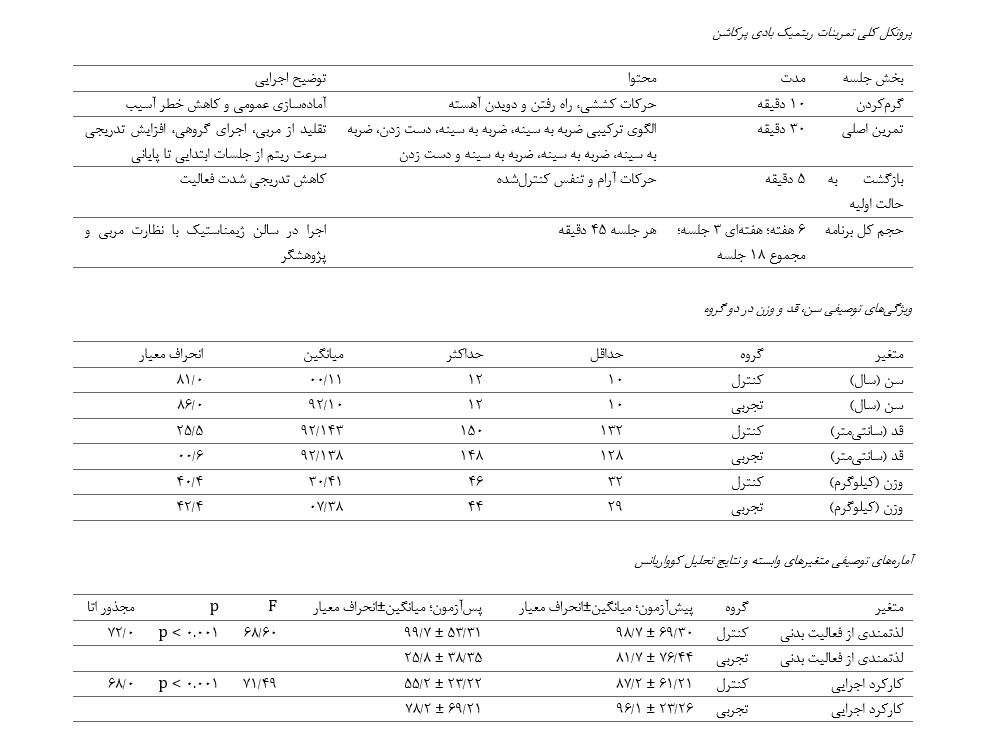
This quasi-experimental study examined the effect of rhythmic body percussion exercises on enjoyment of physical activity and executive function in girls aged 10-12 years with educable intellectual disability. The study used a pretest-posttest control-group design. Twenty-six eligible students from exceptional elementary schools in Dezful, Iran, during the 2023-2024 academic year were selected purposefully and randomly assigned to an experimental group (n = 13) and a control group (n = 13). Enjoyment of physical activity was assessed using the Moore et al. questionnaire, and executive function was assessed using the Tower of London test. The experimental group completed an 18-session body percussion program over six weeks, with three 45-minute sessions per week, whereas the control group continued its usual daily routine. Data were analyzed using analysis of covariance at the 0.05 significance level. After adjustment for pretest scores, significant between-group differences were observed in posttest enjoyment of physical activity and executive function (p < 0.001). Because baseline differences between groups were considerable and adjusted means were not available in the initial statistical output, the findings should be interpreted as preliminary evidence rather than as definitive proof of effectiveness. Body percussion exercises may be a low-cost, group-based, and feasible activity for special schools and rehabilitation settings; however, larger studies with active control groups and follow-up assessments are required.
References
Black, D. W., & Grant, J. E. (2014). DSM-5 Guidebook: The Essential Companion to the Diagnostic and Statistical Manual of Mental Disorders. American Psychiatric Publishing.
Brighenti, S., Cicinelli, G., Urdanch, B., & Keller, R. (2024). Effects of executive functions training in primary school students with borderline intellectual functioning through a multi-method, multi-informant intervention: a pilot study. Clinical Neuropsychiatry, 21(3), 159-170.
Diamond, A. (2013). Executive functions. Annual Review of Psychology, 64, 135-168. https://doi.org/10.1146/annurev-psych-113011-143750
Erickson, K. I., Donofry, S. D., Sewell, K. R., Brown, B. M., & Stillman, C. M. (2022). Cognitive aging and the promise of physical activity. Annual Review of Clinical Psychology, 18, 417-442. https://doi.org/10.1146/annurev-clinpsy-072720-014213
Erostarbe-Pérez, M., Reparaz-Abaitua, C., Martínez-Pérez, L., & Magallón-Recalde, S. (2022). Executive functions and their relationship with intellectual capacity and age in schoolchildren with intellectual disability. Journal of Intellectual Disability Research, 66(1-2), 50-67. https://doi.org/10.1111/jir.12885
Gravråkmo, S., Olsen, A., Lydersen, S., Ingul, J. M., Henry, L., & Øie, M. G. (2023). Associations between executive functions, intelligence and adaptive behaviour in children and adolescents with mild intellectual disability. Journal of Intellectual Disabilities, 27(3), 715-727. https://doi.org/10.1177/17446295221095951
Haas, P., Yang, C. H., & Dunton, G. F. (2021). Associations between physical activity enjoyment and age-related decline in physical activity in children: results from a longitudinal within-person study. Journal of Sport and Exercise Psychology, 43(3), 205-214. https://doi.org/10.1123/jsep.2020-0156
Jiménez-Molina, J. B., Vicedo-Cantó, E., Sayago-Martínez, R., & Romero-Naranjo, F. J. (2017). Evaluating attention, socioemotional factors and anxiety in secondary school students in Murcia (Spain) using the BAPNE method: research protocol. Procedia - Social and Behavioral Sciences, 237, 1071-1075. https://doi.org/10.1016/j.sbspro.2017.02.157
Lezak, M. D. (2004). Neuropsychological Assessment (4th ed.). Oxford University Press.
Mokaberian, M., Kashani, V., & Sedighi Faroji, F. (2018). Validation of the Persian version of Physical Activity Enjoyment Scale in children. Motor Behavior, 9(30), 17-36.
Moore, J. B., Yin, Z., Hanes, J., Duda, J., Gutin, B., & Barbeau, P. (2009). Measuring enjoyment of physical activity in children: validation of the Physical Activity Enjoyment Scale. Journal of Applied Sport Psychology, 21(Suppl 1), S116-S129. https://doi.org/10.1080/10413200802593612
Morris, P., Hope, E., Foulsham, T., & Mills, J. P. (2021). The effectiveness of mirroring- and rhythm-based interventions for children with autism spectrum disorder: a systematic review. Review Journal of Autism and Developmental Disorders, 8(4), 541-561. https://doi.org/10.1007/s40489-021-00236-z
Mosavi, H. S., Ayatizadeh Tafti, F., Abedinzadeh Masuleh, S., & Abbasi Bafghi, H. (2023). Effectiveness of cognitive-motor intervention on physical literacy and enjoyment of physical activity of female students. Journal of Psychological Science, 22(124), 685-702.
Piqueres de Juan, I., Sánchez González, E., Romero-Naranjo, F. J., & Sarmiento-Alienes, S. (2018). Pilot study into sustained and selective attention using the BAPNE method. European Proceedings of Social and Behavioural Sciences, 751-759. https://doi.org/10.15405/epsbs.2019.04.02.93
Rodan, L. H., Stoler, J., Chen, E., & Geleske, T. (2025). Genetic evaluation of the child with intellectual disability or global developmental delay: clinical report. Pediatrics, 156(1), e2025072219. https://doi.org/10.1542/peds.2025-072219
Romero-Naranjo, A. A., Romero-Naranjo, F. J., & Bofill, L. M. (2016). Body percussion and team building through the BAPNE method. SHS Web of Conferences, 26, 01010. https://doi.org/10.1051/shsconf/20162601020
Tandon, P. S., Klein, M., Saelens, B. E., Christakis, D. A., Marchese, A. J., & Lengua, L. (2018). Short-term impact of physical activity vs. sedentary behavior on preschoolers' cognitive functions. Mental Health and Physical Activity, 15, 17-21. https://doi.org/10.1016/j.mhpa.2018.06.004
Teques, P., Calmeiro, L., Silva, C., & Borrego, C. (2020). Validation and adaptation of the Physical Activity Enjoyment Scale (PACES) in fitness group exercisers. Journal of Sport and Health Science, 9(4), 352-357. https://doi.org/10.1016/j.jshs.2017.09.010
Wan, C. Y., & Schlaug, G. (2010). Music making as a tool for promoting brain plasticity across the life span. The Neuroscientist, 16(5), 566-577. https://doi.org/10.1177/1073858410377805
Downloads
Publication Timeline
- Submitted
- Revised
- Accepted
Issue
Section
License
Copyright (c) 2025 میترا غفوری زاده (نویسنده); نگار آرازشی; علی کاشی, کیوان ملانوروزی (نویسنده)

This work is licensed under a Creative Commons Attribution-NonCommercial 4.0 International License.