The Relationship Between Continuous Social Media Use and Working Memory Performance and Mindfulness in Young Adults
Keywords:
Social Media, Working Memory, Mindfulness, Problematic Use, Young AdultsAbstract
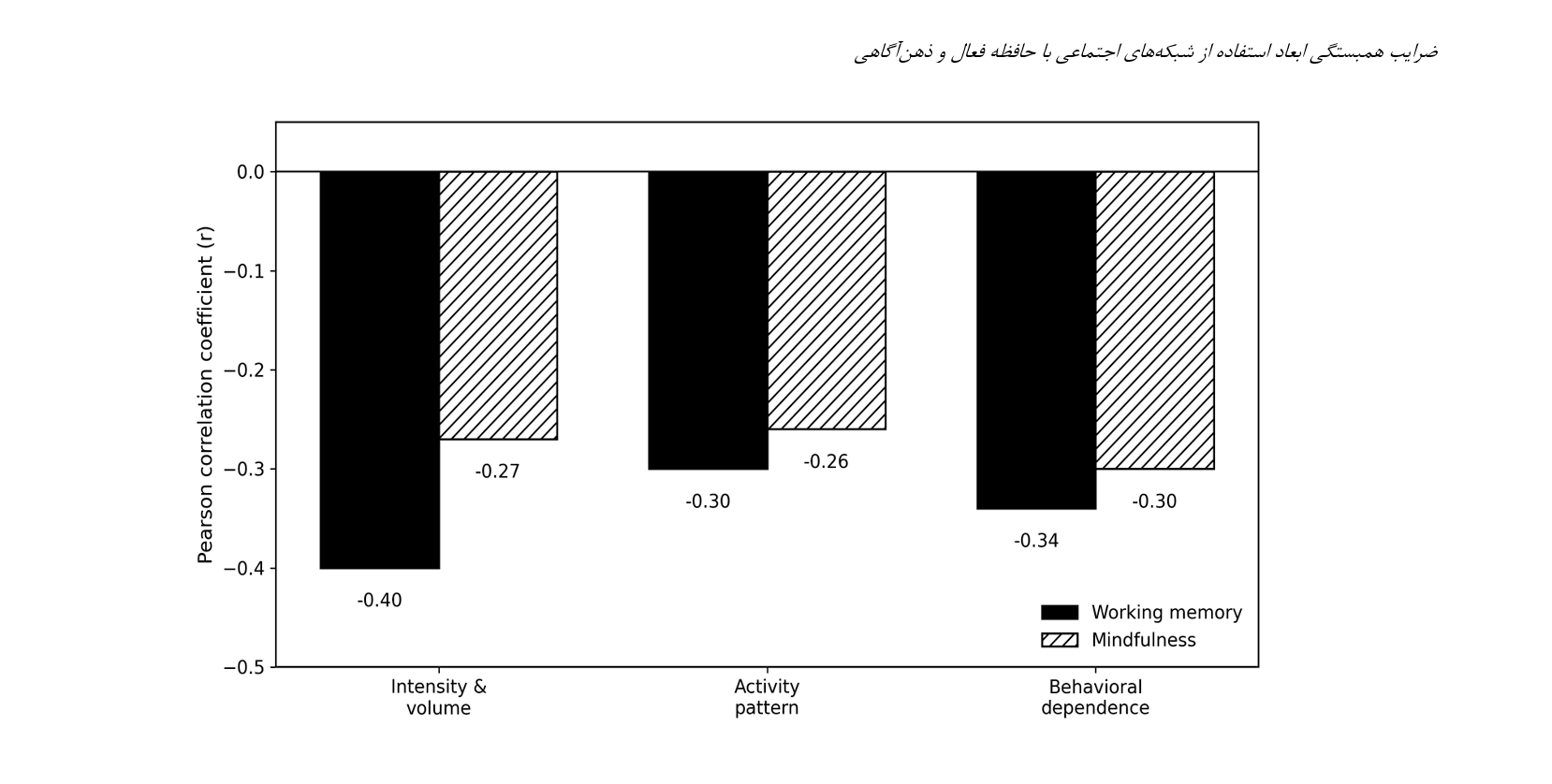
The present study aimed to examine the relationship between continuous social media use and working memory performance and mindfulness in young adults. In terms of purpose, this study was applied research, and in terms of methodology, it employed a descriptive-correlational and cross-sectional design. The statistical population consisted of active social media users aged 18 to 30 years, and 384 participants were included in the study based on Cochran’s formula and according to the inclusion and exclusion criteria. Data were collected using the n-back task to assess working memory, the Kentucky Inventory of Mindfulness Skills, and a researcher-developed questionnaire on continuous social media use. The reliability of the researcher-developed questionnaire was acceptable, with a Cronbach’s alpha coefficient of .73. Data were analyzed using SPSS software and Pearson correlation tests. The findings indicated that the intensity and volume of social media use had a significant negative relationship with working memory (r = −0.40, p < .001) and mindfulness (r = −0.27, p < .001). Patterns of use and type of activity also showed negative relationships with working memory (r = −0.30, p < .001) and mindfulness (r = −0.26, p < .001). Furthermore, behavioral dependence and compulsive use demonstrated significant negative correlations with working memory (r = −0.34, p < .001) and mindfulness (r = −0.30, p < .001). Overall, the results suggest that extensive, fragmented, and compulsive social media use may be associated with reduced working memory efficiency and diminished mindful attention to present-moment experiences. Accordingly, media literacy education, notification management, limiting non-purposeful use, and strengthening mindfulness skills may play an important role in preserving the cognitive and psychological health of young adults.
References
Amarlou, H., Moozekesh, L., & Movahedi, Y. (2018). The effect of computer-assisted rehabilitation on improving working memory performance and shape recognition in students. Journal of Nursing, Midwifery and Paramedical Sciences, 4(3), 6-15. http://sjnmp.muk.ac.ir/article-1-179-fa.html
Arslan, G., & Coşkun, M. (2022). Social exclusion, self-forgiveness, mindfulness, and Internet addiction in college students: A moderated mediation approach. International Journal of Mental Health and Addiction, 20(4), 2165-2179. https://doi.org/10.1007/s11469-021-00506-1
Baddeley, A. D., & Hitch, G. J. (1974). Working memory. In Psychology of Learning and Motivation (Vol. 8, pp. 47-89). Academic Press. https://doi.org/10.1016/S0079-7421(08)60452-1
Baer, R. A., Smith, G. T., & Allen, K. B. (2004). Assessment of mindfulness by self-report: The Kentucky Inventory of Mindfulness Skills. Assessment, 11(3), 191-206. https://doi.org/10.1177/1073191104268029
Bordiameanesh, S. (2025). The role of digital mental health in learning: Investigating the effect of continuous use of social networks and online education on attention, working memory, and academic burnout of students. Proceedings of the 26th National Scientific-Research Conference on Psychology and Educational Sciences, Shirvan.
Kirchner, W. K. (1958). Age differences in short-term retention of rapidly changing information. Journal of Experimental Psychology, 55(4), 352-358. https://doi.org/10.1037/h0043688
Liu, C., Chen, H., Zhang, A., Gong, X., Wu, K., Liu, C. Y., & Chiou, W. K. (2023). The effects of short video app-guided loving-kindness meditation on college students’ mindfulness, self-compassion, positive psychological capital, and suicide ideation. Psicologia: Reflexão e Crítica, 36, 32. https://doi.org/10.1186/s41155-023-00276-w
Moghaddam, K., & Karimi, R. (2024). Sentiment analysis in social networks based on a combination of deep belief networks and long short-term memory. Proceedings of the 9th National Conference on New Studies and Research in Computer Science, Electrical and Mechanical Engineering of Iran, Tehran.
Nazerifar, F., & Mosadeghi Nik, M. (2025). The role of mindfulness and self-compassion in emotion regulation in the context of social networks: A narrative review. Proceedings of the 8th International Conference and 11th National Conference on Management, Psychology and Behavioral Sciences, Tehran.
Shannon, H., Bush, K., Villeneuve, P. J., Hellemans, K. G. C., & Guimond, S. (2022). Problematic social media use in adolescents and young adults: Systematic review and meta-analysis. JMIR Mental Health, 9(4). https://doi.org/10.2196/33450
Tran, M. A. Q., Vo-Thanh, T., Soliman, M., Ha, A. T., & Van Pham, M. (2024). Could mindfulness diminish mental health disorders? The serial mediating role of self-compassion and psychological well-being. Current Psychology, 43(15), 13909-13922. https://doi.org/10.1007/s12144-022-03421-3
Vamegh, Z. (2025). A meta-analysis of the relationship between self-compassion, mindfulness, and psychological well-being with social network addiction in university students. Proceedings of the 1st International Conference on Applied Psychology and Counseling, Tehran.
Wilson, B. A. (2009). Memory rehabilitation: Integrating theory and practice. Guilford Press. https://journals.lww.com/intjrehabilres/fulltext/2009/08001/Memory_Rehabilitation.4.aspx
Younesi, M., Tahmasebi, S., & Anzelchi, S. (2025). Predicting the amount of social network use based on working memory performance and aggression in first-grade secondary school female students. Proceedings of the 1st National Conference on Research and Studies in Psychology and Educational Sciences: Mental Health in the Digital Age, Arak.
Zhang, D., Lee, E. K. P., Mak, E. C. W., Ho, C. Y., & Wong, S. Y. S. (2021). Mindfulness-based interventions: An overall review. British Medical Bulletin, 138(1), 41-57. https://doi.org/10.1093/bmb/ldab005
Downloads
Publication Timeline
- Submitted
- Revised
- Accepted
Issue
Section
License
Copyright (c) 2025 مریم امیری (نویسنده); فیروزه نهضت; فاطمه ولی پور صاحبی, آرزو عظیم نوهسی, شهرهالسادات فیلسوف (نویسنده)

This work is licensed under a Creative Commons Attribution-NonCommercial 4.0 International License.