مطالعه تاثیر چابکی سازمانی بر سلامت سازمانی کارکنان ادارات ورزش و جوانان استان البرز با نقش میانجی خودارزشیابیهای مرکزی
DOI:
https://doi.org/10.61838/kman.longevity.73کلمات کلیدی:
چابکی سازمانی, سلامت سازمانی, خودارزشیابی های مرکزی, کارکنان ادارات ورزش و جوانانچکیده
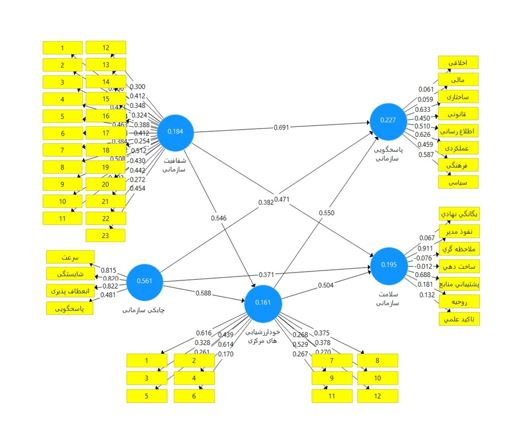
هدف از این تحقیق بررسی تاثیر چابکی سازمانی بر سلامت سازمانی کارکنان ادارات ورزش و جوانان استان البرز با نقش میانجی خودارزشیابیهای مرکزی بود. پژوهش حاضر، توصیفی همبستگی میباشد که دادهها به صورت میدانی و از طریق پرسشنامه و به روش میدانی گردآوری شد. جامعه آماری پژوهش شامل کلیه کارکنان ادارات ورزش و جوانان استان البرز به تعداد 215 نفر میباشد که طبق جدول کرجسی و مورگان(1970)، تعداد 136 نفر از کارکنان ادارات ورزش و جوانان استان البرز به صورت تصادفی طبقهای نسبی به عنوان نمونه آماری انتخاب شدند. برای گردآوری دادهها از پرسشنامههای چابکی سازمانی ژانگ و شریفی (2000)، سلامت سازمانی هوی و همكاران(1996) و خودارزشیابیهای جاج و همکاران (2003) استفاده شد. برای تجزیه و تحلیل دادهها از ضریب همبستگی، آزمون رگرسیون چندگانه و تحلیل معادلات ساختاری استفاده شد. کلیه محاسبات با استفاده از نرم افزارهای PLS و SPSS انجام شد. نتایج نشان داد که چابکی سازمانی بر سلامت سازمانی و خودارزشیابیهای مرکزی در ادارات ورزش و جوانان استان البرز تاثیر دارد و 76/13% از تغییرات سلامت سازمانی و 57/34% از تغییرات خودارزشیابیهای مرکزی توسط چابکی سازمانی تبیین میشود. همچنین خودارزشیابیهای مرکزی بر سلامت سازمانی در ادارات ورزش و جوانان استان البرز تاثیر دارد و 40/25% از تغییرات سلامت سازمانی توسط خودارزشیابیهای مرکزی تبیین میشود. همچنین نتایج آزمون سوبل نشان داد که خودارزشیابیهای مرکزی در رابطه شفافیت سازمانی و چابکی سازمانی بر پاسخگویی سازمانی و سلامت سازمانی نقش میانجی دارد. لذا پیشنهاد میشود فراهمسازی فرصتهای رشد شغلی، بازخوردهای مثبت و طراحی نظام پاداش منصفانه میتواند نقش مؤثری در افزایش خودباوری و احساس ارزشمندی کارکنان ایفا کند.
مراجع
Alimohammadzadeh, K., Darabi, A., & Jafari, M. (2017). The relationship between organizational agility and organizational health in hospitals of Shahid Beheshti University of Medical Sciences. Payavard Salamat, 11(3), 276-286. https://search.ebscohost.com/login.aspx?direct=true&profile=ehost&scope=site&authtype=crawler&jrnl=17358132&AN=126811401&h=IZYEXfgy9%2FZnTG4NryZxSZB53RruelyFp5V%2Fe6hE4e0P2iAMEpqH9iZ8ArSG8VKvywae83rq4AdwbR%2FSu9uIow%3D%3D&crl=c
Arshadi, N., Naisi, A., & Dadras, M. (2012). Direct and indirect effect of core self-evaluations on job satisfaction, organizational commitment and job performance. Contemporary Psychology, 7(1), 35-48. https://www.sid.ir/paper/120191/
Barati, M., Mostahafezian, M., Jafari, S., & Rahbari, S. (2019). Designing a model of the relationship between purposeful organizational forgetting and organizational agility with organizational effectiveness of staff in General Department of Sports and Youth of Isfahan Province. Sport Management Studies, 11(57), 217-238. https://smrj.ssrc.ac.ir/m/article_1755.html
Erhan, A. (2021). Performance: The role of organizational agility. Journal of Business Research, 69(5), 1544-1549.
Eydi, H., Abbasi, H., & Bakhshi Chenari, A. (2018). Predicting organizational agility of the Ministry of Sports and Youth through organizational forgetting and its components. Sport Management Studies, 10(47), 241-258. https://www.sid.ir/paper/234397/fa
Ghahremani, M., Abolghasemi, M., Arefi, M., & Khatami, M. H. (2017). Evaluation of organizational health in faculties of Shahid Beheshti University. Quarterly Journal of Career & Organizational Counseling, 3(10), 85-91. https://ensani.ir/fa/article/296487/
Hoffmann, S., Jenny, G. J., & Bauer, F. (2023). Capacity Building as a Key Mechanism of Organizational Health Development. In. Springer. https://doi.org/10.1007/978-94-007-5640-3_7
Hosseini Pazhouh, M., Allameh, S. M., & Shahin, A. (2021). Designing an organizational health model. Journal of Transformation Management Research, 13(1), 135-166. https://tmj.um.ac.ir/article/view/81132
Jafarzadeh Zarandi, M., Sharifian, E., & Ghahreman Tabrizi, K. (2018). Presenting an organizational agility model based on information technology in Iranian sports organizations. Sport Management Studies, 10(52), 137-160. https://www.sid.ir/paper/234541/fa
Judge, T. A., Erez, A., Bono, J. E., & Thoresen, C. J. (2021). The Core Self-evaluation Scale: Development of a Measure. Personnel Psychology, 53, 303-331. https://doi.org/10.1111/j.1744-6570.2003.tb00152.x
Kittinger, J. D., Walker, A. G., Cope, J. G., & Wuensch, K. L. (2019). The relationship between core self-evaluations and affective commitment. Institute of Behavioral and Applied Management, 1, 68-92. https://doi.org/10.21818/001c.17322
Lashnizand, I., & Moradi, F. (2022, 2022). The impact of organizational health and employee organizational commitment on managers' performance. Third National Conference on Business Management, Entrepreneurship and Accounting of Iran, Tehran.
Lin, C. T., Chiu, H., & Tseng, Y. (2016). Agility evaluation using fuzzy logic. International Journal of Production Economics, 101(2), 353-368. https://doi.org/10.1016/j.ijpe.2005.01.011
Masoumi Javid, Z., Safania, A. M., Nikbakhsh, R., & Bagherian, M. (2023). Understanding the consequences of managers' accountability in sports organizations using grounded theory. Sport Management Studies, 15(80), 75-104. https://www.sid.ir/paper/1506568/fa
Rahnavard, F., Jokar, A., Taherpour, H., & Rasouli, M. (2019). Developing a framework for social accountability of Iranian government organizations. Management of Government Organizations, 7(2), 115-134. https://ipom.journals.pnu.ac.ir/article_5716_d78beaff49ae93a2bd9ddcd322577b5b.pdf
Robati, S., Fahiminejad, A., Morsal, B., & Hosseininia, S. R. (2021). The effect of organizational transparency on organizational ambidexterity mediated by documentation of experiences and synergy of human capital (Case study: Sports and Youth Departments of Tehran Province). Human Resource Management in Sport, 9(1), 25-43. http://journals.shahroodut.ac.ir/article_2355.html
Saha, N., Gregar, A., & Sáha, P. (2017). Organizational agility and HRM strategy: Do they really enhance firms' competitiveness? International Journal of Organizational Leadership, 6, 323-334. https://doi.org/10.33844/ijol.2017.60454
Shokri, M., Shabani Bahar, G., & Soleimani, M. (2022). The effect of organizational memory on performance management with the mediating role of organizational agility in physical education departments of medical sciences universities in Iran. Sport Management Studies, 14(73), 315-334. https://smrj.ssrc.ac.ir/article_2329.html?lang=fa
Torkzadeh, J., Basiri, S., & Aghili, R. (2017). An analysis of the triple aspects of organizational health: A model of interaction between effectiveness, accountability and cohesion. Journal of Human Resource Management Development and Support, 46(2), 43-70. https://www.noormags.ir/view/fa/articlepage/1339921/
دانلودها
گاهشمار انتشار
- ارسال
- بازنگری
- پذیرش
شماره
نوع مقاله
مجوز
حق نشر 2025 اتابک شیری پیرایواتلو (نویسنده); مهرداد محرم زاده; مسعود ایمانزاده , محمد نصیری (نویسنده)

این پروژه تحت مجوز بین المللی Creative Commons Attribution-NonCommercial 4.0 می باشد.