Study of the Effect of Organizational Agility on Organizational Health of Employees of Sports and Youth Departments in Alborz Province with the Mediating Role of Central Self-Evaluations
DOI:
https://doi.org/10.61838/kman.longevity.73Keywords:
Organizational agility, organizational health, central self-evaluations, , employees of sports and youth departmentsAbstract
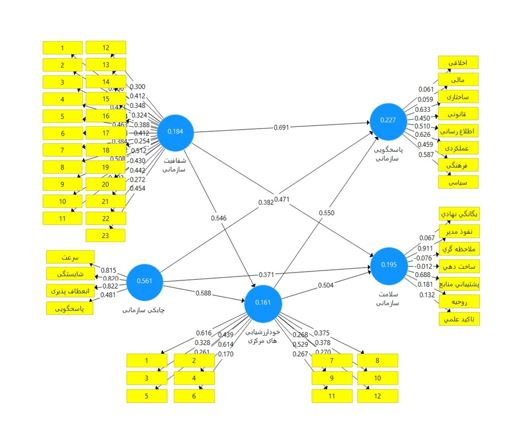
The aim of this study was to investigate the effect of organizational agility on organizational health of employees of sports and youth departments of Alborz province with the role of mediator of central self-evaluations. The present study is a descriptive correlational study in which data were collected in the field through a questionnaire and by the field method. The statistical population of the study includes all employees of sports and youth departments of Alborz province, 215 people, of which according to the Krejci and Morgan table (1970), 136 employees of sports and youth departments of Alborz province were selected as a statistical sample by stratified relative random sampling. To collect data, organizational agility questionnaires of Zhang and Sharifi (2000), organizational health of Hui et al. (1996) and self-evaluations of Judge et al. (2003) were used. To analyze the data, correlation coefficient, multiple regression test and structural equation analysis were used. All calculations were performed using PLS and SPSS software. The results showed that organizational agility has an effect on organizational health and central self-evaluations in the sports and youth departments of Alborz province, and 13.76% of the changes in organizational health and 34.57% of the changes in central self-evaluations are explained by organizational agility. Also, central self-evaluations have an effect on organizational health in the sports and youth departments of Alborz province, and 25.40% of the changes in organizational health are explained by central self-evaluations. Also, the results of the Sobel test showed that central self-evaluations have a mediating role in the relationship between organizational transparency and organizational agility on organizational accountability and organizational health. Therefore, it is suggested that providing career growth opportunities, positive feedback, and designing a fair reward system can play an effective role in increasing employees' self-confidence and sense of worth.
References
Alimohammadzadeh, K., Darabi, A., & Jafari, M. (2017). The relationship between organizational agility and organizational health in hospitals of Shahid Beheshti University of Medical Sciences. Payavard Salamat, 11(3), 276-286. https://search.ebscohost.com/login.aspx?direct=true&profile=ehost&scope=site&authtype=crawler&jrnl=17358132&AN=126811401&h=IZYEXfgy9%2FZnTG4NryZxSZB53RruelyFp5V%2Fe6hE4e0P2iAMEpqH9iZ8ArSG8VKvywae83rq4AdwbR%2FSu9uIow%3D%3D&crl=c
Arshadi, N., Naisi, A., & Dadras, M. (2012). Direct and indirect effect of core self-evaluations on job satisfaction, organizational commitment and job performance. Contemporary Psychology, 7(1), 35-48. https://www.sid.ir/paper/120191/
Barati, M., Mostahafezian, M., Jafari, S., & Rahbari, S. (2019). Designing a model of the relationship between purposeful organizational forgetting and organizational agility with organizational effectiveness of staff in General Department of Sports and Youth of Isfahan Province. Sport Management Studies, 11(57), 217-238. https://smrj.ssrc.ac.ir/m/article_1755.html
Erhan, A. (2021). Performance: The role of organizational agility. Journal of Business Research, 69(5), 1544-1549.
Eydi, H., Abbasi, H., & Bakhshi Chenari, A. (2018). Predicting organizational agility of the Ministry of Sports and Youth through organizational forgetting and its components. Sport Management Studies, 10(47), 241-258. https://www.sid.ir/paper/234397/fa
Ghahremani, M., Abolghasemi, M., Arefi, M., & Khatami, M. H. (2017). Evaluation of organizational health in faculties of Shahid Beheshti University. Quarterly Journal of Career & Organizational Counseling, 3(10), 85-91. https://ensani.ir/fa/article/296487/
Hoffmann, S., Jenny, G. J., & Bauer, F. (2023). Capacity Building as a Key Mechanism of Organizational Health Development. In. Springer. https://doi.org/10.1007/978-94-007-5640-3_7
Hosseini Pazhouh, M., Allameh, S. M., & Shahin, A. (2021). Designing an organizational health model. Journal of Transformation Management Research, 13(1), 135-166. https://tmj.um.ac.ir/article/view/81132
Jafarzadeh Zarandi, M., Sharifian, E., & Ghahreman Tabrizi, K. (2018). Presenting an organizational agility model based on information technology in Iranian sports organizations. Sport Management Studies, 10(52), 137-160. https://www.sid.ir/paper/234541/fa
Judge, T. A., Erez, A., Bono, J. E., & Thoresen, C. J. (2021). The Core Self-evaluation Scale: Development of a Measure. Personnel Psychology, 53, 303-331. https://doi.org/10.1111/j.1744-6570.2003.tb00152.x
Kittinger, J. D., Walker, A. G., Cope, J. G., & Wuensch, K. L. (2019). The relationship between core self-evaluations and affective commitment. Institute of Behavioral and Applied Management, 1, 68-92. https://doi.org/10.21818/001c.17322
Lashnizand, I., & Moradi, F. (2022, 2022). The impact of organizational health and employee organizational commitment on managers' performance. Third National Conference on Business Management, Entrepreneurship and Accounting of Iran, Tehran.
Lin, C. T., Chiu, H., & Tseng, Y. (2016). Agility evaluation using fuzzy logic. International Journal of Production Economics, 101(2), 353-368. https://doi.org/10.1016/j.ijpe.2005.01.011
Masoumi Javid, Z., Safania, A. M., Nikbakhsh, R., & Bagherian, M. (2023). Understanding the consequences of managers' accountability in sports organizations using grounded theory. Sport Management Studies, 15(80), 75-104. https://www.sid.ir/paper/1506568/fa
Rahnavard, F., Jokar, A., Taherpour, H., & Rasouli, M. (2019). Developing a framework for social accountability of Iranian government organizations. Management of Government Organizations, 7(2), 115-134. https://ipom.journals.pnu.ac.ir/article_5716_d78beaff49ae93a2bd9ddcd322577b5b.pdf
Robati, S., Fahiminejad, A., Morsal, B., & Hosseininia, S. R. (2021). The effect of organizational transparency on organizational ambidexterity mediated by documentation of experiences and synergy of human capital (Case study: Sports and Youth Departments of Tehran Province). Human Resource Management in Sport, 9(1), 25-43. http://journals.shahroodut.ac.ir/article_2355.html
Saha, N., Gregar, A., & Sáha, P. (2017). Organizational agility and HRM strategy: Do they really enhance firms' competitiveness? International Journal of Organizational Leadership, 6, 323-334. https://doi.org/10.33844/ijol.2017.60454
Shokri, M., Shabani Bahar, G., & Soleimani, M. (2022). The effect of organizational memory on performance management with the mediating role of organizational agility in physical education departments of medical sciences universities in Iran. Sport Management Studies, 14(73), 315-334. https://smrj.ssrc.ac.ir/article_2329.html?lang=fa
Torkzadeh, J., Basiri, S., & Aghili, R. (2017). An analysis of the triple aspects of organizational health: A model of interaction between effectiveness, accountability and cohesion. Journal of Human Resource Management Development and Support, 46(2), 43-70. https://www.noormags.ir/view/fa/articlepage/1339921/
Downloads
Publication Timeline
- Submitted
- Revised
- Accepted
Issue
Section
License
Copyright (c) 2025 اتابک شیری پیرایواتلو (نویسنده); مهرداد محرم زاده; مسعود ایمانزاده , محمد نصیری (نویسنده)

This work is licensed under a Creative Commons Attribution-NonCommercial 4.0 International License.