Examining the Relationship Between Parent–Child Relationship, Parenting Goals, and Spiritual Intelligence with Adolescents’ Self-Esteem
DOI:
https://doi.org/10.61838/kman.longevity.75Keywords:
Parent–Child Relationship, Parenting Goals, Spiritual Intelligence, Self-EsteemAbstract
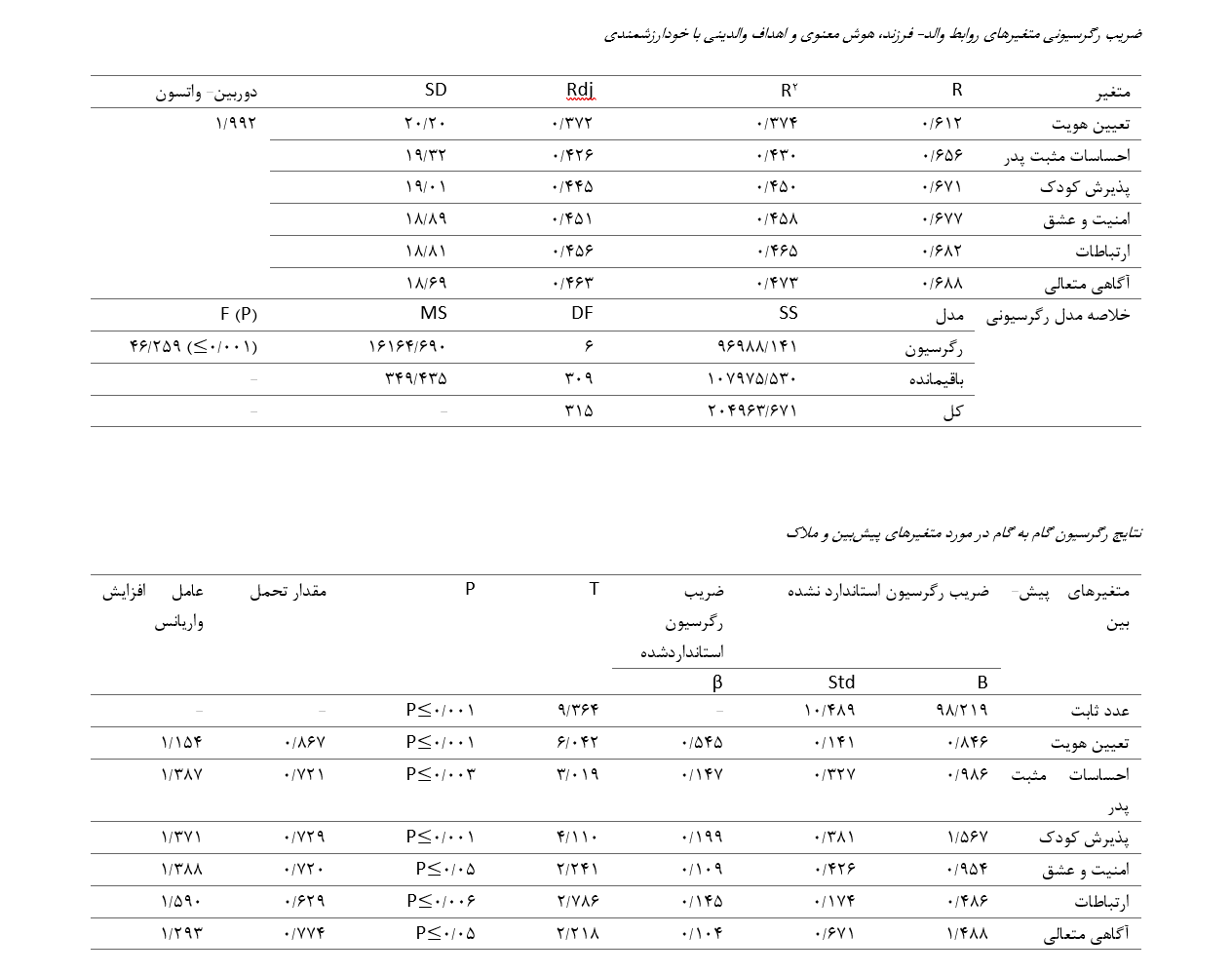
The present study aimed to examine the relationship between the parent–child relationship, parenting goals, and spiritual intelligence with adolescents’ self-esteem. The research method was descriptive and correlational in nature. The statistical population consisted of all female high school students (second cycle of secondary education) in Districts 5 and 6 of Tehran during the 2023–2024 academic year. A total of 300 students were selected using a multistage cluster sampling method. The research instruments included the Parent–Child Relationship Evaluation Questionnaire, the Spiritual Intelligence Scale, the Self-Esteem Scale, and the Parenting Goals Questionnaire. Data were analyzed using Pearson’s correlation coefficient and multiple regression analysis in SPSS version 27. The findings indicated that there were significant relationships between the parent–child relationship, parenting goals, and spiritual intelligence with adolescents’ self-esteem (p < .05). Furthermore, the parent–child relationship, parenting goals, and spiritual intelligence significantly predicted adolescents’ self-esteem (p < .05). Based on these findings, professionals and counselors working in the field of child and adolescent development may design and implement interventions aimed at enhancing adolescents’ self-esteem.
References
Aghajani, S., & Samadifard, H. R. (2018). Correlation of spiritual well-being with spiritual intelligence and emotional intelligence among students of Mohaghegh Ardabili University [In Persian]. Journal of Health Promotion Management, 8(4), 1-7. https://doi.org/10.31219/osf.io/anhcq
Anzola, D. (2020). Adolescence as a critical developmental period: Psychological vulnerability and identity formation. Journal of Adolescent Research, 35(4), 456-472.
Balochi, A. (2018). Academic stress and lifestyle changes among adolescents: The role of social adjustment. Journal of Educational and Developmental Psychology, 8(2), 112-121.
Cairns-Holt, N. (2012). Parent-child relationships: Creating security and emotional connection. Journal of Family Studies, 18(3), 245-258.
Crocker, J., & Wolfe, C. T. (2001). Contingencies of self-worth. Psychological Review, 108(3), 593-623. https://doi.org/10.1037/0033-295x.108.3.593
Hawley, L. L., & Germain, A. (2014). Self-criticism and self-injury: The mediating role of self-worth. Journal of Affective Disorders, 152-154, 76-82.
Huang, C. (2003). Personal and social self-esteem: Conceptualization and measurement. Journal of Personality Assessment, 81(1), 45-57.
Imani, M. (2021). The role of spiritual intelligence in adolescents' psychological adjustment. Journal of Spirituality in Mental Health, 23(2), 135-150.
Krauss, S., Orth, U., & Robins, R. W. (2020). Family environment and self-esteem development: A longitudinal study from age 10 to 16. Journal of Personality and Social Psychology, 119(2), 457-478. https://doi.org/10.1037/pspp0000263
Krueger, J. (2003). Self-worth and subjective evaluation: A multidimensional approach. Personality and Social Psychology Bulletin, 29(6), 675-688.
Le, B. M., & Impett, E. A. (2019). Parenting goal pursuit is linked to emotional well-being, relationship quality, and responsiveness. Journal of Social and Personal Relationships, 36(3), 879-904. https://doi.org/10.1177/0265407517747417
Lee, A., & Impett, E. A. (2019). Parenting goals and parental well-being: Distinguishing self-oriented and child-oriented goals. Journal of Personality and Social Psychology, 116(5), 841-859.
Li, W., Tan, F., Zhou, Z., Xue, Y., Gu, C., & Xu, X. (2022). Parents' response to children's performance and children's self-esteem: Parent-child relationship and friendship quality as mediators. International Journal of Environmental Research and Public Health, 19(10), 6012. https://doi.org/10.3390/ijerph19106012
Luo, Y., Gao, W., & Liu, X. (2022). Longitudinal relationship between self-esteem and academic self-efficacy among college students in China: Evidence from a cross-lagged model. Frontiers in Psychology, 13, 877343. https://doi.org/10.3389/fpsyg.2022.877343
Mandal, E. (2023). Shyness and self-esteem in women: The role of likeability, personal power, lovability, and self-worth conditioned by others' approval. Current Issues in Personality Psychology, 11(4), 310-318. https://doi.org/10.5114/cipp/171607
Orth, U. (2018). The family environment in early childhood has a long-term effect on self-esteem: A longitudinal study from birth to age 27 years. Journal of Personality and Social Psychology, 114(4), 637-655. https://doi.org/10.1037/pspp0000143
Pinto, S. (2023). Spiritual intelligence and quality of life: A systematic review. Journal of Religion and Health, 62(1), 210-228.
Sahebalzamani, M., Farahani, H., Abasi, R., & Talebi, M. (2013). The relationship between spiritual intelligence with psychological well-being and purpose in life of nurses. Iranian Journal of Nursing and Midwifery Research, 18(1), 38-41.
Sargent, J. T. (2006). Self-worth and depression in adolescence: A longitudinal analysis. Developmental Psychology, 42(3), 443-456.
Senior, J. (2014). All joy and no fun: The paradox of modern parenthood. Hachette.
Siddiqui, S., & Khan, M. A. (2018). Spiritual intelligence and psychological well-being among university students. Pakistan Journal of Psychological Research, 33(2), 317-330.
Steiger, A. E., Allemand, M., Robins, R. W., & Fend, H. A. (2014). Low and decreasing self-esteem during adolescence predict adult depression two decades later. Journal of Personality and Social Psychology, 106(2), 325-338. https://doi.org/10.1037/a0035133
Weisberger, R., & Ziv, Y. (2023). Family functioning and adolescent self-worth: The mediating role of parent-child relationships. Journal of Adolescence, 95, 45-58.
Zhang, B., & Lin, R. (2023). Dispositional awe and self-worth in Chinese undergraduates: The suppressing effects of self-concept clarity and small self. International Journal of Environmental Research and Public Health, 20(13), 6296. https://doi.org/10.3390/ijerph20136296
Zhang, Y. (2022). Self-worth and psychological adjustment: Evidence from adolescent samples. Journal of Youth and Adolescence, 51(9), 1745-1758.
Zhang, Y., & Lane, J. (2023). Self-worth and self-evaluation processes in adolescence. Personality and Individual Differences, 201, 111936.
Zhou, Z., Tavan, H., Kavarizadeh, F., Sarokhani, M., & Sayehmiri, K. (2024). The relationship between emotional intelligence, spiritual intelligence, and student achievement: A systematic review and meta-analysis. BMC Medical Education, 24(1), 217. https://doi.org/10.1186/s12909-024-05208-5
Downloads
Publication Timeline
- Submitted
- Revised
- Accepted
Issue
Section
License
Copyright (c) 2025 سودابه سودابه

This work is licensed under a Creative Commons Attribution-NonCommercial 4.0 International License.