Comparison of the Effects of Resistance and Aerobic Training on the Expression of IRS-1, PIK3R1, and Akt Genes in the Skeletal Muscle of Mice with Type 2 Diabetes
Keywords:
Type 2 diabetes, Aerobic training, Resistance training, IRS-1, PIK3R1, Akt, skeletal muscleAbstract
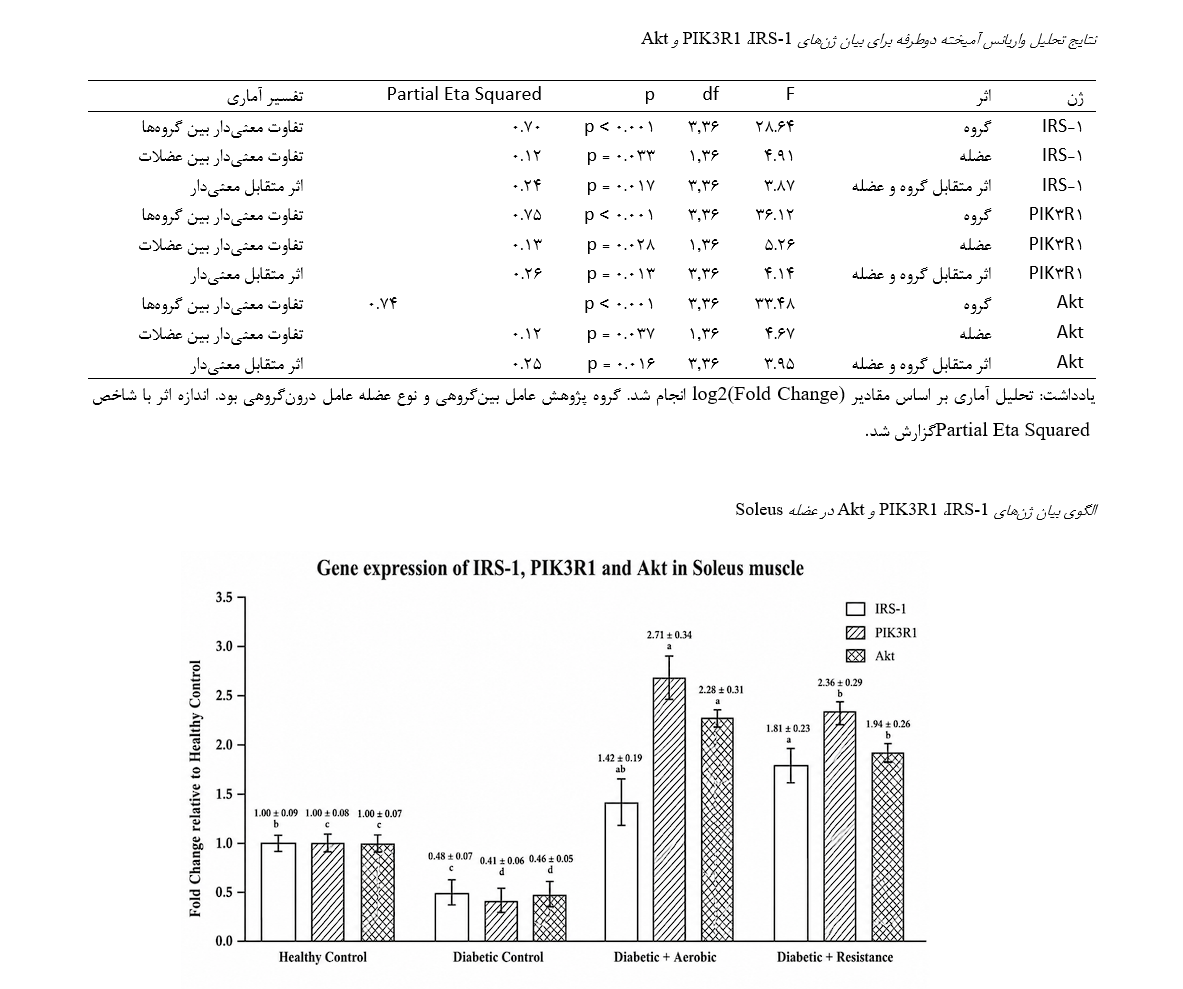
Type 2 diabetes is a common metabolic disorder characterized by reduced insulin sensitivity and alterations in the molecular response of skeletal muscle. The IRS-1/PIK3R1/Akt axis is one of the key pathways involved in the insulin response of skeletal muscle, and changes in the expression of genes within this axis may reflect molecular adaptations or dysfunctions in diabetic conditions. The present study aimed to compare the effects of aerobic and resistance training on the expression of IRS-1, PIK3R1, and Akt genes in the skeletal muscle of mice with type 2 diabetes. This experimental laboratory study was conducted on 40 male C57BL/6 mice. The animals were randomly assigned to four groups: healthy control, diabetic control, diabetic with aerobic training, and diabetic with resistance training. Type 2 diabetes was induced using a high-fat diet and a low-dose streptozotocin injection. The exercise programs were performed for 8 weeks, 5 sessions per week. Gene expression levels of IRS-1, PIK3R1, and Akt were measured in the Soleus and EDL muscles using Real-Time PCR. Data were reported using the 2^-ΔΔCt method, with the healthy control group serving as the calibrator. Data analysis was performed using two-way mixed ANOVA followed by the Bonferroni post hoc test. The results showed that type 2 diabetes was associated with reduced expression of IRS-1, PIK3R1, and Akt genes in both muscles. Both exercise interventions increased the expression of these genes compared with the diabetic control group; however, the pattern of gene response differed between the two training modalities. IRS-1 expression was higher in the resistance training group, whereas PIK3R1 and Akt expression levels were greater in the aerobic training group. Furthermore, significant effects of group, muscle type, and the group × muscle interaction were observed for all three genes. Overall, aerobic and resistance training were associated with distinct patterns of changes in the expression of genes related to the IRS-1/PIK3R1/Akt signaling axis in diabetic skeletal muscle.
References
Arshadi, S., Ghomi, M. H., Banaeifar, A., & Kazemzadeh, Y. (2019). The effect of eight weeks of aerobic and resistance training on AMP-activated protein kinase (AMPK) gene expression in the soleus muscle and insulin resistance in streptozotocin-induced diabetic rats. Journal of Medical Council of Iran, 37(2), 81-87. https://jmciri.ir/article-1-2905-fa.html
Babaeinejad, M., Tajik, M., & Hosseinabadi, A. (2024). Comparison of the effect of four weeks of aerobic and resistance training on muscular leukemia inhibitory factor gene expression in rats fed a high-fat diet. Exercise Physiology of Special Groups, 1(2), 1-8. https://doi.org/10.22098/rsph.2024.14570.1037
Bozkurt, O., Severcan, M., & Severcan, F. (2010). Diabetes induces compositional, structural and functional alterations on rat skeletal soleus muscle revealed by FTIR spectroscopy: A comparative study with EDL muscle. Analyst, 135(12), 3110-3119. https://doi.org/10.1039/C0AN00542H
Colberg, S. R., Sigal, R. J., Yardley, J. E., Riddell, M. C., Dunstan, D. W., Dempsey, P. C., Horton, E. S., Castorino, K., & Tate, D. F. (2016). Physical activity/exercise and diabetes: A position statement of the American Diabetes Association. Diabetes Care, 39(11), 2065-2079. https://doi.org/10.2337/dc16-1728
Copps, K. D., & White, M. F. (2012). Regulation of insulin sensitivity by serine/threonine phosphorylation of insulin receptor substrate proteins IRS1 and IRS2. Diabetologia, 55(10), 2565-2582. https://doi.org/10.1007/s00125-012-2644-8
Furman, B. L. (2021). Streptozotocin-induced diabetic models in mice and rats. Current Protocols, 1(4), e78. https://doi.org/10.1002/cpz1.78
Gan, L., Chen, P., Zhang, Z., He, X., Wu, X., Chen, Z., Wei, Q., & Wu, Y. (2025). Static training improves insulin resistance in skeletal muscle of type 2 diabetic mice via the IGF-2/IGF-1R pathway. Scientific Reports, 15, 10662. https://doi.org/10.1038/s41598-025-94360-z
Han, X., Yang, Y., Liu, S., Niu, Y., Shao, H., & Fu, L. (2023). Aerobic exercise ameliorates insulin resistance in C57BL/6J mice via activating Sestrin3. Biochimica et Biophysica Acta (BBA) - Molecular Basis of Disease, 1869(1), 166568. https://doi.org/10.1016/j.bbadis.2022.166568
Holten, M. K., Zacho, M., Gaster, M., Juel, C., Wojtaszewski, J. F. P., & Dela, F. (2004). Strength training increases insulin-mediated glucose uptake, GLUT4 content, and insulin signaling in skeletal muscle in patients with type 2 diabetes. Diabetes, 53(2), 294-305. https://doi.org/10.2337/diabetes.53.2.294
Li, N., Zhang, L., Guo, Q., Shi, H., Gan, Y., Wang, W., Yang, X., & Zhou, Y. (2025). Aerobic exercise improves inflammation and insulin resistance in skeletal muscle by regulating miR-221-3p via JAK/STAT signaling pathway. Frontiers in Physiology, 16, 1534911. https://doi.org/10.3389/fphys.2025.1534911
Ma, X., Rao, Z., Jin, Z., Lu, Y., Sun, Z., & Zheng, L. (2026). Resistance Exercise Counteracts Skeletal Muscle Atrophy in T2DM Mice by Upregulating FGF21 and Activating PI3K/Akt Pathway. Biomolecules, 16(1), 3. https://doi.org/10.3390/biom16010003
Mann, G., Riddell, M. C., & Adegoke, O. A. J. (2022). Effects of acute muscle contraction on the key molecules in insulin and Akt signaling in skeletal muscle in health and in insulin resistant states. Diabetology, 3(3), 423-446. https://doi.org/10.3390/diabetology3030032
Nadi, M., Banaeifar, A., Arshadi, S., & Eizadi, M. (2022). Investigating the effect of resistance training on the IGF-1/PI3K axis in skeletal muscle and insulin sensitivity in type 2 diabetic rats. Journal of Shahid Sadoughi University of Medical Sciences, 30(11), 6126-6135. https://doi.org/10.18502/ssu.v30i11.11789
Racine, K. C., Iglesias-Carres, L., Herring, J. A., Wieland, K. L., Ellsworth, P. N., Tessem, J. S., Ferruzzi, M. G., Kay, C. D., & Neilson, A. P. (2024). The high-fat diet and low-dose streptozotocin type-2 diabetes model induces hyperinsulinemia and insulin resistance in male but not female C57BL/6J mice. Nutrition Research, 131, 135-146. https://doi.org/10.1016/j.nutres.2024.09.008
Tabibirad, S., Abednantanzi, H., Nikbakht, H., Ghazalian, F., & Gholami, M. (2020). Comparison of the effect of aerobic and resistance training on glucagon-like peptide-1 and insulin resistance in obese women with type 2 diabetes. Daneshvar Medicine, 28(4), 46-56. https://doi.org/10.22070/daneshmed.2020.2977
World Health, O. (2016). Global report on diabetes. https://books.google.com/books?hl=en&lr=&id=-A4LDgAAQBAJ&oi=fnd&pg=PP1&dq=World+Health,+O.+(2016).+Global+report+on+diabetes,+World+Health+Organization.++&ots=ddpc_OgmxF&sig=fRhDyFrC14en_WuvgGF8PKfrfFI
Zheng, L., Rao, Z., Wu, J., Ma, X., Jiang, Z., & Xiao, W. (2024). Resistance exercise improves glycolipid metabolism and mitochondrial biogenesis in skeletal muscle of T2DM mice via miR-30d-5p/SIRT1/PGC-1α axis. International Journal of Molecular Sciences, 25(22), 12416. https://doi.org/10.3390/ijms252212416
Downloads
Publication Timeline
- Submitted
- Revised
- Accepted
Issue
Section
License
Copyright (c) 2025 ریحانه علیزاده بهبهانی (نویسنده); سعید کشاورز ; : لیلا صرامی , جمشید بنایی بروجنی (نویسنده)

This work is licensed under a Creative Commons Attribution-NonCommercial 4.0 International License.