مقایسه اثر تمرینات مقاومتی و هوازی بر بیان ژنهای IRS-1، PIK3R1 و Akt در عضله اسکلتی موشهای مبتلا به دیابت نوع ۲
کلمات کلیدی:
دیابت نوع ۲, تمرین هوازی, تمرین مقاومتی, IRS-1, PIK3R1, Akt, عضله اسکلتیچکیده
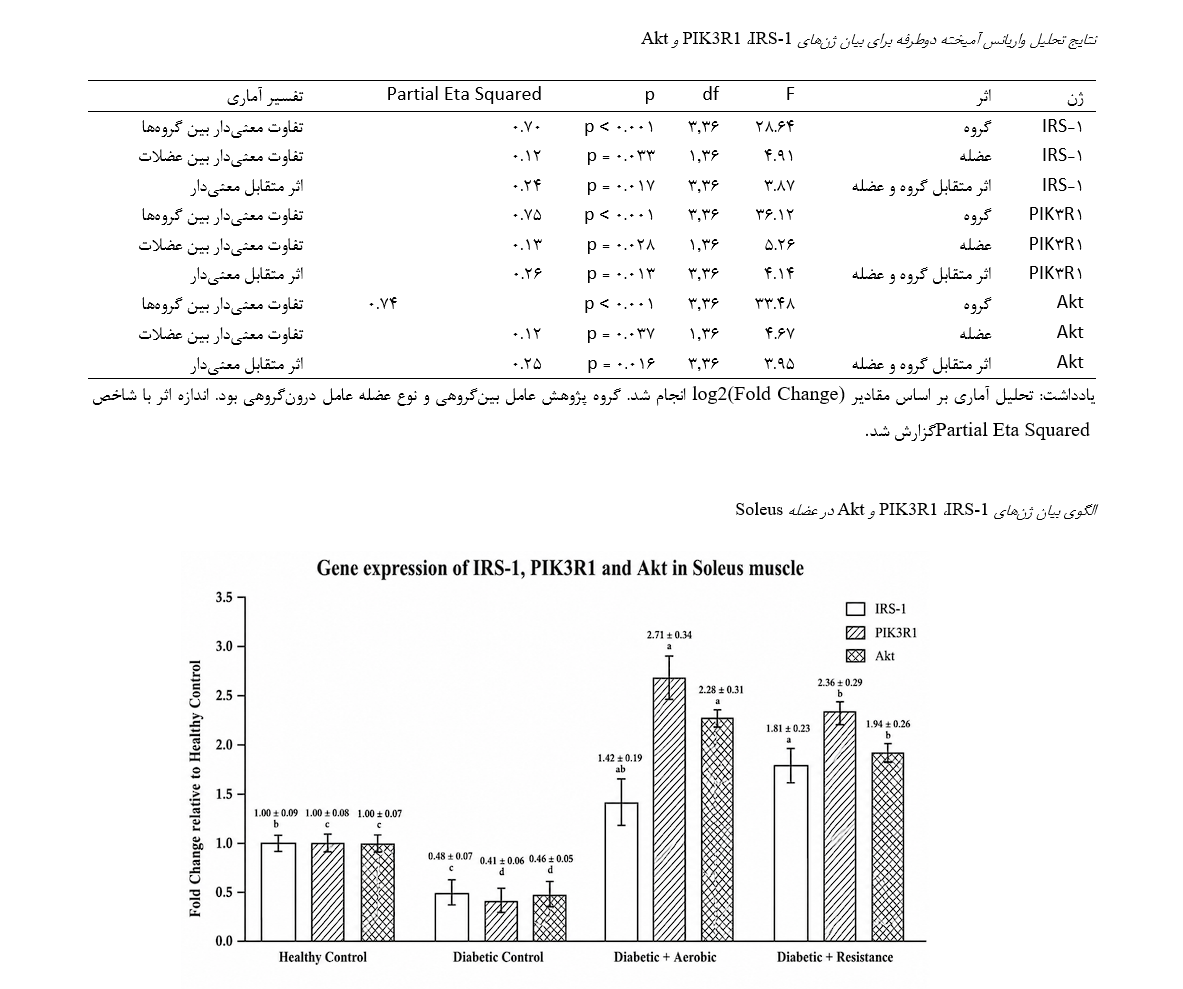
دیابت نوع ۲ یکی از اختلالات متابولیکی شایع است که با کاهش حساسیت به انسولین و تغییر در پاسخ مولکولی عضله اسکلتی همراه میشود. محور IRS-1/PIK3R1/Akt از مسیرهای مهم مرتبط با پاسخ انسولینی عضله اسکلتی است و تغییر در بیان ژنهای این محور میتواند بخشی از سازگاری یا اختلال مولکولی عضله را در شرایط دیابتی نشان دهد. هدف پژوهش حاضر، مقایسه اثر تمرینات هوازی و مقاومتی بر بیان ژنهای IRS-1، PIK3R1 و Akt در عضله اسکلتی موشهای مبتلا به دیابت نوع ۲ بود. این مطالعه بهصورت تجربی آزمایشگاهی بر روی ۴۰ سر موش نر C57BL/6 انجام شد. حیوانات بهصورت تصادفی در چهار گروه کنترل سالم، کنترل دیابتی، دیابتی همراه با تمرین هوازی و دیابتی همراه با تمرین مقاومتی قرار گرفتند. دیابت نوع ۲ با رژیم پرچرب و تزریق دوز پایین استرپتوزوتوسین القا شد. برنامههای تمرینی به مدت ۸ هفته و ۵ جلسه در هفته اجرا شدند. بیان ژنهای IRS-1، PIK3R1 و Akt در عضلات Soleus و EDL با روش Real-Time PCR اندازهگیری شد و دادهها با روش 2^-ΔΔCt نسبت به گروه کنترل سالم بهعنوان کالیبراتور گزارش شدند. تحلیل دادهها با استفاده از تحلیل واریانس آمیخته دوطرفه و آزمون تعقیبی بونفرونی انجام شد. نتایج نشان داد دیابت نوع ۲ با کاهش بیان ژنهای IRS-1، PIK3R1 و Akt در هر دو عضله همراه بود. هر دو مداخله تمرینی بیان این ژنها را نسبت به گروه کنترل دیابتی افزایش دادند؛ با این حال، الگوی پاسخ ژنی در دو نوع تمرین یکسان نبود. بیان IRS-1 در گروه تمرین مقاومتی بیشتر بود، درحالیکه PIK3R1 و Akt در گروه تمرین هوازی مقادیر بالاتری نشان دادند. همچنین اثر گروه، اثر عضله و اثر متقابل گروه و عضله برای هر سه ژن معنیدار بود. بهطور کلی، تمرینات هوازی و مقاومتی با الگوهای متفاوتی از تغییر بیان ژنهای مرتبط با محور IRS-1/PIK3R1/Akt در عضله اسکلتی دیابتی همراه بودند.
مراجع
Arshadi, S., Ghomi, M. H., Banaeifar, A., & Kazemzadeh, Y. (2019). The effect of eight weeks of aerobic and resistance training on AMP-activated protein kinase (AMPK) gene expression in the soleus muscle and insulin resistance in streptozotocin-induced diabetic rats. Journal of Medical Council of Iran, 37(2), 81-87. https://jmciri.ir/article-1-2905-fa.html
Babaeinejad, M., Tajik, M., & Hosseinabadi, A. (2024). Comparison of the effect of four weeks of aerobic and resistance training on muscular leukemia inhibitory factor gene expression in rats fed a high-fat diet. Exercise Physiology of Special Groups, 1(2), 1-8. https://doi.org/10.22098/rsph.2024.14570.1037
Bozkurt, O., Severcan, M., & Severcan, F. (2010). Diabetes induces compositional, structural and functional alterations on rat skeletal soleus muscle revealed by FTIR spectroscopy: A comparative study with EDL muscle. Analyst, 135(12), 3110-3119. https://doi.org/10.1039/C0AN00542H
Colberg, S. R., Sigal, R. J., Yardley, J. E., Riddell, M. C., Dunstan, D. W., Dempsey, P. C., Horton, E. S., Castorino, K., & Tate, D. F. (2016). Physical activity/exercise and diabetes: A position statement of the American Diabetes Association. Diabetes Care, 39(11), 2065-2079. https://doi.org/10.2337/dc16-1728
Copps, K. D., & White, M. F. (2012). Regulation of insulin sensitivity by serine/threonine phosphorylation of insulin receptor substrate proteins IRS1 and IRS2. Diabetologia, 55(10), 2565-2582. https://doi.org/10.1007/s00125-012-2644-8
Furman, B. L. (2021). Streptozotocin-induced diabetic models in mice and rats. Current Protocols, 1(4), e78. https://doi.org/10.1002/cpz1.78
Gan, L., Chen, P., Zhang, Z., He, X., Wu, X., Chen, Z., Wei, Q., & Wu, Y. (2025). Static training improves insulin resistance in skeletal muscle of type 2 diabetic mice via the IGF-2/IGF-1R pathway. Scientific Reports, 15, 10662. https://doi.org/10.1038/s41598-025-94360-z
Han, X., Yang, Y., Liu, S., Niu, Y., Shao, H., & Fu, L. (2023). Aerobic exercise ameliorates insulin resistance in C57BL/6J mice via activating Sestrin3. Biochimica et Biophysica Acta (BBA) - Molecular Basis of Disease, 1869(1), 166568. https://doi.org/10.1016/j.bbadis.2022.166568
Holten, M. K., Zacho, M., Gaster, M., Juel, C., Wojtaszewski, J. F. P., & Dela, F. (2004). Strength training increases insulin-mediated glucose uptake, GLUT4 content, and insulin signaling in skeletal muscle in patients with type 2 diabetes. Diabetes, 53(2), 294-305. https://doi.org/10.2337/diabetes.53.2.294
Li, N., Zhang, L., Guo, Q., Shi, H., Gan, Y., Wang, W., Yang, X., & Zhou, Y. (2025). Aerobic exercise improves inflammation and insulin resistance in skeletal muscle by regulating miR-221-3p via JAK/STAT signaling pathway. Frontiers in Physiology, 16, 1534911. https://doi.org/10.3389/fphys.2025.1534911
Ma, X., Rao, Z., Jin, Z., Lu, Y., Sun, Z., & Zheng, L. (2026). Resistance Exercise Counteracts Skeletal Muscle Atrophy in T2DM Mice by Upregulating FGF21 and Activating PI3K/Akt Pathway. Biomolecules, 16(1), 3. https://doi.org/10.3390/biom16010003
Mann, G., Riddell, M. C., & Adegoke, O. A. J. (2022). Effects of acute muscle contraction on the key molecules in insulin and Akt signaling in skeletal muscle in health and in insulin resistant states. Diabetology, 3(3), 423-446. https://doi.org/10.3390/diabetology3030032
Nadi, M., Banaeifar, A., Arshadi, S., & Eizadi, M. (2022). Investigating the effect of resistance training on the IGF-1/PI3K axis in skeletal muscle and insulin sensitivity in type 2 diabetic rats. Journal of Shahid Sadoughi University of Medical Sciences, 30(11), 6126-6135. https://doi.org/10.18502/ssu.v30i11.11789
Racine, K. C., Iglesias-Carres, L., Herring, J. A., Wieland, K. L., Ellsworth, P. N., Tessem, J. S., Ferruzzi, M. G., Kay, C. D., & Neilson, A. P. (2024). The high-fat diet and low-dose streptozotocin type-2 diabetes model induces hyperinsulinemia and insulin resistance in male but not female C57BL/6J mice. Nutrition Research, 131, 135-146. https://doi.org/10.1016/j.nutres.2024.09.008
Tabibirad, S., Abednantanzi, H., Nikbakht, H., Ghazalian, F., & Gholami, M. (2020). Comparison of the effect of aerobic and resistance training on glucagon-like peptide-1 and insulin resistance in obese women with type 2 diabetes. Daneshvar Medicine, 28(4), 46-56. https://doi.org/10.22070/daneshmed.2020.2977
World Health, O. (2016). Global report on diabetes. https://books.google.com/books?hl=en&lr=&id=-A4LDgAAQBAJ&oi=fnd&pg=PP1&dq=World+Health,+O.+(2016).+Global+report+on+diabetes,+World+Health+Organization.++&ots=ddpc_OgmxF&sig=fRhDyFrC14en_WuvgGF8PKfrfFI
Zheng, L., Rao, Z., Wu, J., Ma, X., Jiang, Z., & Xiao, W. (2024). Resistance exercise improves glycolipid metabolism and mitochondrial biogenesis in skeletal muscle of T2DM mice via miR-30d-5p/SIRT1/PGC-1α axis. International Journal of Molecular Sciences, 25(22), 12416. https://doi.org/10.3390/ijms252212416
دانلودها
گاهشمار انتشار
- ارسال
- بازنگری
- پذیرش
شماره
نوع مقاله
مجوز
حق نشر 2025 ریحانه علیزاده بهبهانی (نویسنده); سعید کشاورز ; : لیلا صرامی , جمشید بنایی بروجنی (نویسنده)

این پروژه تحت مجوز بین المللی Creative Commons Attribution-NonCommercial 4.0 می باشد.