Identifying the Factors Affecting the Development of Marketing in Football Sports Print Media in Iraq
Keywords:
Sports marketing, sports print media, Iraqi football, modern technology, grounded theoryAbstract
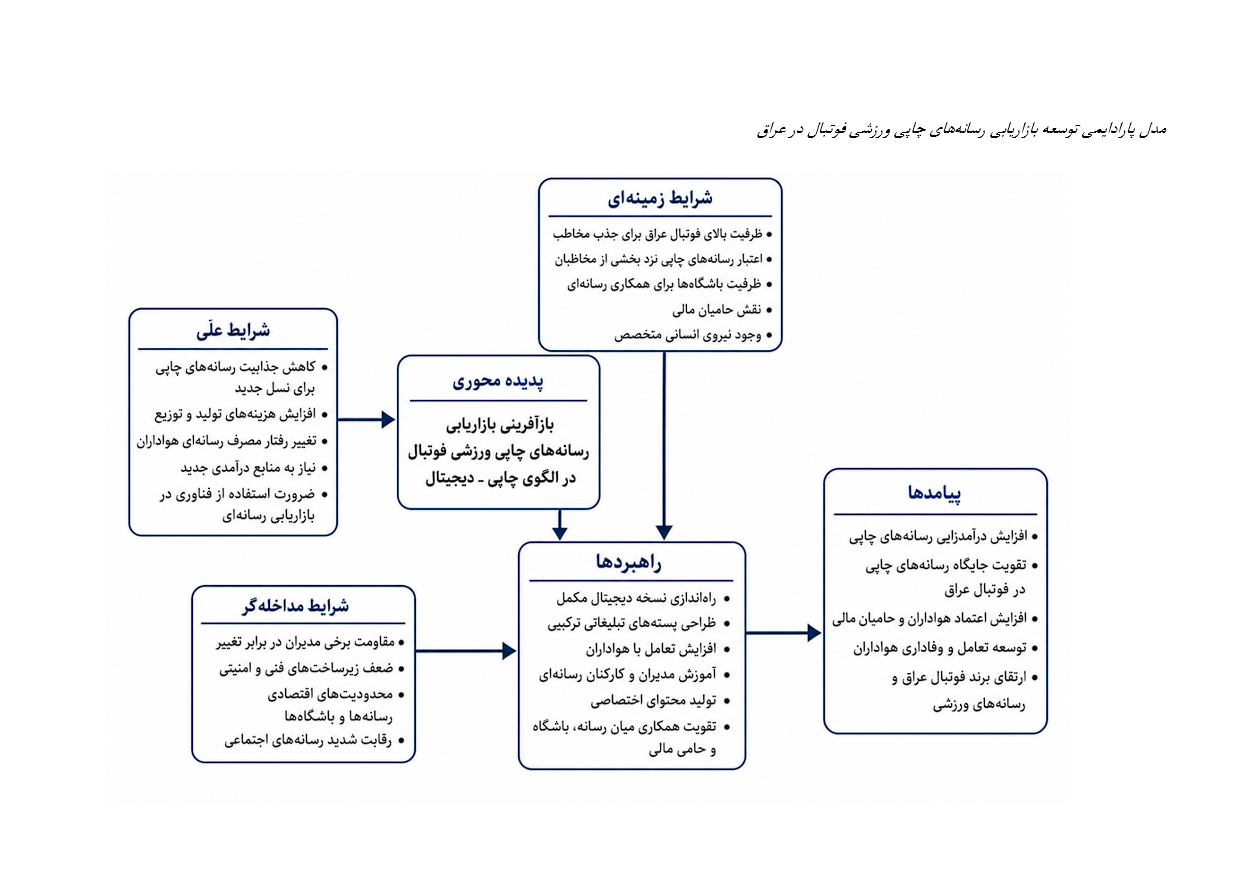
The present study aimed to identify the factors affecting print-digital marketing development in football sports print media in Iraq. The study sought to present a conceptual model for redefining the role of print media in football marketing and explaining their connection with modern technologies. This study was conducted using a qualitative approach based on grounded theory. The research population included sports media managers, sports journalists, football section editors, club marketing managers, football coaches, and sponsors active in Iraqi sports print media. The participants consisted of 16 experts in this field, selected through purposive sampling. Primary data were collected through semi-structured interviews; sources were reviewed for the theoretical background. Data analysis was performed based on the Strauss and Corbin approach in three stages: open coding, axial coding, and selective coding. The data analysis process led to the extraction of 126 initial open codes, 28 axial codes, and 6 main categories. The main categories included causal conditions, the central phenomenon, contextual conditions, intervening conditions, strategies, and consequences. The central phenomenon was identified as the reconfiguration of football sports print media marketing within a print-digital model. The main strategies included launching complementary digital versions, designing integrated advertising packages, increasing interaction with fans, training media managers and staff, producing exclusive content, and strengthening cooperation among media, clubs, and sponsors. The qualitative findings indicated that Iraqi football sports print media need to move beyond traditional approaches and adopt an integrated, interactive, and technology-based model to maintain and strengthen their position.
References
Da Silva, E. C., & Las Casas, A. L. (2020). Key elements of sports marketing activities for sports events. International Journal of Business Administration, 11(1), 11-21. https://doi.org/10.5430/ijba.v11n1p11
Ghasemi, R., Javadipour, M., & Torkfar, A. (2016). Identifying sport marketing barriers in Iran from sport managers perspectives. Journal of Sport Management, 7(6), 829-846. https://jsm.ut.ac.ir/article_57451_en.html
Gil-Gomez, H., Guerola-Navarro, V., OltraBadenes, R., & Lozano-Quilis, J. A. (2020). Customer relationship management: digital transformation and sustainable business model innovation. Economic Research-Ekonomska Istraživanja, 33(1), 1-18. https://doi.org/10.1080/1331677X.2019.1676283
Gray, G. T., & Wert-Gray, S. (2012). Customer retention in sports organization marketing: Examining the impact of team identification and satisfaction with team performance. International Journal of Consumer Studies, 36(3), 275-281. https://doi.org/10.1111/j.1470-6431.2011.00999.x
Ha, J. P., Kang, S. J., & Kim, Y. (2017). Sport fans in a 'smart sport' (SS) age: Drivers of smartphone use for sport consumption. International Journal of Sports Marketing and Sponsorship, 18(3), 281-297. https://doi.org/10.1108/IJSMS-08-2017-093
Halikainen, H., & Laukkanen, T. (2018). National culture and consumer trust in e-commerce. International Journal of Information Management, 38, 97-106. https://doi.org/10.1016/j.ijinfomgt.2017.07.002
Holland, C. P. (2015). Internet and social media strategy in sports marketing. ECIS 2015 Completed Research Papers,
Karimi, A., Bahrami, S., Rasekh, N., & Ghasemi, H. (2022). Development of Paradigm Pattern of the Advertisement Role on Willingness of Sports Products' Customers (Focusing on Social Media). Communication Management in Sport Media, 9(3), 30-44. https://sportmedia.journals.pnu.ac.ir/article_8691_d41ac11975376ad7e26927faa3303036.pdf?lang=en
Karimi, F., & Yarmand, H. (2018). The use of image in sport advertisement from viewpoint of semiotics: Case study on Wrestling Federation of Islamic. Applied Research in Sport Management, 7(1), 89-103. https://arsmb.journals.pnu.ac.ir/article_4722.html?lang=en
Kashkar, S. (2020). The role of mass media in creating identity and promoting various sports in Iran. Communication Management in Sports Media, 8(3), 70-80. https://sportmedia.journals.pnu.ac.ir/article_7728_en.html?lang=fa
Khademi, A., Mejedi, N., & Naderi Nasab, M. (2019). Codification of I.R.I wrestling federation marketing strategies. Sport Management and Development, 7(4), 18-39. https://jsmd.guilan.ac.ir/article_3250_en.html
Leng, H. K., & Phua, P. (2021). Eye tracker technology in sports sponsorship research. In Encyclopedia of Organizational Knowledge, Administration, and Technology (pp. 2278-2285). IGI Global. https://doi.org/10.4018/978-1-7998-3473-1.ch157
Mahmoodin, A., Sadeghi Boroujerdi, S., Delshad, V., & Gharibi, S. (2019). Presenting the model of the influencing factors to usage intention of smartphones in sport. Sport Management and Development, 8(4), 118-134. https://jsmd.guilan.ac.ir/article_3907_en.html
Marquez, A., Cianfrone, B. A., & Kellison, T. (2020). Factors affecting spectators' adoption of digital ticketing: The case of interscholastic sports. International Journal of Sports Marketing and Sponsorship, 21(3), 527-541. https://doi.org/10.1108/IJSMS-07-2019-0080
Pashaie, S., Abdavi, F., Badriazarin, Y., Cincimino, S., & Fişne, M. (2020). The model of creation of customer relationship management (CRM) technology in sports services section. Journal of advanced sport technology, 4(2), 38-48. https://jast.uma.ac.ir/article_951.html
Raghavendra, G. S., & Sudhakara, A. M. (2017). Digital marketing plan an alternative framework for sports products. International Research Journal of Management Science & Technology, 8(5), 290-296. https://www.academia.edu/download/56739603/6662.pdf
Sadeghi, M., Sobhani, M. S., & Rahnavard, F. (2011). Analyzing the effectiveness of marketing information system on strategic planning efficiency: Case study of banks. The Journal of Productivity Management, 5(3), 25-52.
Şahin, E., Demirsel, M. T., & Adam, A. A. (2020). The effect of social media on sports marketing Konyaspor football club case. Journal of Business Research-Turk, 12(1), 79-94. https://doi.org/10.20491/isarder.2020.829
Shokrani, E., & Aghapour, S. M. (2015). Content analysis of sport program in IRIB. Contemporary Studies on Sport Management, 4(8), 81-92.
Wen, Y. C. (2020). Research on the Tokyo 2020 olympic games and sports smart technology. European Journal of Physical Education and Sport Science, 6(2), 77-82. https://oapub.org/edu/index.php/ejep/article/view/2905
Zhao, Q., Chen, C. D., Wang, J. L., & Wang, K. J. (2016). Study of factors influencing mobile ticketing adoption: Status quo bias perspective. Journal of Marine Science and Technology, 24(5), 926-937. https://jmstt.ntou.edu.tw/journal/vol24/iss5/4/
Downloads
Publication Timeline
- Submitted
- Revised
- Accepted
Issue
Section
License
Copyright (c) 2025 عمار زهیر صبری (نویسنده); مهرداد محرم زاده; نسرین عزیزیان کهن, فرزاد نوبخت (نویسنده)

This work is licensed under a Creative Commons Attribution-NonCommercial 4.0 International License.