Presenting a Model of Leadership Style and Attitude Toward Change with the Mediating Role of Moral Intelligence among Football Coaches in Iraq
Keywords:
Leadership style, attitude toward change, moral intelligence, football coaches, IraqAbstract
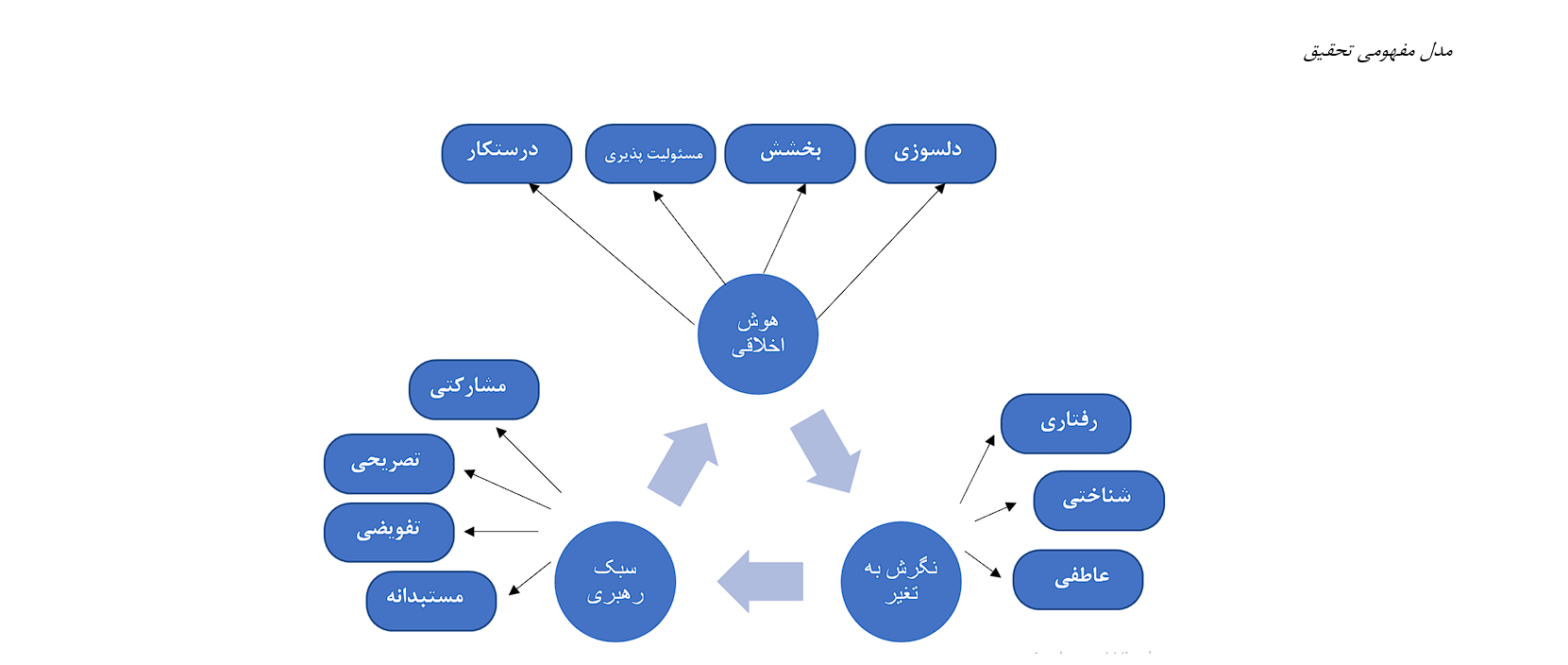
The purpose of the present study was to present a model of the relationship between leadership style and attitude toward change with the mediating role of moral intelligence among football coaches in Iraq. In terms of purpose, this research was applied, and in terms of method, it was descriptive-correlational. The study was conducted through a survey approach and structural equation modeling. The statistical population consisted of football coaches in Iraq and relevant members of the football coaches’ assembly, totaling 336 individuals. Based on the Krejcie and Morgan table, 179 participants were selected using simple random sampling. Data were collected using a leadership style questionnaire based on the situational leadership framework of Hersey, Blanchard, and Natemeyer, an attitude toward change questionnaire, and a moral intelligence questionnaire. Instrument validity was examined through content, convergent, and discriminant validity, and reliability was assessed using Cronbach’s alpha and composite reliability. Data were analyzed using SPSS and Smart PLS. The findings showed that leadership style was positively and significantly associated with moral intelligence among football coaches in Iraq. Moreover, moral intelligence was positively and significantly associated with attitude toward change. Mediation analysis confirmed the mediating role of moral intelligence in the relationship between leadership style and attitude toward change. Model fit indices, including the GOF value of 0.660, indicated a desirable fit. Therefore, strengthening effective leadership styles along with enhancing moral intelligence may be associated with a more positive attitude toward change among football coaches.
References
Barati, N., & Yazdanpanah Shah Abadi, M. R. (2011). Investigating the conceptual relationship between social capital and quality of life in urban environment. Cultural Sociology Research, 2(1), 25-49. https://www.sid.ir/paper/241236/
Beheshtifar, M., Esmaeli, Z., & Nekoie-Moghadam, M. (2011). Effect of moral intelligence on leadership. European Journal of Economics, Finance and Administrative Sciences, 43, 6-11. https://www.researchgate.net/profile/Malikeh-Beheshtifar/publication/267404562_Effect_of_Moral_Intelligence_on_Leadership/links/55d86fca08aec156b9ac128a/Effect-of-Moral-Intelligence-on-Leadership.pdf
Chin, W. W. (1998). Modern methods for business research. Lawrence Erlbaum Associates. https://www.taylorfrancis.com/chapters/edit/10.4324/9781410604385-10/partial-least-squares-approach-structural-equation-modeling-wynne-chin
Creswell, J. W., & Creswell, J. D. (2018). Research design: Qualitative, quantitative, and mixed methods approaches. SAGE Publications. https://www.ucg.ac.me/skladiste/blog_609332/objava_105202/fajlovi/Creswell.pdf
Davari, A., & Rezazadeh, A. (2014). Structural equation modeling with PLS software. Jahad Daneshgahi Publishing Organization. https://www.researchgate.net/publication/264519454_Structural_Equation_Modeling_with_PLS
Dunham, R. B., Grube, J. A., Gardner, D. G., Cummings, L. L., & Pierce, J. L. (1989). The development of an attitude toward change instrument. Washington, DC.
Errida, A., & Lotfi, B. (2021). The determinants of organizational change management success: Literature review and case study. International Journal of Engineering Business Management, 13, 1-15. https://doi.org/10.1177/18479790211016273
Fornell, C., & Larcker, D. F. (1981). Evaluating structural equation models with unobservable variables and measurement error. Journal of Marketing Research, 18(1), 39-50. https://doi.org/10.2307/3151312
Geisser, S. (1974). A predictive approach to the random effects model. Biometrika, 61(1), 101-107. https://doi.org/10.1093/biomet/61.1.101
Gholizadeh, M., & Manzari, M. (2019). Effectiveness of moral intelligence training on changing students' attitudes toward drugs. Social Health and Addiction, 6(21). https://www.noormags.ir/view/fa/articlepage/1497890/
Hair, J. F., Risher, J. J., Sarstedt, M., & Ringle, C. M. (2019). When to use and how to report the results of PLS-SEM. European Business Review, 31(1), 2-24. https://doi.org/10.1108/EBR-11-2018-0203
Henseler, J., Ringle, C. M., & Sarstedt, M. (2015). A new criterion for assessing discriminant validity in variance-based structural equation modeling. Journal of the Academy of Marketing Science, 43(1), 115-135. https://doi.org/10.1007/s11747-014-0403-8
Hersey, P., Blanchard, K. H., & Natemeyer, W. E. (1979). Situational leadership, perception, and the impact of power. Group & Organization Studies, 4(4), 418-428. https://doi.org/10.1177/105960117900400404
Holten, A. L., & Brenner, S. O. (2015). Leadership style and the process of organisational change. Leadership & Organization Development Journal, 36(1), 2-16. https://doi.org/10.1108/LODJ-11-2012-0155
Hussain, S. T., Lei, S., Akram, T., Haider, M. J., Hussain, S. H., & Ali, M. (2018). Kurt Lewin's change model: A critical review of the role of leadership and employee involvement in organizational change. Journal of Innovation & Knowledge, 3(3), 123-127. https://doi.org/10.1016/j.jik.2016.07.002
Izadi, K., & Siadat, S. A. (2016). Investigating the relationship between quantum management with job enthusiasm and job adaptability of University of Isfahan staff. Educational Management Innovations, 3(11), 25-34. https://sanad.iau.ir/Journal/jmte/Article/1110414
Jung, K. B., Kang, S. W., & Choi, S. B. (2020). Empowering leadership, risk-taking behavior, and employees' commitment to organizational change: The mediated moderating role of task complexity. Sustainability, 12(6), Article 2340. https://doi.org/10.3390/su12062340
Lawshe, C. H. (1975). A quantitative approach to content validity. Personnel Psychology, 28(4), 563-575. https://doi.org/10.1111/j.1744-6570.1975.tb01393.x
Lennick, D., & Kiel, F. (2007). Moral intelligence: Enhancing business performance and leadership success. Pearson Prentice Hall. https://books.google.com/books?hl=en&lr=&id=tfk6gKtF5WYC&oi=fnd&pg=PR7&dq=Lennick,+D.+and+F.+Kiel+(2007).+Moral+intelligence:+Enhancing+business+performance+and+leadership+success,+Pearson+Prentice+Hall.+%09&ots=L4fH90LCU6&sig=RtknRq8kCg6x5LgTGHwMUbjQ8VY
Mayer, D. M., Aquino, K., Greenbaum, R. L., & Kuenzi, M. (2012). Who displays ethical leadership, and why does it matter? An examination of antecedents and consequences of ethical leadership. Academy of Management Journal, 55(1), 151-171. https://doi.org/10.5465/amj.2008.0276
Oreg, S., & Sverdlik, N. (2011). Ambivalence toward imposed change: The conflict between dispositional resistance to change and the orientation toward the change agent. Journal of Applied Psychology, 96(2), 337-349. https://doi.org/10.1037/a0021100
Polit, D. F., Beck, C. T., & Owen, S. V. (2007). Is the CVI an acceptable indicator of content validity? Appraisal and recommendations. Research in Nursing & Health, 30(4), 459-467. https://doi.org/10.1002/nur.20199
Rafferty, A. E., Jimmieson, N. L., & Armenakis, A. A. (2013). Change readiness: A multilevel review. Journal of Management, 39(1), 110-135. https://doi.org/10.1177/0149206312457417
Saatchi, M., Kamkari, K., & Asgarian, M. (2010). Psychological tests. Virayesh Publishing.
Sobel, M. E. (1982). Asymptotic confidence intervals for indirect effects in structural equation models. Sociological Methodology, 13, 290-312. https://doi.org/10.2307/270723
Stone, M. (1974). Cross-validatory choice and assessment of statistical predictions. Journal of the Royal Statistical Society: Series B, 36(2), 111-147. https://doi.org/10.1111/j.2517-6161.1974.tb00994.x
Tenenhaus, M., Vinzi, V. E., Chatelin, Y. M., & Lauro, C. (2005). PLS path modeling. Computational Statistics & Data Analysis, 48(1), 159-205. https://doi.org/10.1016/j.csda.2004.03.005
Downloads
Publication Timeline
- Submitted
- Revised
- Accepted
Issue
Section
License
Copyright (c) 2025 علی حسین جاسم (نویسنده); نسرین عزیزیان کهن; عباس نقی زاده باقی, مهرداد محرم زاده (نویسنده)

This work is licensed under a Creative Commons Attribution-NonCommercial 4.0 International License.