Effects of High-Intensity Interval, Moderate-Intensity Continuous, Combined with Strength Training on Quality of Life and Functional Capacity Indices in Women with Sarcopenic Obesity following Bariatric Surgery
DOI:
https://doi.org/10.61838/kman.longevity.67Keywords:
Quality of life, balance, muscle strength, aerobic capacity, sarcopenic obesity, bariatric surgeryAbstract
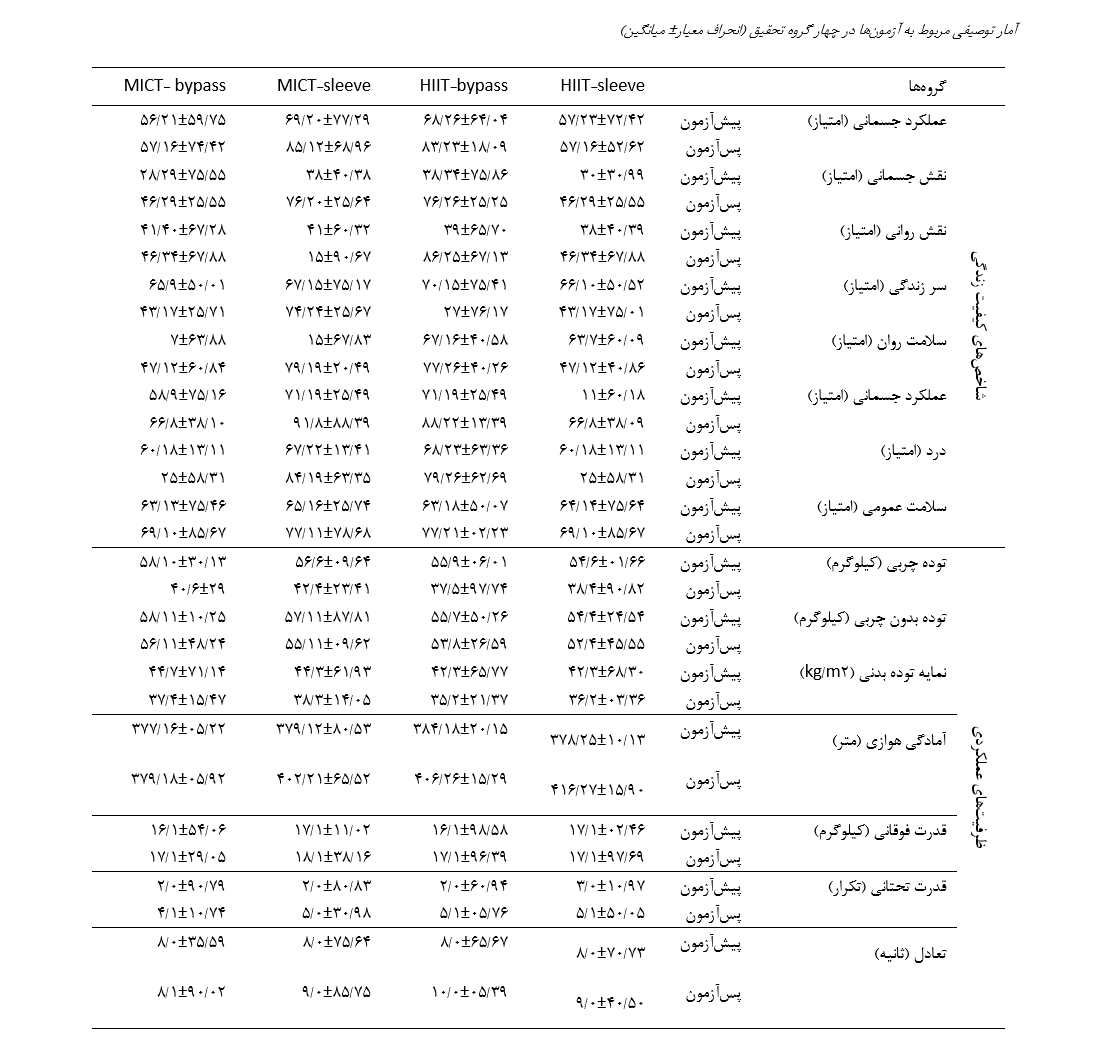
Sarcopenic obesity, as an emerging public health challenge, requires integrated interventions including surgery and targeted exercise programs to improve functional indices and quality of life. This study aimed to investigate the effects of high-intensity interval training (HIIT) and moderate-intensity continuous training (MICT) combined with resistance exercises on quality of life and functional capacity in women with sarcopenic obesity following bariatric surgery. Eighty women with sarcopenic obesity who had undergone bariatric surgery (mean age: 41.67 ± 10.56 years; BMI: 43.66 ± 4.8 kg/m²) and met the inclusion criteria were purposefully selected and randomly assigned to HIIT or MICT groups. Each group was further divided into two subgroups based on the type of surgery: sleeve and bypass (n = 20 per subgroup). The eight-week intervention included HIIT (four 4-minute bouts at 85–90% of heart rate reserve) and MICT (three 40-minute sessions per week at 65–75% of heart rate reserve). In both groups, supplementary resistance exercises were performed using elastic bands tailored to each participant’s estimated one-repetition maximum. Pre- and post-intervention assessments included quality of life (SF-36 questionnaire), baseline physical activity level (GPAQ), body composition, aerobic fitness (6MWT), muscle strength (sit-to-stand and handgrip dynamometer tests), and balance (TUG test). Data were analyzed using ANCOVA and Bonferroni post-hoc tests at a significance level of α ≤ 0.05. ANCOVA results revealed significant differences in overall quality of life (except for general health) among the four groups (p < 0.003), with the MICT-sleeve group showing superior outcomes. Significant between-group differences were also observed in fat mass (η² = 0.15, p = 0.007), body mass index (η² = 0.36, p < 0.001), aerobic fitness (η² = 0.30, p < 0.001), lower-limb strength (η² = 0.14, p = 0.009), and balance (η² = 0.27, p < 0.001). The MICT-bypass group demonstrated lower aerobic fitness and leg strength but better balance than some other groups. Overall, these findings indicate that structured exercise training following bariatric surgery—particularly moderate-intensity continuous training combined with resistance exercise—can significantly enhance quality of life, body composition, balance, and functional capacity in women with sarcopenic obesity.
References
Amini, M., & Mirmoezzi, M. (2017). Effect of 8-week of selected aerobic exercises on improving the quality of life in healthy aged inactive men. International Journal of Sport Studies for Health, 1(1), 1-6. https://doi.org/10.5812/intjssh.67514
Andrade Fernandes, A. d., Natali, A. J., Vieira, B. C., Valle, M. A. A. N. d., Gomes Moreira, D., Massy-Westropp, N., & Bouzas Marins, J. C. (2014). The relationship between hand grip strength and anthropometric parameters in men. Archivos de Medicina del Deporte, 161(31 (3)), 160-164.
Bond, D. S., Thomas, J. G., King, W. C., Vithiananthan, S., Trautvetter, J., Unick, J. L., Ryder, B. A., Pohl, D., Roye, G. D., & Sax, H. C. (2015). Exercise improves quality of life in bariatric surgery candidates: Results from the B ari‐A ctive trial. Obesity, 23(3), 536-542. https://doi.org/10.1002/oby.20988
Bullo, V., Pavan, D., Gobbo, S., Bortoletto, A., Cugusi, L., Di Blasio, A., Pippi, R., Cruz-Diaz, D., Bocalini, D. S., & Gasperetti, A. (2024). From surgery to functional capacity: muscle strength modifications in women post sleeve gastrectomy. BMC Sports Science, Medicine and Rehabilitation, 16(1), 118. https://doi.org/10.1186/s13102-024-00910-9
Cano-Montoya, J., Rojas Vargas, M., Báez Vargas, S., Núñez Vergara, C., Martínez Huenchullán, S., Gallegos, F., Álvarez, C., & Izquierdo, M. (2025). Impact of resistance and high-intensity interval training on body composition, physical function, and temporal dynamics of adaptation in older women with impaired cardiometabolic health: a randomized clinical trial. BMC Sports Science, Medicine and Rehabilitation, 17(1), 78. https://doi.org/10.1186/s13102-025-01119-0
Cardoso, P., Santos, T. V., Ramon-Krauel, M., Pais, S., & De Sousa-Coelho, A. L. (2025). Impact of Bariatric and Metabolic Surgery on Sarcopenia-Related Parameters According to the EWGSOP2 Consensus Criteria in Persons Living with Obesity. Obesity Surgery, 1-11. https://doi.org/10.1007/s11695-025-07816-6
Clifford, K., Woodfield, J. C., Tait, W., Campbell, H. A., & Baldi, J. C. (2023). Association of preoperative high-intensity interval training with cardiorespiratory fitness and postoperative outcomes among adults undergoing major surgery: a systematic review and meta-analysis. JAMA network open, 6(6), e2320527-e2320527. https://doi.org/10.1001/jamanetworkopen.2023.20527
Enríquez-Schmidt, J., Molina, C. M., Rosales, M. K., Muñoz, M., Ruiz-Uribe, M., Leal, F. F., Uarac, M. M., Ibaceta, C. C., Fazakerley, D. J., & Larance, M. (2024). Moderate-intensity constant or high-intensity interval training? Metabolic effects on candidates to undergo bariatric surgery. Nutrition, Metabolism and Cardiovascular Diseases, 34(7), 1681-1691. https://doi.org/10.1111/obr.13790
Fiorillo, C., Quero, G., Vix, M., Guerriero, L., Pizzicannella, M., Lapergola, A., D’Urso, A., Swanstrom, L., Mutter, D., & Dallemagne, B. (2020). 6-month gastrointestinal quality of life (QoL) results after endoscopic sleeve gastroplasty and laparoscopic sleeve gastrectomy: a propensity score analysis. Obesity Surgery, 30, 1944-1951. https://doi.org/10.1007/s11695-020-04419-1
Fontana, A. D., Lopes, A. D., & Lunardi, A. C. (2019). Bariatric surgery associated with practice of moderate to intense physical activity related to weight loss, activity level in daily life, dyspnea, and quality of life of sedentary individuals with morbid obesity: a prospective longitudinal study. Obesity Surgery, 29, 2442-2448. https://doi.org/10.1007/s11695-019-03859-8
Griffiths, M., Edwards, J., McNamara, J., Galbraith, A., Bruce-Low, S., & O’Driscoll, J. (2024). The effects of high intensity interval training on quality of life: a systematic review and meta-analysis. Journal of Public Health, 1-11. https://doi.org/10.1007/s10389-024-02192-4
Ibacache‐Saavedra, P., Martínez‐Rosales, E., Jerez‐Mayorga, D., Miranda‐Fuentes, C., Artero, E. G., & Cano‐Cappellacci, M. (2024). Effects of bariatric surgery on muscle strength and quality: A systematic review and meta‐analysis. Obesity Reviews, 25(9), e13790. https://doi.org/10.1111/obr.13790
Irandoust, K., Taheri, M., Mirmoezzi, M., H’mida, C., Chtourou, H., Trabelsi, K., Ammar, A., Nikolaidis, P. T., Rosemann, T., & Knechtle, B. (2019). The effect of aquatic exercise on postural mobility of healthy older adults with endomorphic somatotype. International Journal of Environmental Research and Public Health, 16(22), 4387. https://doi.org/https://doi.org/10.3390/ijerph16224387
Karlsen, T. I., Lund, R. S., Røislien, J., Tonstad, S., Natvig, G. K., Sandbu, R., & Hjelmesæth, J. (2013). Health related quality of life after gastric bypass or intensive lifestyle intervention: a controlled clinical study. Health and quality of life outcomes, 11, 1-10. https://doi.org/10.1186/1477-7525-11-17
Kim, J. H., Choi, S. H., Lim, S., Kim, K. W., Lim, J. Y., Cho, N. H., Park, K. S., & Jang, H. C. (2014). Assessment of appendicular skeletal muscle mass by bioimpedance in older community-dwelling Korean adults. Archives of gerontology and geriatrics, 58(3), 303-307. https://doi.org/10.1016/j.archger.2013.11.004
King, W. C., Hinerman, A. S., White, G. E., Courcoulas, A. P., Saad, M. A. B., & Belle, S. H. (2022). Associations between physical activity and changes in weight across 7 years after Roux-en-Y gastric bypass surgery: a multicenter prospective cohort study. Annals of surgery, 275(4), 718-726. https://doi.org/10.1097/SLA.0000000000004456
Mendes, C., Carvalho, M., Bravo, J., Martins, S., & Raimundo, A. (2024). Exercise Interventions for the Prevention of Sarcopenia After Bariatric Surgery: A Systematic Review. Journal of Science in Sport and Exercise, 1-19. https://doi.org/10.1007/s42978-024-00311-x
Mendes, C., Carvalho, M., Bravo, J., Martins, S., & Raimundo, A. (2025). The impact of bariatric surgery and exercise on systemic immune inflammation index in patients with sarcopenia obesity. Scientific Reports, 15(1), 5188. https://doi.org/10.1038/s41598-025-89806-3
Mirmoezzi, M., Namazizadeh, M., Sadeghi, H., & Mohammadi, F. (2020). Effect of Walking Speed and Cognitive Load on Gait Stability in the Elderly. The Scientific Journal of Rehabilitation Medicine, 9(1), 156-163. https://doi.org/10.22037/jrm.2019.111801.2103
Moradi, M., Eskandari, Z., Mirmoezzi, M., & Lashgari, M. (2023). Effect of TRX Suspension Training on Balance, Mobility, Lower Limb Muscle Strength, and Fear of Falling in Older Men. The Scientific Journal of Rehabilitation Medicine, 12(5), 868-879. https://doi.org/10.32598/SJRM.12.5.4
O'Donoghue, G., Blake, C., Cunningham, C., Lennon, O., & Perrotta, C. (2021). What exercise prescription is optimal to improve body composition and cardiorespiratory fitness in adults living with obesity? A network meta‐analysis. Obesity Reviews, 22(2), e13137. https://doi.org/10.1111/obr.13137
Picó-Sirvent, I., Aracil-Marco, A., Pastor, D., & Moya-Ramón, M. (2019). Effects of a combined high-intensity interval training and resistance training program in patients awaiting bariatric surgery: a pilot study. Sports, 7(3), 72. https://doi.org/10.3390/sports7030072
Santos, C., Carvalho, M., Oliveira, L., Palmeira, A., Rodrigues, L. M., & Gregório, J. (2022). The long-term association between physical activity and weight regain, metabolic risk factors, quality of life and sleep after bariatric surgery. International Journal of Environmental Research and Public Health, 19(14), 8328. https://doi.org/10.3390/ijerph19148328
Shang-Guan, Z.-X., Lin, G.-T., Liu, Z.-Y., Zhong, Q., Huang, Q., Li, P., Xie, J.-W., Wang, J.-B., Lu, J., & Chen, Q.-Y. (2024). Effect of sarcopenic obesity on weight loss outcomes and quality of life after laparoscopic sleeve gastrectomy: a retrospective cohort study. Obesity Surgery, 34(5), 1479-1490. https://doi.org/10.1007/s11695-024-07146-z
Stolberg, C. R., Mundbjerg, L. H., Bladbjerg, E.-M., Funch-Jensen, P., Gram, B., & Juhl, C. B. (2018). Physical training following gastric bypass: effects on physical activity and quality of life—a randomized controlled trial. Quality of Life Research, 27, 3113-3122. https://doi.org/10.1007/s11136-018-1938-9
Strain, T., Flaxman, S., Guthold, R., Semenova, E., Cowan, M., Riley, L. M., Bull, F. C., & Stevens, G. A. (2024). National, regional, and global trends in insufficient physical activity among adults from 2000 to 2022: a pooled analysis of 507 population-based surveys with 5· 7 million participants. The Lancet Global Health, 12(8), e1232-e1243. https://doi.org/10.1016/S2214-109X(24)00150-5
Downloads
Publication Timeline
- Submitted
- Revised
- Accepted
Issue
Section
License
Copyright (c) 2026 Mastaneh Rajabian Tabesh (Author); Rahman Soori; Fatemeh Shabkhiz, Alireza Khalaj (Author)

This work is licensed under a Creative Commons Attribution-NonCommercial 4.0 International License.