اثربخشی آموزش پذیرش خویشتن بر احساس خودارزشمندی و کمالگرایی دانشآموزان تیزهوش
DOI::
https://doi.org/10.61838/kman.longevity.77کلمات کلیدی:
آموزش پذیرش خویشتن, احساس خودارزشمندی, کمالگرایی, دانشآموزان تیزهوشچکیده
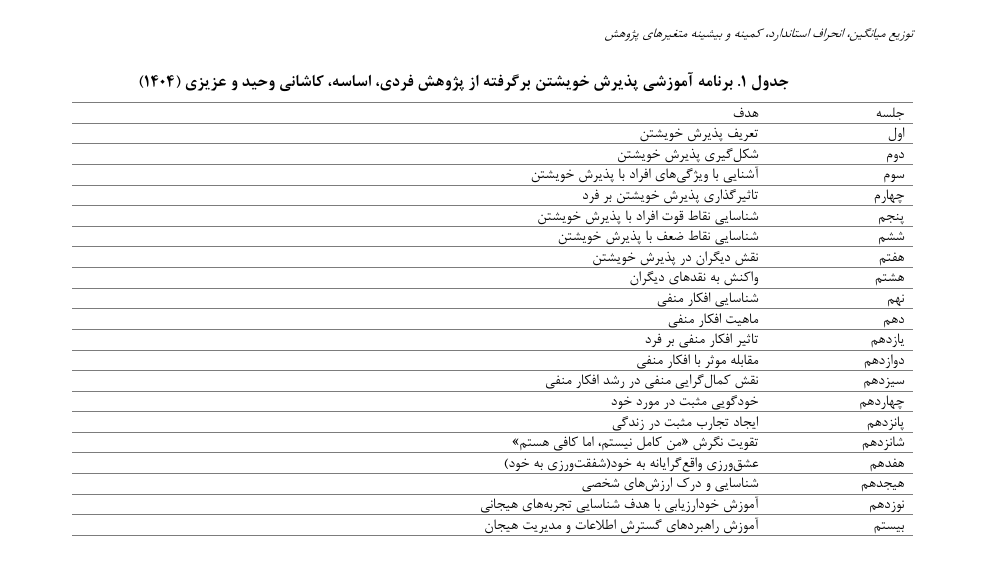
این پژوهش با هدف بررسی اثربخشی آموزش پذیرش خویشتن بر احساس خودارزشمندی و کمالگرایی در دانشآموزان دختر تیزهوش انجام شد. روش پژوهش نیمهآزمایشی با طرح پیشآزمون، پسآزمون و پیگیری با گروه گواه بود. جامعه آماری شامل دانشآموزان دختر تیزهوش شهر تهران در سال تحصیلی ۱۴۰۳–۱۴۰۴ بود که از میان آنها ۳۰ نفر به روش نمونهگیری هدفمند انتخاب و بهصورت تصادفی در دو گروه آزمایش و گواه (هر گروه ۱۵ نفر) تقسیم شدند. گروه آزمایش طی ۲۰ جلسه ۶۰ دقیقهای آموزش پذیرش خویشتن را دریافت کرد، در حالی که گروه گواه مداخلهای دریافت نکرد. ابزارهای پژوهش شامل پرسشنامه احساس خودارزشمندی کروکر و همکاران (۲۰۰۳) و پرسشنامه کمالگرایی چندبعدی فلت و هویت (۱۹۹۱) بود. دادهها با استفاده از تحلیل کواریانس آمیخته مورد تجزیه و تحلیل قرار گرفتند. نتایج نشان داد که آموزش پذیرش خویشتن بهطور معناداری موجب افزایش مؤلفههای مختلف احساس خودارزشمندی شامل حمایت خانواده، شایستگی علمی، ظاهر جسمانی، عشق معنوی و تأیید اجتماعی در گروه آزمایش نسبت به گروه گواه شد. همچنین این مداخله منجر به کاهش معنادار کمالگرایی خودمدار گردید، در حالی که تأثیر معناداری بر کمالگرایی دیگرمدار و جامعهمدار مشاهده نشد. نتایج پیگیری نیز پایداری اثرات مداخله را تأیید کرد. در مجموع، یافتهها نشان میدهد آموزش پذیرش خویشتن میتواند بهعنوان یک مداخله روانشناختی مؤثر در ارتقای خودارزشمندی و کاهش ابعاد ناسازگار کمالگرایی در دانشآموزان تیزهوش مورد استفاده قرار گیرد. این نتایج اهمیت توجه به مداخلات مبتنی بر خودپذیری را در بهبود سلامت روان و سازگاری این گروه از دانشآموزان برجسته میسازد.
مراجع
Aghajani, S., Narimani, M., & Ariapooran, S. (2011). Comparison of perfectionism and ambiguity tolerance in gifted and normal female students. Journal of Exceptional Children, 11, 1-8. https://joec.ir/browse.php?a_id=254&sid=1&slc_lang=en
Akkaya, S., Dogan, A., & Tosik, H. (2021). Investigation of the relationship between the perfectionism and self-efficacy of gifted children. International Online Journal of Educational Sciences, 13(4), 1-18. https://doi.org/10.15345/iojes.2021.05.001
Alshoufani, R. (2025). Education and Other Journeys: The Self, the Other and Stanley Cavell's Moral Perfectionism Department of Education, Stockholm University]. https://www.diva-portal.org/smash/record.jsf?pid=diva2:1937588
Augustsson, F., Mellroth, E., Gustafsson, H., & Högman, J. (2025). Mapping academically gifted students' relationship to physical activity: A scoping review. High Ability Studies, 1-27. https://doi.org/10.1080/13598139.2025.2498325
Bassami, M. (2023). Comparison of lifestyle and psychological capital in gifted and normal students of Kermanshah city. Journal of New Achievements in Humanities Studies, 61(20), 101-113. https://www.magiran.com/paper/2589353/
Bektas, I., Bektas, M., Ayar, D., Akdeniz, A., Sal, S., & Selekoglu, O. K. (2021). The Predict of Metacognitive Awareness of Nursing Students on Self‐Confidence and Anxiety in Clinical Decision‐Making. Perspectives in Psychiatric Care, 57(2), 747-752. https://doi.org/10.1111/ppc.12609
Bilicha, P. N., Nashori, F., & Sulistyarini, I. (2022). Positive thinking training for improving self-acceptance of children in correctional facility. Jurnal Ilmiah Psikologi Terapan, 10(2), 89-93. https://doi.org/10.22219/jipt.v10i2.16557
Borland, J. H. (2023). Gifted education without gifted programs or gifted students: An anti-model. In Systems and models for developing programs for the gifted and talented (pp. 105-118). Routledge. https://doi.org/10.4324/9781003419426-4
Doğan, Ş., & Yilmaz, Ş. (2023). Investigation of the relationship between gifted students' attitudes to collaborative learning and their perfectionist structure. Journal for the Education of Gifted Young Scientists, 11(3), 325-348. https://doi.org/10.17478/jegys.1325115
Fairlamb, S. (2022). We need to talk about self-esteem: The effect of contingent self-worth on student achievement and well-being. Scholarship of Teaching and Learning in Psychology, 8(1), 45. https://doi.org/10.1037/stl0000205
Fındık, H., & Afat, N. (2023). Perfectionism and Life Satisfaction in Gifted Students. International Journal of Psychology and Educational Studies, 10(4), 1012-1023. https://doi.org/10.52380/ijpes.2023.10.4.1285
Gilson, C. M., & Lee, L. E. (2023). Cultivating a learning environment to support diverse gifted students. Gifted Child Today, 46(4), 235-249. https://doi.org/10.1177/10762175231186454
Hashemi, N., & Kharouti, F. (2020). Comparison of academic motivation, self-regulation, and self-worth in gifted and normal students of Karaj city. Journal of Educational Innovations, 73(11), 27-42. https://noavaryedu.oerp.ir/&url=http:/noavaryedu.oerp.ir/article_107719.html?lang=en
Heydarizad, M., & Janbozorgi, M. (2022). Effectiveness of a self-esteem training package in elementary school students. Journal of Islamic Education, 17(42), 3-15. https://islamicedu.rihu.ac.ir/article_2004.html?lang=en
Johnsen, S. K. (2021). Identifying gifted students: A practical guide. Taylor & Francis. https://doi.org/10.4324/9781003235682
Latifi, Z., Bagheri, N., & Soleimani, F. (2022). Effectiveness of self-healing training on self-worth and psychological distress in families of students with specific learning disorders. Journal of Empowering Exceptional Children, 123(2), 54-66. https://www.sid.ir/paper/1172113/en
Mansouri Hassanabadi, F., & Abedi, A. (2022). Successful intelligence: An efficient approach for underachieving gifted students. Journal of Modern Advances in Psychology and Education, 52(11), 198-208. https://ensani.ir/fa/article/download/511907
Maryatmi, A. S. (2023). A Correlation Between Self Esteem And Self Acceptance With Body Dysmorphic Disorder Tendency In Female Adolescents In BPS & K 1 Jakarta Senior High School.
Morales, M. I. J., & Fernández, P. C. (2024). Is Perfectionism an Exclusive Characteristics of Gifted Students? Systematic Review. LIBERABIT. Revista Peruana de Psicología, 30(1), e806. https://doi.org/10.24265/liberabit.2024.v30n1.806
Nacaroğlu, O., & Bektaş, O. (2023). The effect of the flipped classroom model on gifted students' self-regulation skills and academic achievement. Thinking Skills and Creativity, 47, 101244. https://doi.org/10.1016/j.tsc.2023.101244
Negrete, A., & Hurd, N. M. (2021). System-justifying beliefs and trajectories of global self-worth among Black and Latinx college students. Cultural Diversity and Ethnic Minority Psychology, 27(2), 227. https://doi.org/10.1037/cdp0000334
Noor, B. (2023). Pressure and perfectionism: A phenomenological study on parents' and teachers' perceptions of the challenges faced by gifted and talented students in self-contained classes. In Frontiers in Education (Vol. 8, pp. 1-9). Frontiers Media SA. https://doi.org/10.3389/feduc.2023.1225623
Önal, N. T., & Önal, N. (2021). The effect of augmented reality on the astronomy achievement and interest level of gifted students. Education and Information Technologies, 26(4), 4573-4599. https://doi.org/10.1007/s10639-021-10474-7
Orhan, B. E., Karadağ, B., Astuti, Y., Karaçam, A., Canli, U., & Govindasamy, K. (2025). The Influence of Demographic, Educational, and Athletic Factors on Women's Self-Worth in Physical Activity. Sport Mont, 23(1). https://doi.org/10.26773/smj.250215
Palmer, S., & Williams, H. (2021). Developing self-acceptance through coaching. In Cognitive Behavioural Coaching in Practice: An Evidence Based Approach (pp. 99). https://doi.org/10.4324/9781003027164-5
Prosek, E. A., Diaz, A. M., Shao, H., & Giordano, A. L. (2023). Envy and Self-Worth as Predictors of Social Media Misuse Among US College Students. International Journal for the Advancement of Counselling, 45(2), 210-225. https://doi.org/10.1007/s10447-023-09504-5
Pyryt, M. C. (2021). Helping gifted students cope with perfectionism. In Parenting gifted children (pp. 546-554). Routledge. https://doi.org/10.4324/9781003237020-62
Qian, Y., Yu, X., & Liu, F. (2022). Comparison of two approaches to enhance self-esteem and self-acceptance in Chinese college students: psychoeducational lecture vs. Group intervention. Frontiers in Psychology, 13, 877737. https://doi.org/10.3389/fpsyg.2022.877737
Riskind, J. H., & Calvete, E. (2020). Anxiety and the dynamic self as defined by the prospection and mental simulation of looming future threats. Journal of Personality, 88(1), 31-44. https://doi.org/10.1111/jopy.12465
Sadati Firozabad, S. (2015). Relationship between dimensions of perfectionism and state/trait anxiety in gifted high school students. Journal of Research in School Learning, 2(8), 1-12. https://noavaryedu.oerp.ir/article_79030.html?lang=en
Sastre-Riba, S., Fonseca-Pedrero, E., & Ortuno-Sierra, J. (2019). From high intellectual ability to genius: Profiles of perfectionism. Comunicar, 27(60), 9-17. https://doi.org/10.3389/ijph.2024.1607575
Sorkkila, M., & Aunola, K. (2020). Risk factors for parental burnout among Finnish parents: The role of socially prescribed perfectionism. Journal of Child and Family Studies, 29(3), 648-659. https://doi.org/10.1007/s10826-019-01607-1
Sotoudehfar, F., Soltanizadeh, M., & Lali Dastjerdi, M. (2014). Comparison of components of perfectionism, emotional intelligence and mental health of gifted and normal high school girls in Isfahan. Journal of Educational and School Studies, 3(8), 1-20. https://pma.cfu.ac.ir/m/article_297.html?lang=en
Tang, S., Mahoney, A., Dobinson, K., & Shiner, C. T. (2025). The relationship between perfectionism and treatment outcomes among people receiving internet-based cognitive behaviour therapy for Generalised Anxiety Disorder. Cognitive Behaviour Therapy, 1-15. https://doi.org/10.1080/16506073.2025.2465737
Te Brinke, L. W., Menting, A. T., Schuiringa, H. D., Deković, M., Weisz, J. R., & De Castro, B. O. (2021). Emotion regulation training as a treatment element for externalizing problems in adolescence: A randomized controlled micro-trial. Behaviour research and therapy, 143, 103889. https://doi.org/10.1016/j.brat.2021.103889
Ti, Y., & Wei, J. (2023). The Reciprocal Associations Between Academic Contingent Self-Worth and Life Satisfaction Among Chinese College Students. Applied Research in Quality of Life, 18(2), 795-810. https://doi.org/10.1007/s11482-022-10106-3
Tsai, M. Y. (2023). Comparing Perfectionism, Cognitive Mindset, Constructive Thinking, and Emotional Intelligence in Gifted Students by Grade and Gender. Social Sciences, 12(4), 233. https://doi.org/10.3390/socsci12040233
Watson, D. R., Hill, A. P., Madigan, D. J., & Donachie, T. C. (2023). Effectiveness of an online acceptance and commitment therapy programme for perfectionism in soccer players: A randomized control trial. Sport, Exercise, and Performance Psychology. https://doi.org/10.1037/spy0000333
Williams, L. (2023). Can I Live: Examining the Self-Worth of Black Men Enrollment in Community College. Journal of Research Initiatives, 8(1), 8. https://digitalcommons.uncfsu.edu/cgi/viewcontent.cgi?article=1337&context=jri
Wolfgang, C., & Snyderman, D. (2022). An analysis of the impact of school closings on gifted services: Recommendations for meeting gifted students' needs in a post-COVID-19 world. Gifted Education International, 38(1), 53-73. https://doi.org/10.1177/02614294211054262
Woo, H., Cumming, T. M., & O'Neill, S. C. (2023). South Korean pre-service primary school teachers' attitudes towards gifted students and gifted education. Gifted Education International, 39(3), 303-317. https://doi.org/10.1177/02614294221108577
Zeidner, M. (2021). "Don't worry-be happy": The sad state of happiness research in gifted students. High Ability Studies, 32(2), 125-142. https://doi.org/10.1080/13598139.2020.1733392
دانلود
گاهشمار انتشار
- ارسال
- بازنگری
- پذیرش
شماره
نوع مقاله
مجوز
حق نشر 2025 الهام فردی (نویسنده); مریم اساسه; لیلا کاشانی وحید, پارسا عزیزی (نویسنده)

این پروژه تحت مجوز بین المللی Creative Commons Attribution-NonCommercial 4.0 می باشد.