The Effectiveness of Mindfulness-Based Stress Reduction Therapy on Nonjudgmental Acceptance, Sociability, and Personal Sense of Security in Individuals with Generalized Anxiety Disorder
Keywords:
mindfulness-based stress reduction therapy, nonjudgmental acceptance, sociability, personal sense of security, generalized anxiety disorderAbstract
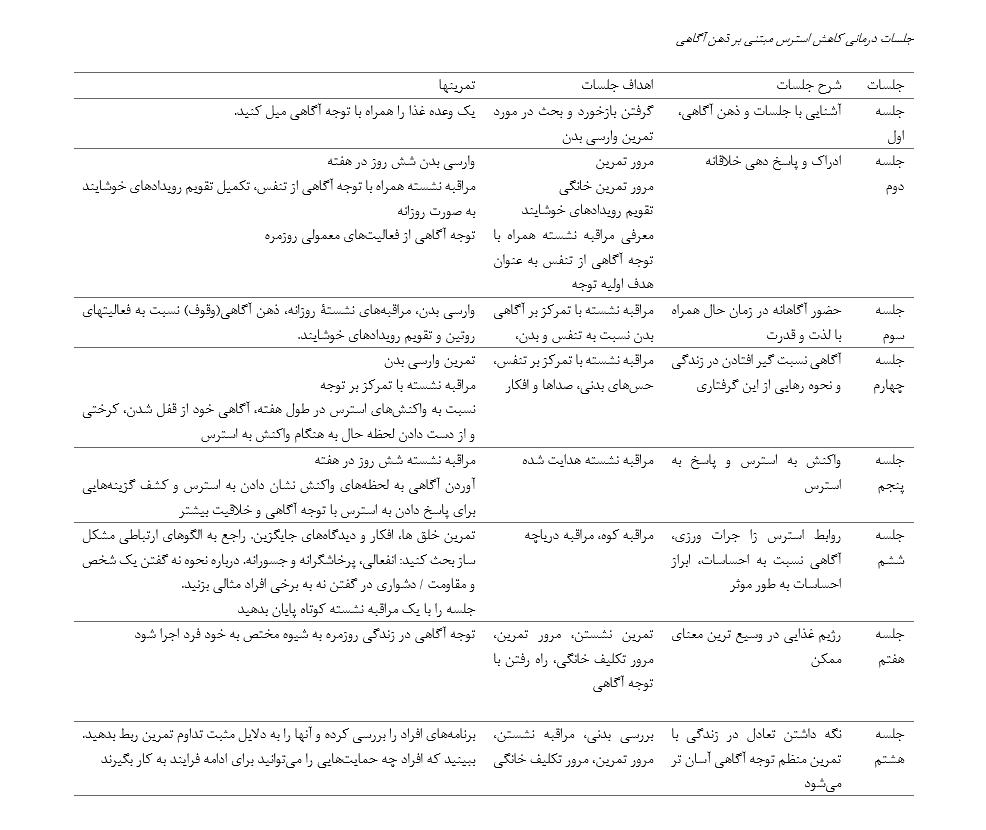
The aim of the present study was to determine the effectiveness of mindfulness-based stress reduction therapy on nonjudgmental acceptance, sociability, and personal sense of security in individuals with generalized anxiety disorder. This study was conducted using a quasi-experimental method with a pretest–posttest design and a control group. From among individuals with generalized anxiety disorder who referred to a psychological and counseling services center in Tehran, 30 participants were selected through purposive sampling and randomly assigned to experimental and control groups, with 15 participants in each group. After sample attrition, data from 24 participants, 12 in each group, were analyzed. The experimental group received mindfulness-based stress reduction therapy in eight 90-minute sessions, accompanied by daily home practice, whereas the control group received no active intervention. The data were analyzed using multivariate and univariate analysis of covariance. The results of multivariate analysis of covariance showed a significant difference between the two groups in the combined dependent variables (F(3,17)=15.232, P=0.001, partial η²=0.877). In addition, the univariate analyses showed that mindfulness-based stress reduction therapy led to significant improvements in nonjudgmental acceptance (F=15.982, P=0.001, partial η²=0.776), sociability (F=10.414, P=0.002, partial η²=0.395), and personal sense of security (F=13.795, P=0.001, partial η²=0.633) compared with the control group. The findings indicate that mindfulness-based stress reduction therapy may be associated with increased nonjudgmental acceptance, improved sociability in the sense of a tendency toward social interactions, and enhanced personal sense of security in individuals with generalized anxiety disorder. However, given the limited sample size, the absence of an active control group, the lack of a follow-up period, and certain methodological limitations, the results should be interpreted with caution. Randomized controlled trials with larger sample sizes and longer follow-up periods are needed to confirm these findings.
References
Aghababaei, N., Hatami, J., & Rostami, R. (2011). The role of individual characteristics and judgment pattern in attitudes toward euthanasia. Iranian Journal of Critical Care Nursing, 4(1), 23-32. https://www.sid.ir/fileserver/jf/40113900104
Ahmadpour, H., & Akbari, K. (2022). Relationship between parenting styles and sociability in preschool children. Quarterly Journal of Educational Psychology, 18(64), 70-85.
Aluja, A., Rossier, J., García, L. F., Angleitner, A., Kuhlman, M., & Zuckerman, M. (2006). A cross-cultural shortened form of the ZKPQ (ZKPQ-50-CC) adapted to English, French, German, and Spanish languages. Personality and Individual Differences, 41(4), 619-628. https://doi.org/10.1016/j.paid.2006.03.001
Baer, R. A., Smith, G. T., & Allen, K. B. (2004). Assessment of mindfulness by self-report: The Kentucky Inventory of Mindfulness Skills. Assessment, 11(3), 191-206. https://doi.org/10.1177/1073191104268029
Bartlett, L., Lee, C., & Chen, J. (2019). Mindfulness-based stress reduction improves social anxiety and emotion regulation in adults: A randomized controlled trial. Journal of Anxiety Disorders, 64, 1-9.
Dehghan Manshadi, M., Dibazar, S., Heydari, Y., & Kalantarzadeh, F. (2021). Effectiveness of mindfulness-based cognitive therapy on reducing stress and perfectionism in female students. Toloo-e-Behdasht, 20(1), 69-79. https://www.sid.ir/paper/965464/
Farhadi, M., & Amini, R. (2019). The relationship between social self-efficacy and sociability with academic stress in students. Journal of Behavioral Sciences, 7(2), 115-128.
Ghasemi, M., & Karimi, Y. (2016). The role of sociability in resilience and mental health of students. Journal of Clinical Psychology, 8(3), 21-35.
Hasani, F., Fathaloloomi, A., Najafi, A., & Askari, Z. (2021). Investigating the role of physical appearance perfectionism, unconditional self-acceptance and quality of life in demand for rhinoplasty surgery. Research in Medicine, 45(1), 60-63. https://pejouhesh.sbmu.ac.ir/article-1-2129-fa.pdf
Hawkley, L. C., & Cacioppo, J. T. (2003). Loneliness, social isolation, and social support: Depicting these relationships and their perceived health implications. Health Psychology, 22(4), 407-417.
Kabat-Zinn, J. (2005). Full Catastrophe Living: Using the Wisdom of Your Body and Mind to Face Stress, Pain, and Illness (2nd ed.). Delacorte Press. https://psycnet.apa.org/record/2006-04192-000
Lee, R. M., Draper, M., & Lee, S. (2001). Development and validation of the social connectedness and intimacy scale. Journal of Counseling Psychology, 48(2), 201-214. https://doi.org/10.1037/0022-0167.48.3.310
Magen, R., & Smetana, J. G. (1999). Parenting styles and social reasoning. Child Development, 70(5), 1133-1145.
Makarem, M., & Yousefi, Z. (2021). Effectiveness of psychodrama group therapy on assertiveness, unconditional self-acceptance and gratitude in individuals with physical-motor disabilities: a quasi-experimental study. Journal of Rafsanjan University of Medical Sciences, 20(6), 681-696. https://www.sid.ir/fa/VEWSSID/J_pdf/lk65614000606.pdf
Najafi, M., & Rostami, J. (2023). Investigating the relationship between life satisfaction and sociability in the elderly. Journal of Geriatric Psychology, 6(4), 55-69.
Oraki, M., Alipour, A., & Dehkhodaei, S. (2021). Comparing the effectiveness of ACT and MBSR with neurofeedback on anxiety sensitivity and perceived stress in diabetic patients. Clinical Psychology.
Rezaei, A., & Ahmadi, F. (2018). Predicting sociability based on attachment styles in high school students. Quarterly Journal of Social Psychology, 12(46), 88-101.
Saberi, Z., & Rezaeian, G. (2022). The mediating role of perceived social support in the relationship between sociability and quality of life. Journal of Clinical Psychology, 14(2), 95-110.
Shibani, F., Dabbaghi, P., Najafi, S., & Rajaee Nejad, M. (2022). Effectiveness of mindfulness-based stress reduction therapy on patients with chronic pain: a randomized clinical trial. Iranian Journal of Psychiatry and Clinical Psychology, 28(2), 182-195. https://www.sid.ir/paper/1071010/fa
Shirey, M. R. (2004). Social connectedness: Development of a concept. Advances in Nursing Science, 27(1), 4-14.
Turner, R. J., Marino, F., & Manis, K. (1994). Social support and depression: A prospective analysis. Journal of Health and Social Behavior, 35(3), 205-217. https://doi.org/10.2307/2137276
Yazdani, S., & Hashemi, N. (2020). The effect of social skills training on increasing sociability and reducing social anxiety in adolescents. Journal of School Psychology, 9(1), 110-125.
Zuckerman, M., Kuhlman, D. M., Joireman, J., Teta, P., & Kraft, M. (1993). A comparison of three structural models for personality: The Big Three, the Big Five, and the Alternative Five. Journal of Personality and Social Psychology, 65(4), 757-768. https://doi.org/10.1037/0022-3514.65.4.757
Downloads
Publication Timeline
- Submitted
- Revised
- Accepted
Issue
Section
License
Copyright (c) 2025 شیوا مست علی (نویسنده); مهریار عناصری

This work is licensed under a Creative Commons Attribution-NonCommercial 4.0 International License.