The Effect of Family-Centered Psychotherapy Interventions on Improving Mental Learning Performance of Children with Mental Disorders Hospitalized in Hospital
Keywords:
Family-centered psychotherapy, Mental learning performance, Learning disorders; Psychological distress, Hospitalized children, Mental disordersAbstract
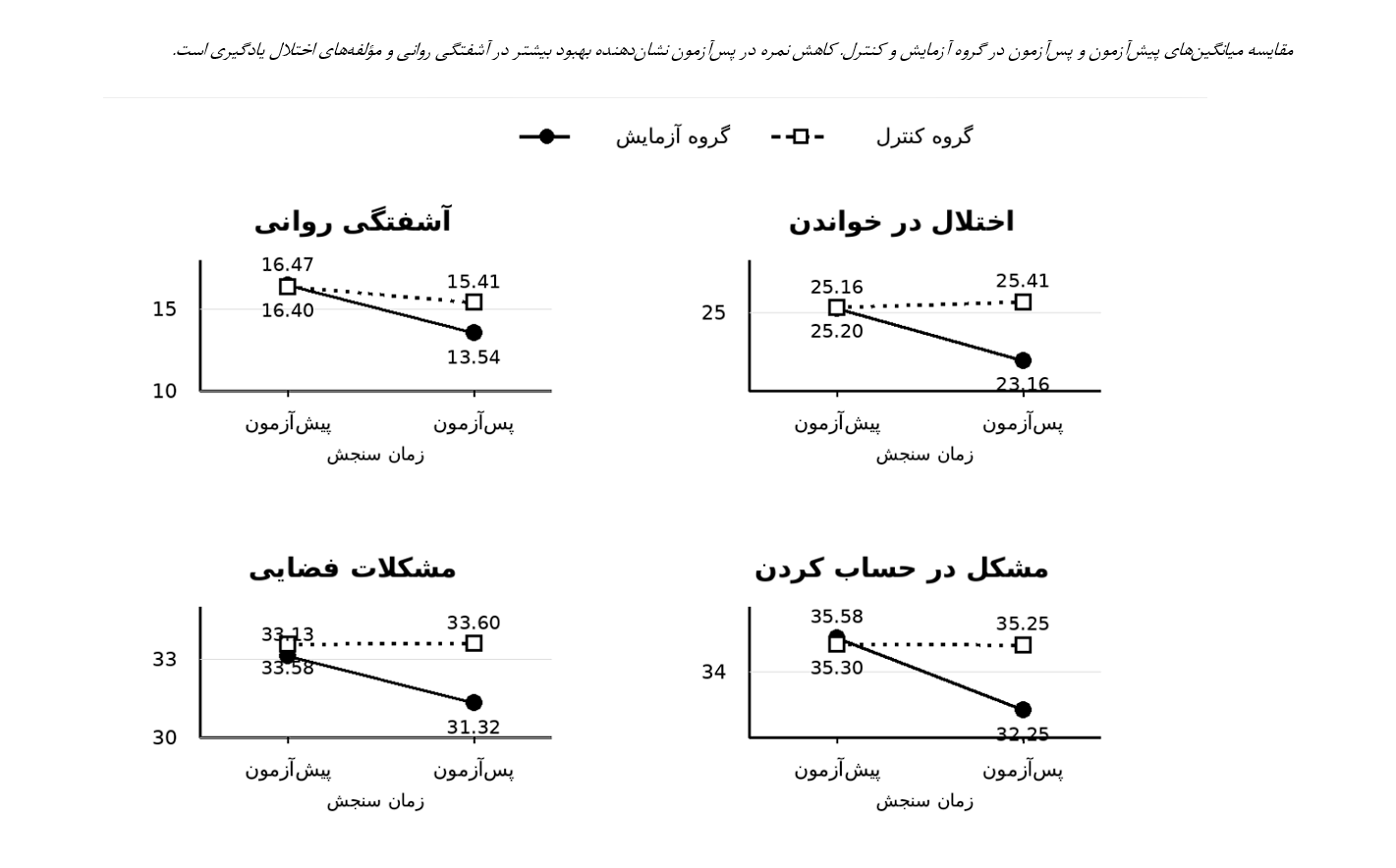
The aim of the present study was to investigate the effect of family-centered psychotherapy interventions on improving selected components of mental learning performance (reading disorder, spatial problems, and arithmetic problems) and reducing psychological distress in children with mental disorders hospitalized in hospital. The research method was quasi-experimental with a pretest-posttest design and a control group. The statistical population included children under 10 years of age with learning disorders and psychological distress who were hospitalized in public hospitals in Tehran in the year 2025 (1404 Persian calendar). Among the screened individuals, 30 children meeting the inclusion criteria were selected and randomly assigned into two groups: experimental and control, with 15 children in each group. The experimental group participated in an eight-session family-centered psychotherapy program (each session lasting 45 minutes), while the control group received no intervention. Research instruments included the Colorado Learning Difficulties Questionnaire and the Impact of Event Scale-Revised. Data were analyzed using descriptive statistics and univariate analysis of covariance (ANCOVA). The results showed that after controlling for the pretest effect, the family-centered intervention had a significant effect on reducing psychological distress (F = 53.63, p < 0.001, η² = 0.98). Additionally, the intervention had a significant effect on reducing reading disorder (F = 10.82, p < 0.01, η² = 0.29).. Regarding the component of spatial problems, a significant difference was also reported between the two groups (F = 16.64, p < 0.001, η² = 0.38). Furthermore, the intervention had a significant effect on reducing arithmetic problems (F = 17.78, p < 0.001, η² = 0.39). Based on the findings, family-centered psychotherapy can be used as a complementary approach to reduce psychological distress and improve certain components of mental learning in hospitalized children.
References
American Psychiatric, A. (2022). Diagnostic and statistical manual of mental disorders. American Psychiatric Association Publishing. https://doi.org/10.1176/appi.books.9780890425787
Beaton, M. C., Codina, G. N., & Wharton, J. C. (2021). Decommissioning normal: COVID-19 as a disruptor of school norms for young people with learning disabilities. British Journal of Learning Disabilities, 49(4), 393-402. https://doi.org/10.1111/bld.12399
Beck, J. G., Grant, D. M., Read, J. P., Clapp, J. D., Coffey, S. F., Miller, L. M., & Palyo, S. A. (2008). The Impact of Event Scale-Revised: Psychometric properties in a sample of motor vehicle accident survivors. Journal of Anxiety Disorders, 22(2), 187-198. https://doi.org/10.1016/j.janxdis.2007.02.002
Becvar, R. J., Becvar, D. S., & Reif, L. V. (2023). Systems theory and family therapy: A primer. Rowman & Littlefield. https://www.amazon.com/Systems-Theory-Family-Therapy-Raphael/dp/1538185679
Carr, A. (2025). Family therapy and systemic interventions for child-focused problems: The evidence base. Journal of Family Therapy, 47(1), e12476. https://doi.org/10.1111/1467-6427.12476
Creamer, M., Bell, R., & Failla, S. (2003). Psychometric properties of the Impact of Event Scale-Revised. Behaviour Research and Therapy, 41(12), 1489-1496. https://doi.org/10.1016/j.brat.2003.07.010
Dallos, R., & Vetere, A. (2021). Systemic therapy and attachment narratives: Applications in a range of clinical settings. Routledge. https://doi.org/10.4324/9781003080152
Degli Espinosa, F., Metko, A., Raimondi, M., Impenna, M., & Scognamiglio, E. (2020). A model of support for families of children with autism living in the COVID-19 lockdown: Lessons from Italy. Behavior Analysis in Practice, 13(3), 550-558. https://doi.org/10.1007/s40617-020-00438-7
Dubois-Comtois, K., Suffren, S., St-Laurent, D., Milot, T., & Lemelin, J. P. (2021). Child psychological functioning during the COVID-19 lockdown: An ecological, family-centered approach. Journal of Developmental & Behavioral Pediatrics, 42(7), 532-539. https://doi.org/10.1097/DBP.0000000000000935
Geary, D. C. (2010). Mathematical disabilities: Reflections on cognitive, neuropsychological, and genetic components. Learning and Individual Differences, 20(2), 130-133. https://doi.org/10.1016/j.lindif.2009.10.008
Hoagwood, K. E., Cavaleri, M. A., Olin, S. S., Burns, B. J., Slaton, E., Gruttadaro, D., & Hughes, R. (2010). Family support in children's mental health: A review and synthesis. Clinical Child and Family Psychology Review, 13(1), 1-45. https://doi.org/10.1007/s10567-009-0060-5
Horowitz, M. J., Wilner, N., & Alvarez, W. (1979). Impact of Event Scale: A measure of subjective stress. Psychosomatic Medicine, 41(3), 209-218. https://doi.org/10.1097/00006842-197905000-00004
Kazak, A. E., Kassam-Adams, N., Schneider, S., Zelikovsky, N., Alderfer, M. A., & Rourke, M. (2006). An integrative model of pediatric medical traumatic stress. Journal of Pediatric Psychology, 31(4), 343-355. https://doi.org/10.1093/jpepsy/jsj054
Kuo, D. Z., Houtrow, A. J., Arango, P., Kuhlthau, K. A., Simmons, J. M., & Neff, J. M. (2012). Family-centered care: Current applications and future directions in pediatric health care. Maternal and Child Health Journal, 16(2), 297-305. https://doi.org/10.1007/s10995-011-0751-7
Peterson, R. L., & Pennington, B. F. (2015). Developmental dyslexia. Annual Review of Clinical Psychology, 11, 283-307. https://doi.org/10.1146/annurev-clinpsy-032814-112842
Schwartz, A. E., Hopkins, B. G., & Stiefel, L. (2021). The effects of special education on the academic performance of students with learning disabilities. Journal of Policy Analysis and Management, 40(2), 480-520. https://doi.org/10.1002/pam.22282
Shields, L., Zhou, H., Pratt, J., Taylor, M., Hunter, J., & Pascoe, E. (2012). Family-centred care for hospitalised children aged 0-12 years. Cochrane Database of Systematic Reviews, 2012(10), CD004811. https://doi.org/10.1002/14651858.CD004811.pub3
Snowling, M. J., & Hulme, C. (2012). Interventions for children's language and literacy difficulties. International Journal of Language & Communication Disorders, 47(1), 27-34. https://doi.org/10.1111/j.1460-6984.2011.00081.x
Taibbi, R. (2022). Doing family therapy: Craft and creativity in clinical practice. Guilford Press. https://books.google.com/books?hl=en&lr=&id=ilZZEAAAQBAJ&oi=fnd&pg=PP1&dq=Taibbi,+R.+(2022).+Doing+family+therapy:+Craft+and+creativity+in+clinical+practice,+Guilford+Press.+%09&ots=FVo5YWIGHP&sig=sAhapWwxBRvzF6YCmg29g30yclQ
Weiss, D. S., & Marmar, C. R. (1997). Assessing psychological trauma and PTSD: A practitioner's handbook. Guilford Press. https://doi.org/10.1037/t12199-000
Willcutt, E. G., Boada, R., Riddle, M. W., Chhabildas, N., DeFries, J. C., & Pennington, B. F. (2011). Colorado Learning Difficulties Questionnaire: Validation of a parent-report screening measure. Psychological Assessment, 23(3), 778-791. https://doi.org/10.1037/a0023290
Downloads
Publication Timeline
- Submitted
- Revised
- Accepted
Issue
Section
License
Copyright (c) 2025 طناز بوستانچی کاشانی (نویسنده); علیرضا جرجندی رحمت آبادی; مریم افشاری حمید, فاطمه ولی پور صاحبی, مهاباد وطن خواه (نویسنده)

This work is licensed under a Creative Commons Attribution-NonCommercial 4.0 International License.