Evaluating the Role of Social Media in Promoting a Health-Oriented Lifestyle and Behavior Change: A Health Management Approach
DOI:
https://doi.org/10.61838/kman.longevity.69Keywords:
social media , health-oriented lifestyle, behavior change, health management, grounded theoryAbstract
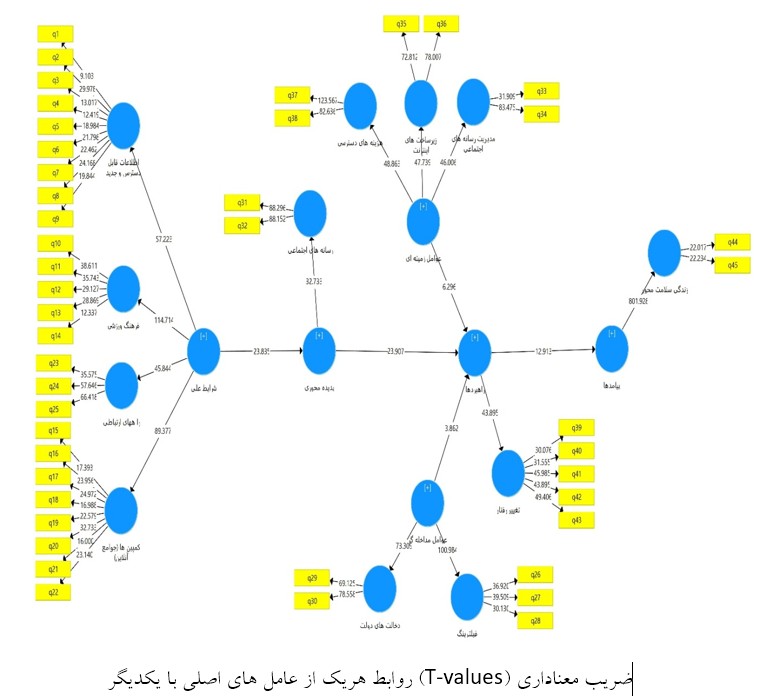
Social media has become a powerful setting in which health-related information, norms, and everyday lifestyle choices are shaped. Yet its role in promoting a health-oriented lifestyle is not uniform because outcomes depend on content credibility, network dynamics, and contextual constraints such as access costs, infrastructure quality, filtering, and government interference. This study evaluated the role of social media in promoting a health-oriented lifestyle and explained the mechanism of behavior change from a health management perspective using a mixed-methods design. In the qualitative phase, experts in sport, health, and social media were recruited through purposive snowball sampling until theoretical saturation. Interviews were analyzed using systematic grounded theory (open and axial coding) to build a paradigm-based conceptual model. In the quantitative phase, sport media consumers completed a researcher-developed questionnaire; 374 valid responses were analyzed. The measurement and structural models were examined using PLS-SEM (SmartPLS), with convergent validity assessed via AVE and discriminant validity via the Fornell–Larcker criterion. Qualitative findings organized the phenomenon into seven domains: informational factors, cultural factors, campaigns/online communities, communication pathways, intervening factors, contextual conditions, and outcomes, with social media identified as the core phenomenon, behavior change as the main strategy, and a health-oriented lifestyle as the final outcome. Quantitative results showed that all main paths were significant (p < .001): causal conditions predicted the core phenomenon; the core phenomenon predicted strategies; contextual and intervening factors affected strategies; and strategies predicted outcomes. The strongest indicators were sport culture (0.91), communication pathways (0.89), accessible/new information (0.87), and campaigns/online communities (0.81), while intervening constraints were dominated by filtering (0.92) and government interference (0.86). The model explained moderate variance in endogenous constructs (R² = 0.47 for the core phenomenon, 0.45 for strategies, and 0.42 for outcomes). Social media can facilitate healthier lifestyles through staged behavior change, provided that supportive conditions are strengthened and constraining factors are managed.
References
Bandura, A. (2004). Health promotion by social cognitive means. Health Education & Behavior, 31(2), 143-164. https://doi.org/10.1177/1090198104263660
boyd d, m., & Ellison, N. B. (2007). Social network sites: Definition, history, and scholarship. Journal of Computer-Mediated Communication, 13(1), 210-230. https://doi.org/10.1111/j.1083-6101.2007.00393.x
Centola, D. (2010). The spread of behavior in an online social network experiment. Science, 329(5996), 1194-1197. https://doi.org/10.1126/science.1185231
Gerbner, G., Gross, L., Morgan, M., Signorielli, N., & Shanahan, J. (2002). Growing up with television: Cultivation processes. In J. Bryant & D. Zillmann (Eds.), Media effects: Advances in theory and research (2nd ed., pp. 43-67). Lawrence Erlbaum Associates.
Kaplan, A. M., & Haenlein, M. (2010). Users of the world, unite! The challenges and opportunities of social media. Business Horizons, 53(1), 59-68. https://doi.org/10.1016/j.bushor.2009.09.003
Kite, J., Chan, L., MacKay, K., Corbett, L., Reyes-Marcelino, G., Nguyen, B., Bellew, W., & Freeman, B. (2023). A model of social media effects in public health communication campaigns: Systematic review. Journal of Medical Internet Research, 25, e46345. https://doi.org/10.2196/e46345
Kreuter, M. W., & McClure, S. M. (2004). The role of culture in health communication. Annual Review of Public Health, 25, 439-455. https://doi.org/10.1146/annurev.publhealth.25.101802.123000
Lupton, D. (2015). Health promotion in the digital era: A critical commentary. Health Promotion International, 30(1), 174-183. https://doi.org/10.1093/heapro/dau091
Michie, S., van Stralen, M. M., & West, R. (2011). The behaviour change wheel: A new method for characterising and designing behaviour change interventions. Implementation Science, 6, 42. https://doi.org/10.1186/1748-5908-6-42
Moorhead, S. A., Hazlett, D. E., Harrison, L., Carroll, J. K., Irwin, A., & Hoving, C. (2013). A new dimension of health care: Systematic review of the uses, benefits, and limitations of social media for health communication. Journal of Medical Internet Research, 15(4), e85. https://doi.org/10.2196/jmir.1933
Prochaska, J. O., & DiClemente, C. C. (1983). Stages and processes of self-change of smoking: Toward an integrative model of change. Journal of Consulting and Clinical Psychology, 51(3), 390-395. https://doi.org/10.1037/0022-006X.51.3.390
Suarez-Lledo, V., & Alvarez-Galvez, J. (2021). Prevalence of health misinformation on social media: Systematic review. Journal of Medical Internet Research, 23(1), e17187. https://doi.org/10.2196/17187
Vosoughi, S., Roy, D., & Aral, S. (2018). The spread of true and false news online. Science, 359(6380), 1146-1151. https://doi.org/10.1126/science.aap9559
Downloads
Publication Timeline
- Submitted
- Revised
- Accepted
Issue
Section
License
Copyright (c) 2025 محمد امين شهيدي بنجار (نویسنده); زهرا نوبخت رمضاني , مهدي نادري نسب ; سید عباس بی نیاز, عارفه جمشيدي (نویسنده)

This work is licensed under a Creative Commons Attribution-NonCommercial 4.0 International License.