Dose-Response Relationship Between Total Physical Activity Volume, Health-Related Quality of Life, and GDF-15 and MDA Levels in Adults Aged 65 to 85 Years
DOI:
https://doi.org/10.61838/kman.longevity.68Keywords:
Exercise, aging, health-related quality of life, oxidative damageAbstract
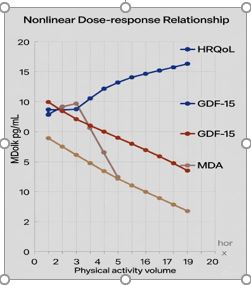
The aging process is associated with a decline in health-related quality of life (HRQoL), which is often exacerbated by increases in biological markers such as growth differentiation factor-15 (GDF-15), a marker of cellular vulnerability and stress, and malondialdehyde (MDA), a marker of lipid oxidative damage. These markers play a key role in predicting physiological decline and age-related diseases. This cross-sectional observational study aimed to investigate the dose-response relationship between total physical activity volume, HRQoL, and serum levels of GDF-15 and MDA in adults aged 65 to 85 years. 200 participants (105 women, 95 men; mean age 74.1 ± 5.2 years) were selected from the active elderly community in Tehran. Weekly physical activity volume was measured using the International Physical Activity Questionnaire (IPAQ-SF) and categorized into three levels: low (<150 min/week), moderate (150–300 min), and high (>300 min). HRQoL was assessed using the SF-36 questionnaire, and GDF-15 and MDA levels were determined from fasting blood samples. Statistical analyses included multivariate linear regression and ANOVA. Increased physical activity volume was significantly associated with improved HRQoL score (β = 0.47, p = 0.001), reduced GDF-15 levels (β = -0.35, p = 0.001), and reduced MDA levels (β = -0.30, p = 0.001). The dose-response relationship was nonlinear, with the greatest improvements observed at moderate to high levels. Gender differences also indicated that women showed a better response to moderate activity levels. Increased physical activity volume was associated with reduced GDF-15 and MDA levels (markers of cellular vulnerability and oxidative damage) and improved health-related quality of life. These findings demonstrate a positive association between physical activity volume and health indicators in older adults and emphasize the need for longitudinal or experimental studies to examine the interventional effects of exercise. The results highlight the importance of planning personalized exercise interventions for older adults, although generalization to sedentary or disabled older adults requires caution due to the selection of an active urban elderly sample.
References
American Heart Association. (2018). Recommendations for physical activity in adults and kids. Available online: https://www. heart. org/en/healthy-living/fitness/fitness-basics/aha-recs-for-physical-activity-in-adults (accessed on 2 August 2021).
Ammar, A., Trabelsi, K., Boukhris, O., Glenn, J. M., Bott, N., Masmoudi, L., Hakim, A., Chtourou, H., Driss, T., & Hoekelmann, A. (2020). Effects of aerobic-, anaerobic-and combined-based exercises on plasma oxidative stress biomarkers in healthy untrained young adults. International Journal of Environmental Research and Public Health, 17(7), 2601.
Bacanoiu, M. V., Danoiu, M., Rusu, L., & Marin, M. I. (2023). New directions to approach oxidative stress related to physical activity and nutraceuticals in normal aging and neurodegenerative aging. Antioxidants, 12(5), 1008.
Carpentieri, S., Ferrari, G., & Donsì, F. (2023). High-pressure homogenization for enhanced Bioactive recovery from tomato processing by-products and improved lycopene bioaccessibility during in vitro digestion. Antioxidants, 12(10), 1855.
Chirumbolo, S., Bertossi, D., & Magistretti, P. (2023). Insights on the role of L-lactate as a signaling molecule in skin aging. Biogerontology, 24(5), 709-726.
Conte, M., Giuliani, C., Chiariello, A., Iannuzzi, V., Franceschi, C., & Salvioli, S. (2022). GDF15, an emerging key player in human aging. Ageing research reviews, 75, 101569.
El-Domiaty, H. F., El-Roghy, E. S., & Salem, H. R. (2022). Combination of magnesium supplementation with treadmill exercise improves memory deficit in aged rats by enhancing hippocampal neurogenesis and plasticity: a functional and histological study. Applied Physiology, Nutrition, and Metabolism, 47(3), 296-308.
Fairof, M. H. Z., Ludin, A. F. M., Anas, N. D., Husna, A., Hasan, A. M. C., Abdullah, A. H. A., Ibrahim, F. W., Pramono, A., & Rajab, N. F. (2025). Early Active Exercise Improves MDA, SOD, and GSH Levels without Memory or NO Changes in Wistar Rats. The Indonesian Biomedical Journal, 17(4), 335-342.
He, P., Ye, Z., Liu, M., Li, H., Zhang, Y., Zhou, C., Wu, Q., Zhang, Y., Yang, S., & Liu, C. (2023). Association of handgrip strength and/or walking pace with incident chronic kidney disease: A UK biobank observational study. Journal of Cachexia, Sarcopenia and Muscle, 14(2), 805-814.
Kim, J., Bressel, E., Kim, M., Kim, T., Koh, S., & Kim, D. (2025). The Effects of a Combined Exercise Intervention on Body Composition, GDF-15, Apelin-12, and IL-15 Among Older Korean Women According to Obesity Status. Journal of Clinical Medicine, 14(14), 4981.
Kleinert, M., Clemmensen, C., Sjøberg, K. A., Carl, C. S., Jeppesen, J. F., Wojtaszewski, J. F., Kiens, B., & Richter, E. A. (2018). Exercise increases circulating GDF15 in humans. Molecular metabolism, 9, 187-191.
Lehrer, S., & Rheinstein, P. H. (2025). Growth Differentiation Factor 15 Connects Stress and Ageing in a UK Biobank Cohort. medRxiv, 2025.2007. 2004.25330886.
Limyati, Y., Rahmia, P., & Hutapea, A. M. (2025). THE EFFECT OF RESISTANCE TRAINING AND ANTIOXIDANT SUPPLEMENTATION WITH ASTAXANTHIN ON PLASMA MALONDIALDEHYDE (MDA) LEVELS IN ADULTS. Jurnal Health Sains, 6(3), 1-12.
Liu, H., Huang, Y., Lyu, Y., Dai, W., Tong, Y., & Li, Y. (2021). GDF15 as a biomarker of ageing. Experimental gerontology, 146, 111228.
Liu, M., Fu, X., Yu, D., Li, M., Pan, Y., Yang, C., & Sun, G. (2024). Mapping the causal associations of cytokines with sarcopenia and aging traits: Evidence from bidirectional Mendelian randomization. Journal of Cachexia, Sarcopenia and Muscle, 15(3), 1121-1133.
Lyu, Z., Fan, N., Deng, P., Huang, Q., Bruns, C., & Zhao, Y. (2025). GDF15 connecting ageing and cancer: Mechanistic insights and therapeutic opportunities. Ageing and Cancer Research & Treatment, 2(2), 202509-202509.
Mohammadifard, N., Sajjadi, F., Maghroun, M., Alikhasi, H., Nilforoushzadeh, F., & Sarrafzadegan, N. (2015). Validation of a simplified food frequency questionnaire for the assessment of dietary habits in Iranian adults: Isfahan Healthy Heart Program, Iran. ARYA atherosclerosis, 11(2), 139.
Ni, C., Ji, Y., Hu, K., Xing, K., Xu, Y., & Gao, Y. (2023). Effect of exercise and antioxidant supplementation on cellular lipid peroxidation in elderly individuals: Systematic review and network meta-analysis. Frontiers in Physiology, 14, 1113270.
Papa, M. V., Ceolin, C., Boschele, F., Pagliuca, R., Sergi, G., & De Rui, M. (2025). The Stress-Responsive Cytokine GDF-15 and Sarcopenia: A Systematic Review and Meta-Analysis on Aging Muscle Decline. Mechanisms of Ageing and Development, 112117.
Piercy, K. L., Troiano, R. P., Ballard, R. M., Carlson, S. A., Fulton, J. E., Galuska, D. A., George, S. M., & Olson, R. D. (2018). The physical activity guidelines for Americans. Jama, 320(19), 2020-2028.
Susanto, I. H., Suherman, W. S., Graha, A. S., Bahauddin, M. A., & Ockta, Y. (2025). The Relationship Between Submaximal Exercise, Oxidative Stress, and Malondialdehyde (MDA) Levels as Indicators of Health and Physiological Adaptation in Athletes: A Litera-ture Review. Balneo & PRM Research Journal, 16(3).
Trumpff, C., Huang, Q., Michelson, J., Liu, C. C., Shire, D., Habeck, C. G., Stern, Y., & Picard, M. (2025). Blood mitochondrial health markers cf-mtDNA and GDF15 in human aging. bioRxiv.
Wan, R., Su, Y., Zhu, M., & Huang, Y. (2024). Elevated blood malondialdehyde level contributed to a high stroke risk in a Chinese elderly population from rural areas: a cross-sectional study. Scientific Reports, 14(1), 4325.
Wan, Y., & Fu, J. (2024). GDF15 as a key disease target and biomarker: linking chronic lung diseases and ageing. Molecular and cellular biochemistry, 479(3), 453-466.
Wang, Y., Luo, D., Jiang, H., Song, Y., Wang, Z., Shao, L., & Liu, Y. (2023). Effects of physical exercise on biomarkers of oxidative stress in healthy subjects: A meta-analysis of randomized controlled trials. Open Life Sciences, 18(1), 20220668.
Widiastuti, I. A. E., Zubaidi, F. F., Rahmat, B., & Buanayuda, G. W. (2022). Analysis of Malondialdehyde (MDA) Levels Based on Body Mass Index, Waist Circumstances, and Body Fat Percentage in Students of Medicine Program Faculty of Medicine Mataram University. Jurnal Biologi Tropis, 22(4), 1455-1461.
Ye, Y., Lin, H., Wan, M., Qiu, P., Xia, R., He, J., Tao, J., Chen, L., & Zheng, G. (2021). The effects of aerobic exercise on oxidative stress in older adults: a systematic review and meta-analysis. Frontiers in Physiology, 12, 701151.
Downloads
Publication Timeline
- Submitted
- Revised
- Accepted
Issue
Section
License
Copyright (c) 2025 اعظم ملانوروزی, نسیم سهیلی (نویسنده)

This work is licensed under a Creative Commons Attribution-NonCommercial 4.0 International License.