Effects of High-Intensity Aerobic Training and Myo-Inositol Supplementation on the Expression of AMPKα, Prkaa1, Prkaa2, and Akt Genes Associated with AMPK and Akt Signaling Pathways in Adipose Tissue of Obese Rats
Keywords:
Obesity, High-Intensity Aerobic Training, Myo-Inositol, AMPKα, AktAbstract
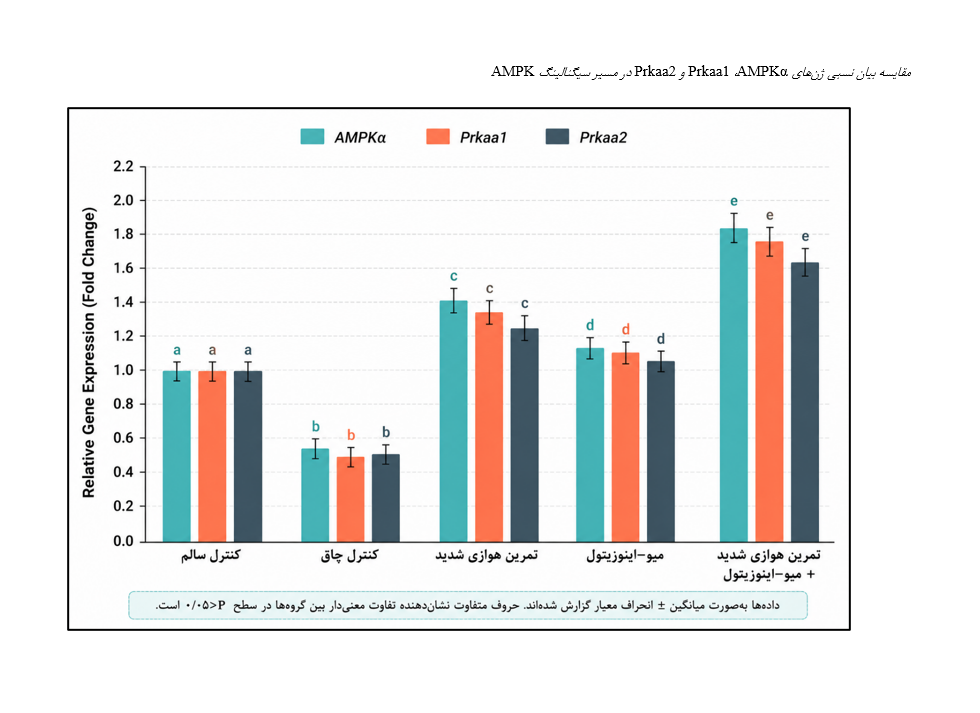
Obesity is one of the most prevalent metabolic disorders worldwide and is associated with profound alterations in energy regulation, insulin resistance, and metabolic diseases. Among the molecular pathways involved in metabolic homeostasis, the AMPK and Akt signaling pathways play critical roles in regulating energy balance and cellular metabolism. Dysregulation of genes related to these pathways may contribute to obesity-associated metabolic impairments. Therefore, the present study aimed to investigate the effects of high-intensity aerobic training and myo-inositol supplementation on the expression of AMPKα, Prkaa1, Prkaa2, and Akt genes in the adipose tissue of obese rats. In this experimental study, fifty male Wistar rats were rendered obese through a high-fat diet and randomly assigned to five groups: healthy control, obese control, high-intensity aerobic training, myo-inositol supplementation, and combined high-intensity aerobic training plus myo-inositol supplementation. The training intervention was performed for eight weeks, five sessions per week, while myo-inositol was administered concurrently throughout the intervention period. Gene expression levels were assessed using Real-Time PCR, and data were analyzed using one-way and two-way analyses of variance. The results demonstrated that obesity significantly reduced the expression of AMPKα, Prkaa1, Prkaa2, and Akt genes. High-intensity aerobic training significantly increased the expression of AMPK pathway-related genes, whereas myo-inositol exerted a more pronounced effect on Akt gene expression. Furthermore, the combined intervention produced the greatest increase in the expression of all investigated genes. These findings suggest that the combination of high-intensity aerobic training and myo-inositol supplementation may serve as an effective non-pharmacological strategy for improving gene expression patterns associated with energy regulation and metabolic function under obese conditions.
References
Aghajani, H. (2024). The effect of myo-inositol supplementation on increased Akt and AMPK expression and improvement of insulin resistance in patients with non-alcoholic fatty liver disease. Journal of Clinical Nutrition, 42(2), 77-90.
Akbari, M., Mohammadi, F., & Hosseini, S. (2021). The effect of aerobic exercise on sirtuin-1 and visceral fat metabolism. Journal of Metabolic Research, 8(3), 45-56.
Ashraf, N., Steinberg, G. R., & Carling, D. (2024). Fine-tuning AMPK in physiology and disease using point mutations. Disease Models & Mechanisms, 17(8), dmm050798. https://doi.org/https://doi.org/10.1242/dmm.050798
Barber, T. M., Nelson, R., & Jones, K. (2021). Insulin sensitivity and systemic metabolism in obesity. Diabetes Care, 44(7), 1523-1532.
Carling, D. (2017). AMPK signalling in health and disease. Current Opinion in Cell Biology, 45, 31-37. https://doi.org/https://doi.org/10.1016/j.ceb.2017.01.005
Cho, H., Kim, J., & Park, S. (2024). High-intensity interval training enhances browning genes in white adipose tissue. Exercise and Metabolism, 15(2), 88-99.
Choi, J., Kim, S., & Lee, H. (2019). Metabolic dysfunction associated with obesity and insulin resistance. Journal of Endocrinology, 242(1), 15-28.
Croze, M. L., & Soulage, C. O. (2013). Potential role and therapeutic interests of myo-inositol in metabolic diseases. Biochimie, 95(10), 1811-1827. https://doi.org/https://doi.org/10.1016/j.biochi.2013.05.011
Eslami, H., Izadi, M., & Roozbehani, M. (2025). The effect of aerobic exercise on insulin resistance and AMPK/PI3K axis in soleus muscle of type 2 diabetic rats. Journal of Mashhad University of Medical Sciences, 68(1), 32-40. https://doi.org/https://doi.org/10.22038/mjms.2024.83168.4784
Fakhr Fatemi, M., & et al. (2023). High-intensity interval training and insulin resistance indicators: An animal study. Iranian Exercise Physiology, 6(3), 75-88.
Fakhrefatemi, M., Ahmadi, S., & Rezaei, H. (2024). The effect of high-intensity interval training on insulin resistance indicators and expression of genes related to adipose tissue in a type 2 diabetic animal model. Iranian Journal of Sports Sciences, 21(2), 45-60. https://sid.ir/paper/1170582/fa
Garcia, D., Fernandez, M., & Lopez, A. (2020). Prkaa1 and Prkaa2 in adipose tissue metabolism and energy homeostasis. Metabolic Research Journal, 18(3), 201-214.
Gibala, M. J., Little, J. P., MacDonald, M. J., & Hawley, J. A. (2012). Physiological adaptations to low-volume high-intensity interval training in health and disease. The Journal of Physiology, 590(5), 1077-1084. https://doi.org/https://doi.org/10.1113/jphysiol.2011.224725
Hardie, D. G., Ross, F. A., & Hawley, S. A. (2012). AMPK: A central regulator of energy homeostasis. Nature Reviews Molecular Cell Biology, 13(4), 251-262. https://doi.org/https://doi.org/10.1038/nrm3311
Hers, I., Vincent, E. E., & Tavaré, J. M. (2011). Akt signalling in health and disease. Cellular Signalling, 23(10), 1515-1527. https://doi.org/https://doi.org/10.1016/j.cellsig.2011.05.004
Jeon, S. M. (2016). Regulation and function of AMPK in physiology and diseases. Experimental & Molecular Medicine, 48(7), e245. https://doi.org/https://doi.org/10.1038/emm.2016.81
Kao, J., Liu, F., & Wong, K. (2024). Aerobic exercise and BCAA metabolism in insulin resistance. Nutrition & Metabolism, 21(1), 15-27.
Kasmass, P., Nguyen, T., & Silva, J. (2023). High-fat diet and metabolic impairment: Mechanisms and interventions. Metabolism Research, 58(3), 120-134.
Kjobsted, R., Hingst, J. R., Fentz, J., Foretz, M., Sanz, M. N., Pehmøller, C., Shum, M., Marette, A., Mounier, R., Treebak, J. T., & Wojtaszewski, J. F. P. (2018). AMPK in skeletal muscle function and exercise metabolism. Physiological Reviews, 98(2), 839-892.
Long, F., Wang, Y., & Zhao, J. (2024). Myo-inositol supplementation in high-fat diet-induced obesity. Nutrition Research, 102, 45-57.
Mihaylova, M. M., & Shaw, R. J. (2011). The AMPK signalling pathway coordinates cell growth, autophagy and metabolism. Nature Cell Biology, 13(9), 1016-1023. https://doi.org/https://doi.org/10.1038/ncb2329
Mingzheng, L., & Yu, H. (2025). AMPK-anabolic pathway imbalance in obesity and aging. International Journal of Obesity, 49(2), 245-258.
Pollard, A. E., Smith, D., & Lee, H. (2019). AMPK activation and metabolic energy expenditure. Metabolism, 95, 25-34.
Quarta, C., & Ming, C. (2025). Myo-inositol effects on adipocyte inflammation and metabolic improvements in obese mice. Metabolic Studies, 15(1), 88-102.
Rakoubian, M., & Khinchin, J. (2025). Isoform-specific roles of AMP-activated protein kinase in metabolism and disease. Frontiers in Cardiovascular Medicine, 12, 1638515. https://doi.org/https://doi.org/10.3389/fcvm.2025.1638515
Seyedheidari, M., Hosseini, A., & Naderi, F. (2019). The effect of high-intensity aerobic exercise on insulin resistance in an animal model of diabetes. Iranian Exercise Physiology, 5(2), 11-24.
Shi, J., & Li, M. (2024). Activation of adipose tissue thermogenic program via irisin secretion and AMPK activation induced by exercise. Molecular Metabolism, 62, 101-116.
Vale, R., Naderi, F., & et al. (2025). Chronic myo-inositol intake reduces white adipose tissue in high-fat diet-induced obesity model. Nutrition & Metabolism, 22(1), 33-48.
Van Baak, M. A., Chen, L., & Wang, Y. (2021). Exercise and metabolic flexibility in overweight subjects. Journal of Applied Physiology, 131(4), 1025-1036.
Wu, J., Bostick, B., & Li, X. (2021). Browning induction improves insulin sensitivity in animal models. American Journal of Physiology-Endocrinology and Metabolism, 320(6), E1234-E1245.
Yazdandoost, S., Karimi, M., & Sharifi, A. (2022). The effect of high-intensity aerobic exercise on adipocyte size and metabolic status in obese mice. Iranian Journal of Sports Sciences, 10(4), 25-38.
Zatterale, F., Longo, M., Naderi, J., Raciti, G. A., Desiderio, A., Miele, C., Beguinot, F., & Perruolo, G. (2020). Chronic adipose tissue inflammation links obesity to insulin resistance and type 2 diabetes. Frontiers in Physiology, 10, 1607. https://doi.org/https://doi.org/10.3389/fphys.2019.01607
Zhao, Y., Wang, X., & Chen, J. (2017). Cross-talk between AMPK and AKT signaling pathways in metabolic regulation. Molecular Cancer, 16(1), 79. https://doi.org/https://doi.org/10.1186/s12943-017-0648-1
Downloads
Publication Timeline
- Submitted
- Revised
- Accepted
Issue
Section
License
Copyright (c) 2025 انیس محمدی (نویسنده); جمشید بنایی بروجنی ; لیلا صرامی (نویسنده)

This work is licensed under a Creative Commons Attribution-NonCommercial 4.0 International License.