Comparison of Changes in Mental Well-Being Following Mindfulness-Based Yoga, Transcranial Direct Current Stimulation (tDCS), and Their Combination in Medical Sciences Students: A Three-Group Pretest–Posttest Study
Keywords:
Mental well-being, mindfulness-based yoga, transcranial direct current stimulation (tDCS)Abstract
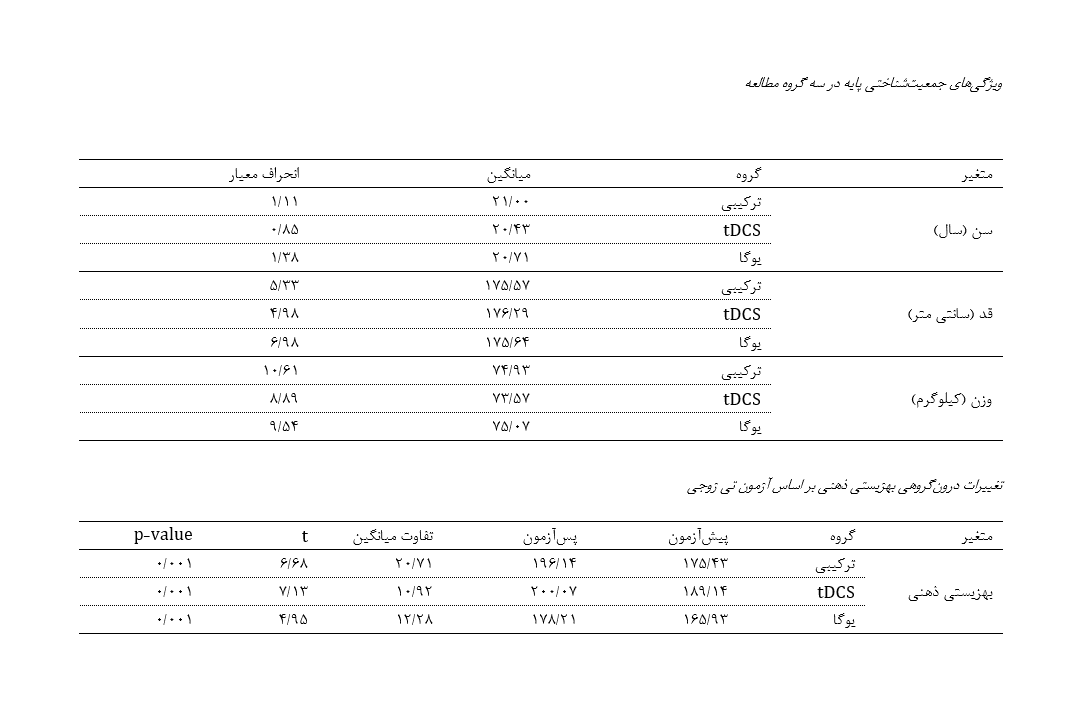
This study compared changes in mental well-being following mindfulness-based yoga, transcranial direct current stimulation (tDCS), and their combination among students at Torbat-e Jam Faculty of Medical Sciences. This pretest–posttest study included three active intervention groups. Forty-five male students aged 18–24 years were allocated to mindfulness-based yoga, active tDCS, or combined yoga plus active tDCS (n=15 per group). Each group completed 12 sessions over 6 weeks. Mental well-being was measured using the Magyar-Moe and Keyes scale. Paired t tests, analysis of covariance, and Bonferroni-adjusted pairwise comparisons were performed in SPSS version 27. No no-intervention control or sham-tDCS group was included. Mental well-being scores increased from pretest to posttest in all three active groups (p<0.05). ANCOVA controlling for baseline scores indicated an overall between-group difference (p=0.020; η²=0.180), with a higher adjusted mean in the combined group. In the absence of a control and sham condition, these findings cannot establish the absolute efficacy of the interventions. The combined intervention was associated with a higher adjusted posttest mental well-being score than either active intervention alone. The finding is preliminary and requires confirmation in adequately powered, sham-controlled randomized trials with blinded assessment and follow-up.
References
Awadalla, S., Davies, E. B., & Glazebrook, C. (2025). A pre-post study evaluating an online CBT-based intervention to improve academic performance in students with low mood. Humanities and Social Sciences Communications, 12, 837. https://doi.org/10.1057/s41599-025-05037-x
Bilagi, A., Kumari, S., & Archana, M. (2025). Effect of integrated yoga on mental health and mindfulness of adolescents in the postpandemic period: A randomized control trial. Yoga Mimamsa, 57(1), 34-41.
Bücker, S., Nuraydin, S., Simonsmeier, B. A., Schneider, M., & Luhmann, M. (2018). Subjective well-being and academic achievement: A meta-analysis. Journal of Research in Personality, 74, 83-94. https://doi.org/10.1016/j.jrp.2018.02.007
Castellote-Caballero, Y., Carcelén-Fraile Md, C., Aibar-Almazán, A., Rivas-Campo, Y., & González-Martín, A. M. (2024). Yoga as a therapeutic approach to mental health in university students: a randomized controlled trial. Frontiers in public health, 12, 1406937. https://doi.org/10.3389/fpubh.2024.1406937
Castellote-Caballero, Y., Carcelén-Fraile, M. d. C., Aibar-Almazán, A., Rivas-Campo, Y., & González-Martín, A. M. (2024). Yoga as a therapeutic approach to mental health in university students: a randomized controlled trial. Frontiers in public health, 12, 1406937.
Chandler, L., Patel, C., Lovecka, L., Gardani, M., Walasek, L., & Ellis, J. (2022). Improving university students' mental health using multi-component and single-component sleep interventions: A systematic review and meta-analysis. Sleep medicine, 100, 354-363. https://doi.org/10.1016/j.sleep.2022.09.003
Chatterjee, S., Mondal, S., & Singh, D. (2021). Effect of 12 weeks of yogic training on neurocognitive variables: A quasi-experimental study. Indian Journal of Community Medicine, 46(1), 112-116. https://doi.org/10.4103/ijcm.IJCM_325_20
Cheng-Kai, W., Dan-Dan, S., Yan, Z., Li-Yin, G., & Tian, H. (2019). Transcranial Direct Current Stimulation on Cognitive Enhancement of Healthy Individuals: Application and Its Influencing Factors. Journal of Psychological Science, 42(4), 963-970. https://jps.ecnu.edu.cn/EN/abstract/abstract10387.shtml
Chuning, A. E., Durham, M. R., Killgore, W. D., & Smith, R. (2024). Psychological resilience and hardiness as protective factors in the relationship between depression/anxiety and well-being: Exploratory and confirmatory evidence. Personality and individual differences, 225, 112664.
Cilar Budler, L. (2025). Well‐Being Unveiled: A Concept Analysis of Mental, Psychological, and Subjective Well‐Being. Health Science Reports, 8(9), e71149.
Cohen, J. (1988). Statistical Power Analysis for the Behavioral Sciences (2nd ed.). Lawrence Erlbaum Associates. https://books.google.com/books?hl=en&lr=&id=2v9zDAsLvA0C&oi=fnd&pg=PR3&dq=Cohen,+J.+(1988).+Statistical+Power+Analysis+for+the+Behavioral+Sciences.+Hillsdale,+NJ,+Lawrence+Erlbaum+Associates.+%09&ots=x8iFiV5BzW&sig=8FOujADiaXeIFtqXx0rmaW_haCk
Collazzoni, A., Stratta, P., Tosone, A., Rossetti, M. C., D'Onofrio, S., & Rossi, A. (2016). Different roles of resilience in a non clinical sample evaluated for family stress and psychiatric symptoms. Personality and individual differences, 100, 12-15.
Golestani Bakht, T. (2007). Presenting a model of mental well-being and happiness in the population of Tehran Al-Zahra University]. Tehran.
Iranmanesh, R., & Dasht Bozorgi, Z. (2019). The Effect of Health-Oriented Lifestyle Training on Psychological Well-being, Blood Pressure and Death Anxiety of Elderly Women. Aging Psychology, 4(4), 263-273. https://jap.razi.ac.ir/article_1090_28eb51eb92ddfd1cc3f7dd5720605fe1.pdf
Kapil, M., Rostampour, R., Hadwin, A., Miller, M., & MacDonald, S. W. (2025). Mental health and foundational academic behaviours: Pieces of the academic success puzzle. Canadian Journal of Higher Education, 55(2), 75-93.
Kaspour, S., & Zarean, M. (2025). The Relationship between Meaning in Life and Psychological Well-Being Among University Students: Mediating Role of the Psychological Capital. Journal of Modern Psychological Researches, 19(76), 97-107. https://doi.org/10.22034/jmpr.2024.63739.6447
Keyes, C. L. M., & Magyar-Moe, J. L. (2003). The measurement and utility of adult subjective well-being. In S. J. Lopez & C. R. Snyder (Eds.), Positive Psychological Assessment: A Handbook of Models and Measures (pp. 411-425). American Psychological Association. https://doi.org/10.1037/10612-026
Koyuncu, F., & Yuceer, B. (2026). Effects of a culturally adapted mindfulness-based intervention on stress, psychological resilience and academic self-efficacy among nursing students in Somalia: A randomized controlled trial. Nurse Education in Practice, 104888.
Movahed, F. S., Goradel, J. A., Pouresmali, A., & Mowlaie, M. (2018). Effectiveness of transcranial direct current stimulation on worry, anxiety, and depression in generalized anxiety disorder: a randomized, single-blind pharmacotherapy and sham-controlled clinical trial. Iran J Psychiatry Behav Sci, 12(2), e11071. https://doi.org/10.5812/ijpbs.11071
Mugnol-Ugarte, L., Bortolini, T., Yao, B., Mikkelsen, M., Carneiro Monteiro, M., & Andorinho de Freitas Ferreira, A. C. (2024). Transcranial electrical stimulation modulates emotional experience and metabolites in the prefrontal cortex in a donation task. Scientific Reports, 14, 14271. https://doi.org/10.1038/s41598-024-64876-x
Ng, T. Y., Ng, T. K., & Siu, O. L. (2025). Enhancing mental well-being in university students through multicomponent low intensity positive education and the mediating role of civic engagement. Scientific Reports, 15(1), 20871.
Park, C. L., Finkelstein-Fox, L., Groessl, E. J., Elwy, A. R., & Lee, S. Y. (2020). Exploring how different types of yoga change psychological resources and emotional well-being across a single session. Complementary Therapies in Medicine, 49, 102354. https://doi.org/10.1016/j.ctim.2020.102354
Rege, M., Bru, E., Solli, I. F., Thijssen, M. W., Tharaldsen, K. B., Vestad, L., Ertesvåg, S. K., Ogden, T., & Stallard, P. N. (2025). The impact of teaching coping skills in schools on youth mental health and academic achievement: Evidence from a field experiment.
Sukumar, S., Shettigar, D., Vaishali, K., Paramashiva, P. S., Nagari, S. K., Kadavigere, R., Amin, R., Srivastav, P., Bommasamudram, T., & Dkhar, W. (2026). Yoga and Mindfulness Interventions for Adolescents with Lifestyle-Related Health Risk Factors: A Systematic Review. Advances in Integrative Medicine, 100664.
Tyagi, A., & Cohen, M. (2016). Yoga and heart rate variability: A comprehensive review of the literature. International Journal of Yoga, 9(2), 97-113. https://doi.org/10.4103/0973-6131.183712
Wu, Y., Jintao, L., Kong, W., & Lin, R. (2025). Happiness predicts academic achievement: A longitudinal empirical analysis of subjective well-being and academic performance among college students. New Horizon of Education, 1(1), 23-37.
Zheng, E. Z., Wong, N. M., Yang, A. S., & Lee, T. M. (2024). Evaluating the effects of tDCS on depressive and anxiety symptoms from a transdiagnostic perspective: a systematic review and meta-analysis of randomized controlled trials. Translational Psychiatry, 14(1), 295. https://doi.org/10.1038/s41398-024-03003-w
Downloads
Publication Timeline
- Submitted
- Revised
- Accepted
Issue
Section
License
Copyright (c) 2025 مجيد کرمي زاده (نویسنده); زهرا انتظاری خراساني; مرضیه بلالی (نویسنده)

This work is licensed under a Creative Commons Attribution-NonCommercial 4.0 International License.