مقایسه اثربخشی مداخلهی تلفیقی تمرینات ذهن آگاهی مبتنی بر یوگا با تحریک مستقیم فراجمجمه ای (tDCS) بر بهزیستی ذهنی دانشجویان دانشکده علوم پزشکی: یک کارآزمایی نیمهتجربی
کلمات کلیدی:
بهزیستی ذهنی, ذهنآگاهی مبتنی بر یوگا, تحریک الکتریکی فراجمجمهای (tDCS)چکیده
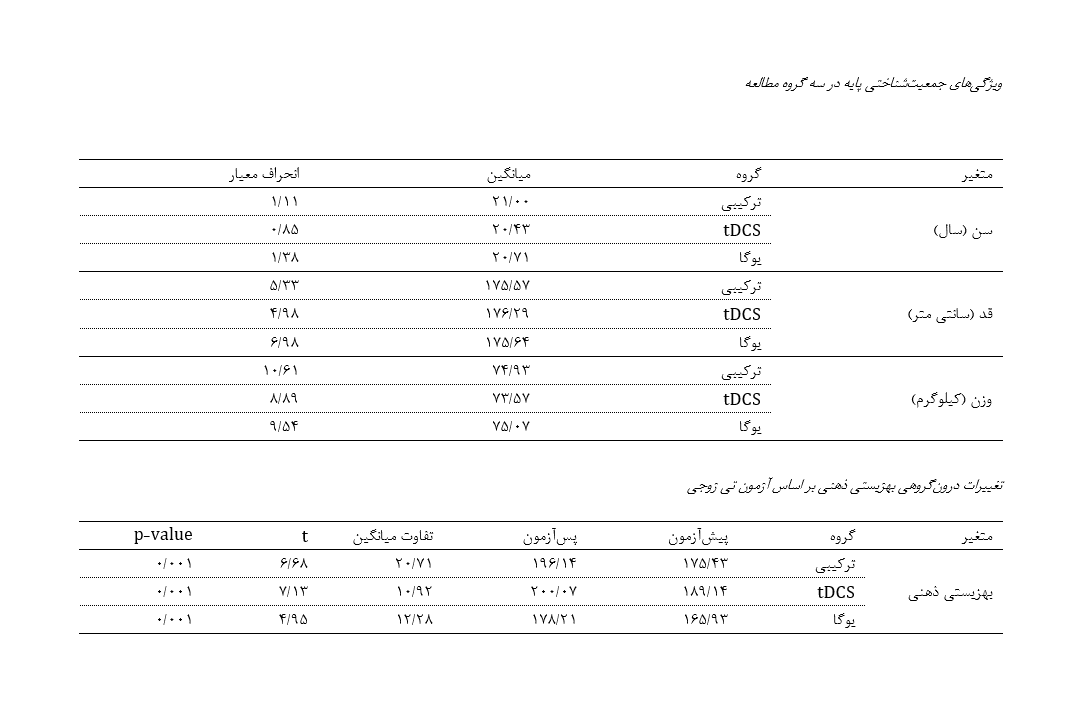
هدف پژوهش حاضر مقایسه تغییرات بهزیستی ذهنی پس از تمرینات ذهنآگاهی مبتنی بر یوگا، تحریک مستقیم الکتریکی فراجمجمهای (tDCS) و ترکیب دو مداخله در دانشجویان دانشکده علوم پزشکی تربت جام بود. این پژوهش با طرح پیشآزمون–پسآزمون و سه گروه مداخله فعال انجام شد. شرکتکنندگان ۴۵ دانشجوی پسر ۱۸ تا ۲۴ ساله بودند که بر اساس معیارهای ورود و محاسبه حجم نمونه با نرمافزار G*Power انتخاب و در سه گروه ۱۵ نفره شامل تمرینات ذهنآگاهی مبتنی بر یوگا، تحریک مستقیم الکتریکی فراجمجمهای (tDCS) و مداخله ترکیبی (یوگا و tDCS) گمارش شدند. هر گروه ۱۲ جلسه مداخله طی ۶ هفته (دو جلسه در هفته) دریافت کرد. بهزیستی ذهنی با مقیاس ماگیار-مو و کییز (۲۰۰۳) سنجیده شد. دادهها با آزمون تی زوجی، تحلیل کوواریانس و مقایسههای زوجی بونفرونی در نرمافزار SPSS نسخه ۲۷ تحلیل شدند. این مطالعه فاقد گروه کنترل بدون مداخله و sham-tDCS بود. نمرات بهزیستی ذهنی از پیشآزمون تا پسآزمون در هر سه گروه افزایش یافت (۰٫۰۵>p). تحلیل کوواریانس با کنترل نمرات پیشآزمون، تفاوت بین سه گروه فعال را نشان داد (۰٫۰۲۰=p؛ η²=۰٫۱۸۰). میانگین تعدیلشده گروه ترکیبی از دو گروه دیگر بیشتر بود؛ بااینحال، به دلیل نبود گروه کنترل و sham، این یافتهها نباید بهعنوان اثبات اثربخشی مطلق مداخلات تفسیر شوند. در این نمونه، مداخله ترکیبی با نمره تعدیلشده بالاتر بهزیستی ذهنی نسبت به دو مداخله فعال دیگر همراه بود. این نتایج مقدماتی است و به علت نبود گروه کنترل، نبود sham-tDCS، کورسازی ناکافی و فقدان پیگیری، برای نتیجهگیری علّی یا توصیه کاربرد بالینی به کارآزماییهای کنترلشده بزرگتر نیاز است.
مراجع
Awadalla, S., Davies, E. B., & Glazebrook, C. (2025). A pre-post study evaluating an online CBT-based intervention to improve academic performance in students with low mood. Humanities and Social Sciences Communications, 12, 837. https://doi.org/10.1057/s41599-025-05037-x
Bilagi, A., Kumari, S., & Archana, M. (2025). Effect of integrated yoga on mental health and mindfulness of adolescents in the postpandemic period: A randomized control trial. Yoga Mimamsa, 57(1), 34-41.
Bücker, S., Nuraydin, S., Simonsmeier, B. A., Schneider, M., & Luhmann, M. (2018). Subjective well-being and academic achievement: A meta-analysis. Journal of Research in Personality, 74, 83-94. https://doi.org/10.1016/j.jrp.2018.02.007
Castellote-Caballero, Y., Carcelén-Fraile Md, C., Aibar-Almazán, A., Rivas-Campo, Y., & González-Martín, A. M. (2024). Yoga as a therapeutic approach to mental health in university students: a randomized controlled trial. Frontiers in public health, 12, 1406937. https://doi.org/10.3389/fpubh.2024.1406937
Castellote-Caballero, Y., Carcelén-Fraile, M. d. C., Aibar-Almazán, A., Rivas-Campo, Y., & González-Martín, A. M. (2024). Yoga as a therapeutic approach to mental health in university students: a randomized controlled trial. Frontiers in public health, 12, 1406937.
Chandler, L., Patel, C., Lovecka, L., Gardani, M., Walasek, L., & Ellis, J. (2022). Improving university students' mental health using multi-component and single-component sleep interventions: A systematic review and meta-analysis. Sleep medicine, 100, 354-363. https://doi.org/10.1016/j.sleep.2022.09.003
Chatterjee, S., Mondal, S., & Singh, D. (2021). Effect of 12 weeks of yogic training on neurocognitive variables: A quasi-experimental study. Indian Journal of Community Medicine, 46(1), 112-116. https://doi.org/10.4103/ijcm.IJCM_325_20
Cheng-Kai, W., Dan-Dan, S., Yan, Z., Li-Yin, G., & Tian, H. (2019). Transcranial Direct Current Stimulation on Cognitive Enhancement of Healthy Individuals: Application and Its Influencing Factors. Journal of Psychological Science, 42(4), 963-970. https://jps.ecnu.edu.cn/EN/abstract/abstract10387.shtml
Chuning, A. E., Durham, M. R., Killgore, W. D., & Smith, R. (2024). Psychological resilience and hardiness as protective factors in the relationship between depression/anxiety and well-being: Exploratory and confirmatory evidence. Personality and individual differences, 225, 112664.
Cilar Budler, L. (2025). Well‐Being Unveiled: A Concept Analysis of Mental, Psychological, and Subjective Well‐Being. Health Science Reports, 8(9), e71149.
Cohen, J. (1988). Statistical Power Analysis for the Behavioral Sciences (2nd ed.). Lawrence Erlbaum Associates. https://books.google.com/books?hl=en&lr=&id=2v9zDAsLvA0C&oi=fnd&pg=PR3&dq=Cohen,+J.+(1988).+Statistical+Power+Analysis+for+the+Behavioral+Sciences.+Hillsdale,+NJ,+Lawrence+Erlbaum+Associates.+%09&ots=x8iFiV5BzW&sig=8FOujADiaXeIFtqXx0rmaW_haCk
Collazzoni, A., Stratta, P., Tosone, A., Rossetti, M. C., D'Onofrio, S., & Rossi, A. (2016). Different roles of resilience in a non clinical sample evaluated for family stress and psychiatric symptoms. Personality and individual differences, 100, 12-15.
Golestani Bakht, T. (2007). Presenting a model of mental well-being and happiness in the population of Tehran Al-Zahra University]. Tehran.
Iranmanesh, R., & Dasht Bozorgi, Z. (2019). The Effect of Health-Oriented Lifestyle Training on Psychological Well-being, Blood Pressure and Death Anxiety of Elderly Women. Aging Psychology, 4(4), 263-273. https://jap.razi.ac.ir/article_1090_28eb51eb92ddfd1cc3f7dd5720605fe1.pdf
Kapil, M., Rostampour, R., Hadwin, A., Miller, M., & MacDonald, S. W. (2025). Mental health and foundational academic behaviours: Pieces of the academic success puzzle. Canadian Journal of Higher Education, 55(2), 75-93.
Kaspour, S., & Zarean, M. (2025). The Relationship between Meaning in Life and Psychological Well-Being Among University Students: Mediating Role of the Psychological Capital. Journal of Modern Psychological Researches, 19(76), 97-107. https://doi.org/10.22034/jmpr.2024.63739.6447
Keyes, C. L. M., & Magyar-Moe, J. L. (2003). The measurement and utility of adult subjective well-being. In S. J. Lopez & C. R. Snyder (Eds.), Positive Psychological Assessment: A Handbook of Models and Measures (pp. 411-425). American Psychological Association. https://doi.org/10.1037/10612-026
Koyuncu, F., & Yuceer, B. (2026). Effects of a culturally adapted mindfulness-based intervention on stress, psychological resilience and academic self-efficacy among nursing students in Somalia: A randomized controlled trial. Nurse Education in Practice, 104888.
Movahed, F. S., Goradel, J. A., Pouresmali, A., & Mowlaie, M. (2018). Effectiveness of transcranial direct current stimulation on worry, anxiety, and depression in generalized anxiety disorder: a randomized, single-blind pharmacotherapy and sham-controlled clinical trial. Iran J Psychiatry Behav Sci, 12(2), e11071. https://doi.org/10.5812/ijpbs.11071
Mugnol-Ugarte, L., Bortolini, T., Yao, B., Mikkelsen, M., Carneiro Monteiro, M., & Andorinho de Freitas Ferreira, A. C. (2024). Transcranial electrical stimulation modulates emotional experience and metabolites in the prefrontal cortex in a donation task. Scientific Reports, 14, 14271. https://doi.org/10.1038/s41598-024-64876-x
Ng, T. Y., Ng, T. K., & Siu, O. L. (2025). Enhancing mental well-being in university students through multicomponent low intensity positive education and the mediating role of civic engagement. Scientific Reports, 15(1), 20871.
Park, C. L., Finkelstein-Fox, L., Groessl, E. J., Elwy, A. R., & Lee, S. Y. (2020). Exploring how different types of yoga change psychological resources and emotional well-being across a single session. Complementary Therapies in Medicine, 49, 102354. https://doi.org/10.1016/j.ctim.2020.102354
Rege, M., Bru, E., Solli, I. F., Thijssen, M. W., Tharaldsen, K. B., Vestad, L., Ertesvåg, S. K., Ogden, T., & Stallard, P. N. (2025). The impact of teaching coping skills in schools on youth mental health and academic achievement: Evidence from a field experiment.
Sukumar, S., Shettigar, D., Vaishali, K., Paramashiva, P. S., Nagari, S. K., Kadavigere, R., Amin, R., Srivastav, P., Bommasamudram, T., & Dkhar, W. (2026). Yoga and Mindfulness Interventions for Adolescents with Lifestyle-Related Health Risk Factors: A Systematic Review. Advances in Integrative Medicine, 100664.
Tyagi, A., & Cohen, M. (2016). Yoga and heart rate variability: A comprehensive review of the literature. International Journal of Yoga, 9(2), 97-113. https://doi.org/10.4103/0973-6131.183712
Wu, Y., Jintao, L., Kong, W., & Lin, R. (2025). Happiness predicts academic achievement: A longitudinal empirical analysis of subjective well-being and academic performance among college students. New Horizon of Education, 1(1), 23-37.
Zheng, E. Z., Wong, N. M., Yang, A. S., & Lee, T. M. (2024). Evaluating the effects of tDCS on depressive and anxiety symptoms from a transdiagnostic perspective: a systematic review and meta-analysis of randomized controlled trials. Translational Psychiatry, 14(1), 295. https://doi.org/10.1038/s41398-024-03003-w
دانلودها
گاهشمار انتشار
- ارسال
- بازنگری
- پذیرش
شماره
نوع مقاله
مجوز
حق نشر 2025 مجيد کرمي زاده (نویسنده); زهرا انتظاری خراساني; مرضیه بلالی (نویسنده)

این پروژه تحت مجوز بین المللی Creative Commons Attribution-NonCommercial 4.0 می باشد.