اثر تمرینات ریتمیک بادی پرکاشن بر لذتمندی از فعالیت بدنی و کارکرد اجرایی در دختران ۱۰ تا ۱۲ ساله با کمتوانی ذهنی آموزشپذیر
کلمات کلیدی:
بادی پرکاشن, کارکرد اجرایی, لذتمندی از فعالیت بدنی, کمتوانی ذهنی, فعالیت بدنی کودکانچکیده
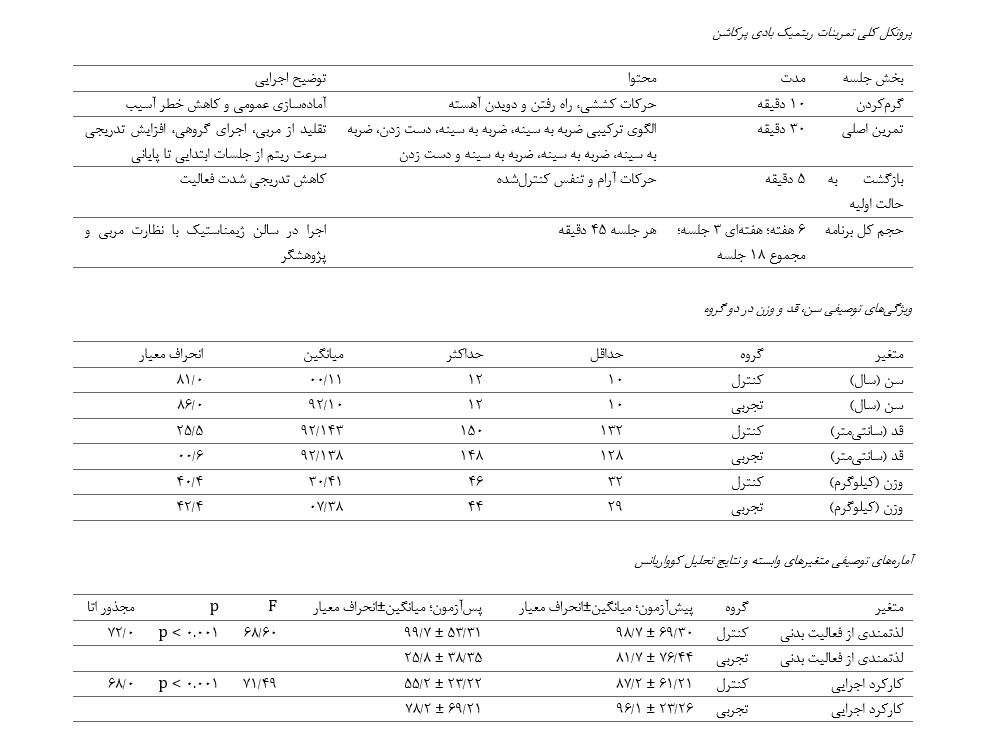
این مطالعه با هدف بررسی اثر تمرینات ریتمیک بادی پرکاشن بر لذتمندی از فعالیت بدنی و کارکرد اجرایی دختران ۱۰ تا ۱۲ ساله با کمتوانی ذهنی آموزشپذیر انجام شد. پژوهش حاضر از نوع نیمهتجربی با طرح پیشآزمون ـ پسآزمون همراه با گروه کنترل بود. جامعه آماری را همه دانشآموزان دختر ۱۰ تا ۱۲ ساله با کمتوانی ذهنی آموزشپذیرِ مشغول به تحصیل در مدارس استثنایی ابتدایی شهر دزفول در سال تحصیلی ۱۴۰۲-۱۴۰۳ تشکیل دادند. از میان آنان، ۲۶ دانشآموز بر اساس معیارهای ورود انتخاب و بهصورت تصادفی در دو گروه تجربی و کنترل، هر گروه ۱۳ نفر، قرار گرفتند. لذتمندی از فعالیت بدنی با پرسشنامه Moore و همکاران و کارکرد اجرایی با آزمون برج لندن ارزیابی شد. گروه تجربی به مدت ۶ هفته، هفتهای سه جلسه و هر جلسه ۴۵ دقیقه تمرین بادی پرکاشن دریافت کرد؛ گروه کنترل فعالیتهای معمول خود را ادامه داد. دادهها با آزمون تحلیل کوواریانس و در سطح معناداری ۰/۰۵ تحلیل شدند. نتایج نشان داد که پس از کنترل اثر پیشآزمون، بین دو گروه در نمرات پسآزمون لذتمندی از فعالیت بدنی و کارکرد اجرایی تفاوت معنادار وجود داشت (p < 0.001). با توجه به تفاوتهای اولیه بین گروهها و نبود گزارش میانگینهای تعدیلشده در خروجی اولیه، نتایج باید بهعنوان شواهد مقدماتی از اثرپذیری این متغیرها از مداخله تفسیر شوند. تمرینات بادی پرکاشن میتواند بهعنوان یک مداخله کمهزینه، گروهی و قابل اجرا در مدارس ویژه و مراکز توانبخشی مورد توجه قرار گیرد؛ با این حال، تأیید قطعی اثربخشی آن نیازمند مطالعات بزرگتر، کنترل فعال و پیگیری بلندمدت است.
مراجع
Black, D. W., & Grant, J. E. (2014). DSM-5 Guidebook: The Essential Companion to the Diagnostic and Statistical Manual of Mental Disorders. American Psychiatric Publishing.
Brighenti, S., Cicinelli, G., Urdanch, B., & Keller, R. (2024). Effects of executive functions training in primary school students with borderline intellectual functioning through a multi-method, multi-informant intervention: a pilot study. Clinical Neuropsychiatry, 21(3), 159-170.
Diamond, A. (2013). Executive functions. Annual Review of Psychology, 64, 135-168. https://doi.org/10.1146/annurev-psych-113011-143750
Erickson, K. I., Donofry, S. D., Sewell, K. R., Brown, B. M., & Stillman, C. M. (2022). Cognitive aging and the promise of physical activity. Annual Review of Clinical Psychology, 18, 417-442. https://doi.org/10.1146/annurev-clinpsy-072720-014213
Erostarbe-Pérez, M., Reparaz-Abaitua, C., Martínez-Pérez, L., & Magallón-Recalde, S. (2022). Executive functions and their relationship with intellectual capacity and age in schoolchildren with intellectual disability. Journal of Intellectual Disability Research, 66(1-2), 50-67. https://doi.org/10.1111/jir.12885
Gravråkmo, S., Olsen, A., Lydersen, S., Ingul, J. M., Henry, L., & Øie, M. G. (2023). Associations between executive functions, intelligence and adaptive behaviour in children and adolescents with mild intellectual disability. Journal of Intellectual Disabilities, 27(3), 715-727. https://doi.org/10.1177/17446295221095951
Haas, P., Yang, C. H., & Dunton, G. F. (2021). Associations between physical activity enjoyment and age-related decline in physical activity in children: results from a longitudinal within-person study. Journal of Sport and Exercise Psychology, 43(3), 205-214. https://doi.org/10.1123/jsep.2020-0156
Jiménez-Molina, J. B., Vicedo-Cantó, E., Sayago-Martínez, R., & Romero-Naranjo, F. J. (2017). Evaluating attention, socioemotional factors and anxiety in secondary school students in Murcia (Spain) using the BAPNE method: research protocol. Procedia - Social and Behavioral Sciences, 237, 1071-1075. https://doi.org/10.1016/j.sbspro.2017.02.157
Lezak, M. D. (2004). Neuropsychological Assessment (4th ed.). Oxford University Press.
Mokaberian, M., Kashani, V., & Sedighi Faroji, F. (2018). Validation of the Persian version of Physical Activity Enjoyment Scale in children. Motor Behavior, 9(30), 17-36.
Moore, J. B., Yin, Z., Hanes, J., Duda, J., Gutin, B., & Barbeau, P. (2009). Measuring enjoyment of physical activity in children: validation of the Physical Activity Enjoyment Scale. Journal of Applied Sport Psychology, 21(Suppl 1), S116-S129. https://doi.org/10.1080/10413200802593612
Morris, P., Hope, E., Foulsham, T., & Mills, J. P. (2021). The effectiveness of mirroring- and rhythm-based interventions for children with autism spectrum disorder: a systematic review. Review Journal of Autism and Developmental Disorders, 8(4), 541-561. https://doi.org/10.1007/s40489-021-00236-z
Mosavi, H. S., Ayatizadeh Tafti, F., Abedinzadeh Masuleh, S., & Abbasi Bafghi, H. (2023). Effectiveness of cognitive-motor intervention on physical literacy and enjoyment of physical activity of female students. Journal of Psychological Science, 22(124), 685-702.
Piqueres de Juan, I., Sánchez González, E., Romero-Naranjo, F. J., & Sarmiento-Alienes, S. (2018). Pilot study into sustained and selective attention using the BAPNE method. European Proceedings of Social and Behavioural Sciences, 751-759. https://doi.org/10.15405/epsbs.2019.04.02.93
Rodan, L. H., Stoler, J., Chen, E., & Geleske, T. (2025). Genetic evaluation of the child with intellectual disability or global developmental delay: clinical report. Pediatrics, 156(1), e2025072219. https://doi.org/10.1542/peds.2025-072219
Romero-Naranjo, A. A., Romero-Naranjo, F. J., & Bofill, L. M. (2016). Body percussion and team building through the BAPNE method. SHS Web of Conferences, 26, 01010. https://doi.org/10.1051/shsconf/20162601020
Tandon, P. S., Klein, M., Saelens, B. E., Christakis, D. A., Marchese, A. J., & Lengua, L. (2018). Short-term impact of physical activity vs. sedentary behavior on preschoolers' cognitive functions. Mental Health and Physical Activity, 15, 17-21. https://doi.org/10.1016/j.mhpa.2018.06.004
Teques, P., Calmeiro, L., Silva, C., & Borrego, C. (2020). Validation and adaptation of the Physical Activity Enjoyment Scale (PACES) in fitness group exercisers. Journal of Sport and Health Science, 9(4), 352-357. https://doi.org/10.1016/j.jshs.2017.09.010
Wan, C. Y., & Schlaug, G. (2010). Music making as a tool for promoting brain plasticity across the life span. The Neuroscientist, 16(5), 566-577. https://doi.org/10.1177/1073858410377805
دانلود
گاهشمار انتشار
- ارسال
- بازنگری
- پذیرش
شماره
نوع مقاله
مجوز
حق نشر 2025 میترا غفوری زاده (نویسنده); نگار آرازشی; علی کاشی, کیوان ملانوروزی (نویسنده)

این پروژه تحت مجوز بین المللی Creative Commons Attribution-NonCommercial 4.0 می باشد.