A Comparative Study of Mindfulness-Based Stress Reduction and Compassion-Focused Therapy for Psychosomatic Symptoms and Physical Health in Patients with Hypertension
Keywords:
Mindfulness-Based Stress Reduction, Compassion-Focused Therapy, Psychosomatic Symptoms, Physical Health, HypertensionAbstract
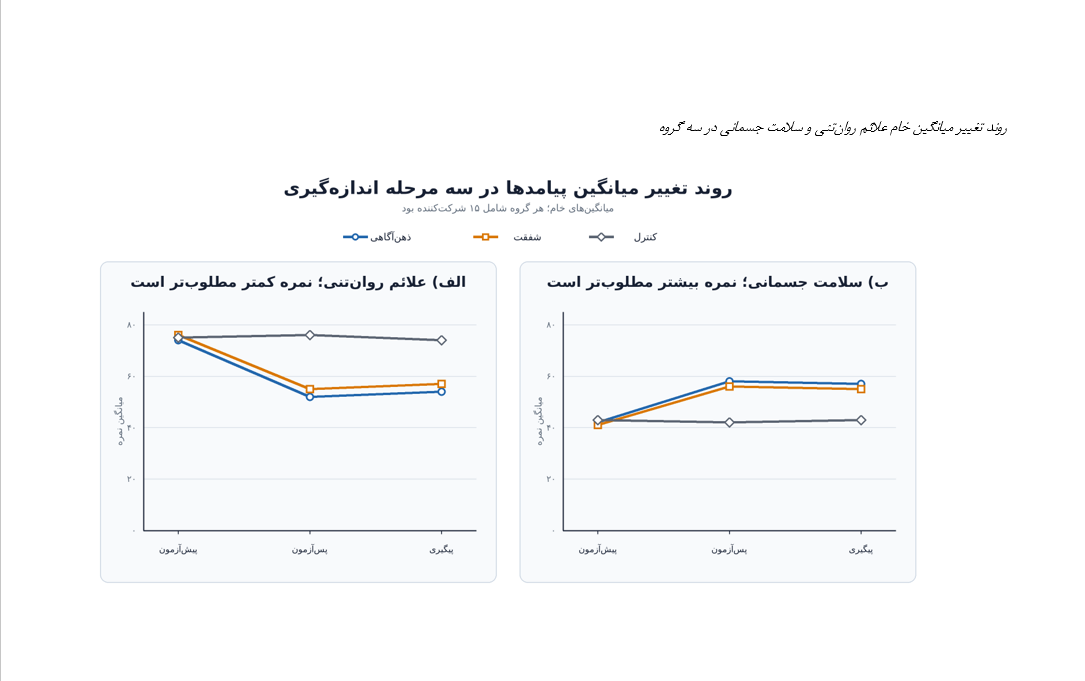
Hypertension is associated not only with cardiovascular morbidity but also with psychological stress, somatic complaints, and poorer perceived health. This study compared mindfulness-based stress reduction (MBSR) and compassion-focused therapy (CFT) for psychosomatic symptoms and physical health in patients with hypertension. This quasi-experimental study used a pretest-posttest-follow-up design with a control group. Forty-five patients with hypertension in Kashan, Iran, were recruited by convenience sampling in 2025 and randomly allocated to MBSR, CFT, or usual-care control groups (n = 15 each). The intervention groups attended eight weekly sessions. Outcomes were assessed using the 39-item Psychosomatic Symptoms Questionnaire and the 14-item Physical Health Questionnaire. Posttest outcomes were compared using analysis of covariance adjusted for baseline scores; follow-up values were summarized descriptively. After adjustment for baseline scores, the group effect was significant for psychosomatic symptoms, F(2, 41) = 44.52, p < .001, partial η² = .68, and physical health, F(2, 41) = 41.28, p < .001, partial η² = .67. Adjusted psychosomatic-symptom means were 51.84, 54.76, and 76.10 for MBSR, CFT, and control, respectively; adjusted physical-health means were 57.62, 55.84, and 42.14. Follow-up means in both intervention groups remained descriptively close to posttest values. Because complete adjusted pairwise comparisons were unavailable, superiority of either active intervention was not inferred. MBSR and CFT were associated with favorable self-reported outcomes and may be considered complementary to usual hypertension care. Interpretation should remain cautious because of the small convenience sample, reliance on self-report, and incomplete pairwise statistical output.
References
Babak, A., Mousavi, S. Z., Dana Siadat, Z., & Pournamati, S. (2022). Effects of mindfulness-based stress reduction on blood pressure, mental health, and quality of life in hypertensive adult women: A randomized clinical trial study. Journal of Tehran University Heart Center, 17(3), 127-133. https://doi.org/10.18502/jthc.v17i3.10845
Blom, K., Baker, B., How, M., Dai, M., Irvine, J., Abbey, S., Abramson, B. L., Myers, M. G., Kiss, A., Perkins, N. J., & Tobe, S. W. (2014). Hypertension analysis of stress reduction using mindfulness meditation and yoga: Results from the HARMONY randomized controlled trial. American Journal of Hypertension, 27(1), 122-129. https://doi.org/10.1093/ajh/hpt134
Chen, Q., Liu, H., & Du, S. (2024). Effect of mindfulness-based interventions on people with prehypertension or hypertension: A systematic review and meta-analysis of randomized controlled trials. BMC Cardiovascular Disorders, 24, 104. https://doi.org/10.1186/s12872-024-03746-w
Gilbert, P. (2009). The compassionate mind: A new approach to life's challenges. Constable & Robinson. https://www.researchgate.net/profile/Susan-Stuntzner/publication/281900130_Book_Review_Paul_Gilbert_2009_The_Compassionate_Mind_A_New_Approach_to_Life's_Challenges/links/56ddd61508aed4e2a99c5f30/Book-Review-Paul-Gilbert-2009-The-Compassionate-Mind-A-New-Approach-to-Lifes-Challenges
Goyal, M., Singh, S., Sibinga, E. M. S., Gould, N. F., Rowland-Seymour, A., Sharma, R., Berger, Z., Sleicher, D., Maron, D. D., Shihab, H. M., Ranasinghe, P. D., Linn, S., Saha, S., Bass, E. B., & Haythornthwaite, J. A. (2014). Meditation programs for psychological stress and well-being: A systematic review and meta-analysis. JAMA Internal Medicine, 174(3), 357-368. https://doi.org/10.1001/jamainternmed.2013.13018
Heidari, Z., Feizi, A., Rezaei, S., Roohafza, H., & Adibi, P. (2021). Psychosomatic symptoms questionnaire (PSQ-39): A psychometric study among the general population of Iranian adults. BMC Psychiatry, 21, 269. https://doi.org/10.1186/s12888-021-03278-z
Hughes, J. W., Fresco, D. M., Myerscough, R., van Dulmen, M. H. M., Carlson, L. E., & Josephson, R. (2013). Randomized controlled trial of mindfulness-based stress reduction for prehypertension. Psychosomatic Medicine, 75(8), 721-728. https://doi.org/10.1097/PSY.0b013e3182a3e4e5
Kabat-Zinn, J. (1990). Full catastrophe living: Using the wisdom of your body and mind to face stress, pain, and illness. Delacorte Press. https://psycnet.apa.org/record/2006-04192-000
Kabat-Zinn, J. (2003). Mindfulness-based interventions in context: Past, present, and future. Clinical Psychology: Science and Practice, 10(2), 144-156. https://doi.org/10.1093/clipsy.bpg016
Kalahi, P., Salehi, M., Maddahi, M. E., & Sepah Mansour, M. (2022). Effectiveness of a mindfulness-based stress reduction program on state anxiety, trait anxiety, and blood pressure in coronary heart disease patients with hypertension. Advances in Cognitive Sciences, 24(1), 147-159. https://icssjournal.ir/browse.php?a_id=1387&sid=1&slc_lang=en
Khosravi, E., & Ghorbani, M. (2016). Effectiveness of mindfulness-based stress reduction on perceived stress and blood pressure in women with hypertension. Feyz Journal of Kashan University of Medical Sciences, 20(4), 361-368.
Khoury, B., Lecomte, T., Fortin, G., Masse, M., Therien, P., Bouchard, V., Chapleau, M. A., Paquin, K., & Hofmann, S. G. (2013). Mindfulness-based therapy: A comprehensive meta-analysis. Clinical Psychology Review, 33(6), 763-771. https://doi.org/10.1016/j.cpr.2013.05.005
Kirby, J. N., Tellegen, C. L., & Steindl, S. R. (2017). A meta-analysis of compassion-based interventions: Current state of knowledge and future directions. Behavior Therapy, 48(6), 778-792. https://doi.org/10.1016/j.beth.2017.06.003
Lacourt, T., Houtveen, J., & van Doornen, L. (2013). Functional somatic syndromes, one or many? An answer by cluster analysis. Journal of psychosomatic research, 74(1), 6-11. https://doi.org/10.1016/j.jpsychores.2012.09.013
Lacourt, T. E., Houtveen, J. H., & van Doornen, L. J. P. (2013). "Functional somatic syndromes, one or many?" An answer by cluster analysis. Journal of Psychosomatic Research, 74(1), 6-11. https://doi.org/10.1016/j.jpsychores.2012.09.013
Leaviss, J., & Uttley, L. (2015). Psychotherapeutic benefits of compassion-focused therapy: An early systematic review. Psychological Medicine, 45(5), 927-945. https://doi.org/10.1017/S0033291714002141
Saeidian, K., Sohrabi, A., & Zemestani, M. (2019). Effectiveness of compassion-focused therapy on blood pressure and quality of life in women with hypertension. Journal of Ilam University of Medical Sciences, 27(1), 161-169.
Schat, A. C. H., Kelloway, E. K., & Desmarais, S. (2005). The Physical Health Questionnaire (PHQ): Construct validation of a self-report scale of somatic symptoms. Journal of Occupational Health Psychology, 10(4), 363-381. https://doi.org/10.1037/1076-8998.10.4.363
Spruill, T. M. (2010). Chronic psychosocial stress and hypertension. Current Hypertension Reports, 12(1), 10-16. https://doi.org/10.1007/s11906-009-0084-8
Wessely, S., Nimnuan, C., & Sharpe, M. (1999). Functional somatic syndromes: One or many? The Lancet, 354(9182), 936-939. https://doi.org/10.1016/S0140-6736(98)08320-2
World Health Organization. (2025). Hypertension.
Downloads
Publication Timeline
- Submitted
- Revised
- Accepted
Issue
Section
License
Copyright (c) 2025 سیدعلی اصغر سیدابراهیمی (نویسنده); طیبه فردوسی; داود نوده ئی (نویسنده)

This work is licensed under a Creative Commons Attribution-NonCommercial 4.0 International License.