Investigating the Relationship Between Emotional Maturity and Emotional Divorce Among Married Women in Tabriz
Keywords:
Emotional maturity, emotional divorce, married women, Tabriz, correlationAbstract
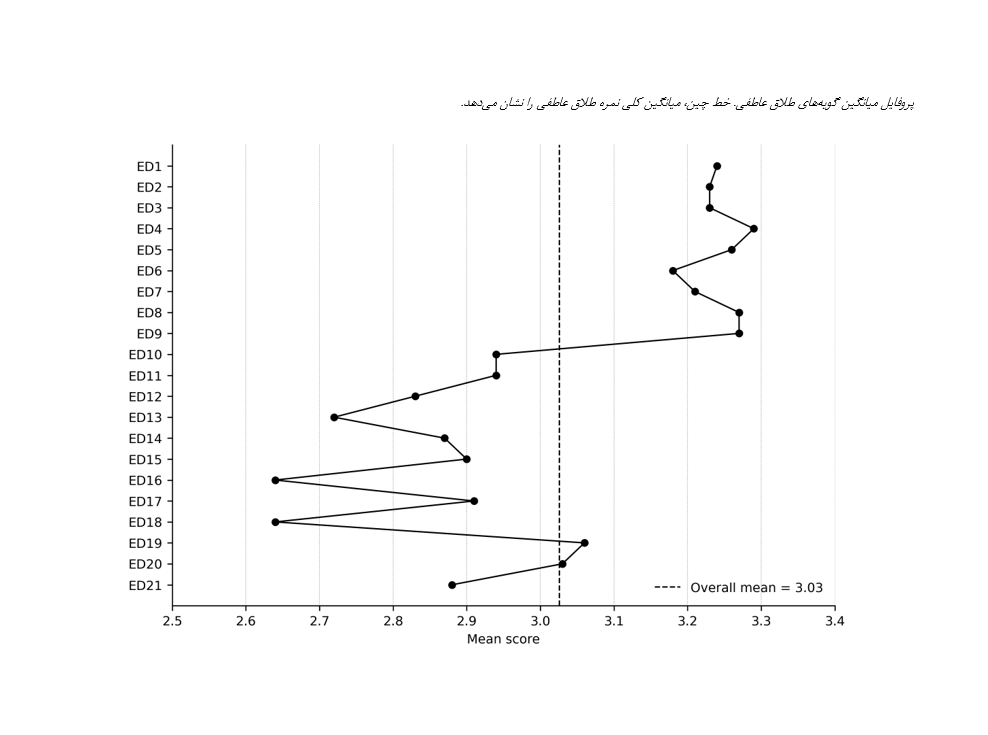
The present study aimed to investigate the relationship between emotional maturity and emotional divorce among married women in Tabriz. This research was conducted using a descriptive-correlational design. The study population consisted of married women living in Tabriz, and the sample size was 100 participants according to the thesis data. Data were collected using the Emotional Maturity Scale developed by Singh and Bhargava and the Emotional Divorce Questionnaire by Gottman. The collected data were analyzed using descriptive statistics, Pearson correlation, and multiple linear regression analysis. Descriptive findings indicated that the mean score of emotional divorce was 3.0257 with a standard deviation of 0.44214, suggesting a moderate level of emotional divorce in the sample. Inferential results showed that the overall regression model was statistically significant (R = 0.288, R² = 0.083, F = 4.396, p = 0.015), indicating that the predictors explained 8.3% of the variance in emotional divorce. However, emotional maturity was not a significant predictor of emotional divorce (β = 0.107, t = 1.104, p = 0.272). The findings suggest that emotional divorce is a multifactorial phenomenon and that emotional maturity alone is not sufficient to explain it.
References
Abdollahi, M. (2013). Emotional Divorce: Concepts and Symbols. Journal of Family Studies.
Ahmadvand, M. A., Ahmadvand, P., & Babaee, Z. (2017). Reduced Quality of Life and Marital Trust in Emotional Divorce.
Al-Ubaidi, B. A. (2017). The psychological and emotional stages of divorce. Family Medicine and Disease Prevention, 3(3), 6. https://doi.org/10.23937/2469-5793/1510060
Alagband, L., Pasha Sharifi, H., Farzad, V., & Aghayousefi, A. (2019). A Model for Predicting Emotional Divorce Based on Emotional Literacy, Coping Styles, Quality of Life, and Sensation Seeking With the Mediation of Emotion Regulation. https://www.sid.ir/paper/51578/fa
Alagband, L., Sharifi, H. P., Farzad, V., & Aghayousefi, A. (2020). Prediction of Emotional Divorce Based on Emotional Literacy, Coping Styles, Quality of Life, and Sensation Seeking With the Mediation of Resilience. https://www.sid.ir/paper/93101/fa
Arjmand Siahpoosh, E., & Piramoon, N. (2014). A Pathological Study of Emotional Divorce From Women's Perspectives and Its Consequences on Children. https://www.sid.ir/paper/170106/
Azimi, N., Hosseini, S. S., Arefi, M., & Parandin, S. (2019). The Mediating Role of Psychological Hardiness in the Relationship Between Conflict Resolution Styles and Emotional Divorce. https://psychologicalscience.ir/article-1-562-fa.html
Azimi Rosta, M., & Abedzadeh Nobaryan, M. (2013). Factors Affecting the Incidence of Emotional Divorce Among Couples. https://www.sid.ir/paper/504015/
Bahari, F., & Bahrami, F. (2008). The Effectiveness of Communication Skills Training for Couples on Marital Conflict Resolution. https://www.sid.ir/paper/496714/fa
Bokharaei, A. (2007). Sociology of Silent Lives in Iran: Emotional Divorce. Pajvak-e Jame-e. https://www.gisoom.com/book/1435332/
Gottman, J. M., & Levenson, R. W. (2000). The timing of divorce: Predicting when a couple will divorce over a 14-year period. Journal of Marriage and Family, 62(3), 737-745. https://doi.org/10.1111/j.1741-3737.2000.00737.x
Hashemi, S. F., & Asghari Ebrahimabad, M. J. (2016). The Role of Emotional Literacy in Predicting Emotional Divorce Through the Mediation of Conflict Resolution. https://www.noormags.ir/view/en/articlepage/1846286/
Imani, R., & Moheb, N. (2020). The Relationship Between Mothers' Emotional Maturity and Children's Behavioral Disorders. https://www.sid.ir/paper/206242/fa
Nichols, M. P. (2012). Family therapy: Concepts and methods. Pearson Higher Ed. https://www.pearson.com/en-us/subject-catalog/p/family-therapy-concepts-and-methods/P200000001566/9780136911814?srsltid=AfmBOopay-gcDomXEX2PvN1sJRI5PifxBasitYnc-3gBO6CazV9AEhWa
Osorio-Molina, C., Martos-Cabrera, M. B., Membrive-Jiménez, M. J., Vargas-Román, K., Martos, N. S., Ortega-Campos, E., & Gómez-Urquiza, J. L. (2020). Smartphone addiction, risk factors and its adverse effects in nursing students: A systematic review and meta-analysis. Nurse Education Today, 104, 104741. https://doi.org/10.1016/j.nedt.2020.104741
Downloads
Publication Timeline
- Submitted
- Revised
- Accepted
Issue
Section
License
Copyright (c) 2025 ثنا آذری

This work is licensed under a Creative Commons Attribution-NonCommercial 4.0 International License.