Comparison of the Effectiveness of Acceptance and Commitment Therapy (ACT) and Cognitive Behavioral Therapy in Patients with Treatment-Resistant Depression
Keywords:
روان درمانی مبتنی بر پذیرش و تعهد (ACT), درمان شناختی- رفتاری (CBT, افسردگی مقاوم به درمان.Abstract
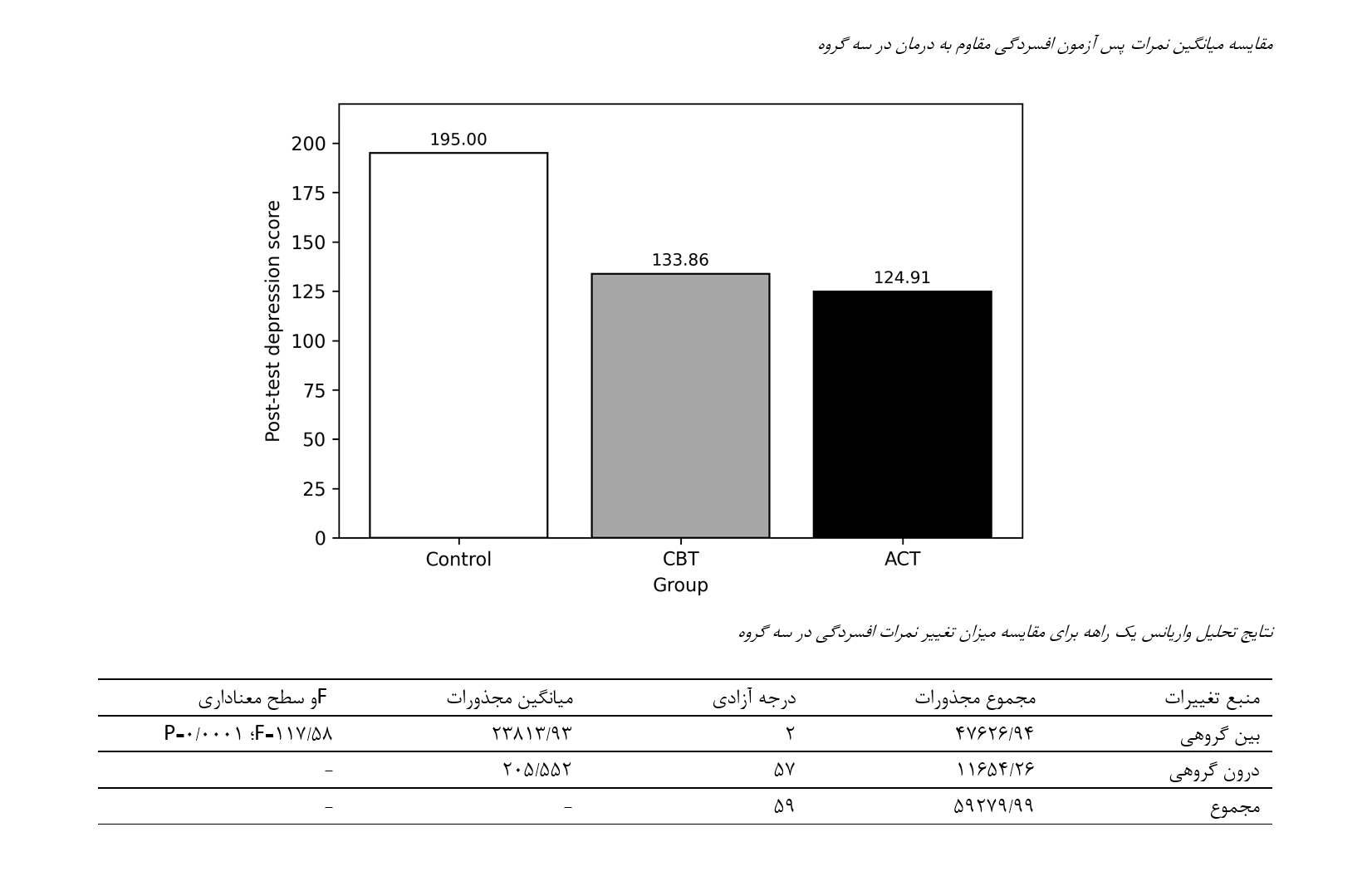
The objective of the present study was to compare the effectiveness of Acceptance and Commitment Therapy (ACT) and Cognitive Behavioral Therapy (CBT) in patients with treatment-resistant depression. The statistical population of this study included all adult patients referring to psychiatric clinics in Tehran who had received at least two standard courses of pharmacological treatment for depression and still experienced depressive symptoms. A total of 60 participants were selected as the sample through purposive sampling and were randomly assigned equally into three groups: Acceptance and Commitment Therapy, Cognitive Behavioral Therapy, and control groups. The research instrument was the Beck Depression Inventory–Second Edition (BDI-II). Participants in each experimental group received Acceptance and Commitment Therapy and Cognitive Behavioral Therapy interventions. The analysis of the findings indicated that both Acceptance and Commitment Therapy and Cognitive Behavioral Therapy were effective in reducing treatment-resistant depression. No significant difference was observed between Cognitive Behavioral Therapy and Acceptance and Commitment Therapy approaches. Furthermore, Acceptance and Commitment Therapy was more effective in reducing treatment-resistant depression among women compared to men.
References
Alam, A., & Mohanty, A. (2023). Interdisciplinary perspectives on sustainable development. CRC Press. https://doi.org/10.1201/9781003457619-10
Alizadeh, N., & Bakhshipour Roudsari, A. (2023). Effectiveness of acceptance and commitment therapy on reducing depression in mothers of children with cerebral palsy. New Strategies in Psychology and Educational Sciences, 20, 52-62. https://www.noormags.ir/view/fa/articlepage/2199373/
Arch, J. J., Fishbein, J. N., Finkelstein, L. B., & Luoma, J. B. (2023). Acceptance and commitment therapy processes and mediation: Challenges and how to address them. Behavior Therapy, 54(6), 971-988. https://doi.org/10.1016/j.beth.2022.07.005
Eisvand, M., Baghouli, H., Javidi, H., & Barzegar, M. (2024). Comparison of the effectiveness of cognitive behavioral therapy with acceptance and commitment therapy on rumination, cognitive flexibility, resilience and perceived stress in women with major depressive disorder. Psychological Achievements, 31(2), 447-476. https://psychac.scu.ac.ir/article_19969.html
Gao, W., Yan, X., & Yuan, J. (2022). Neural correlations between cognitive deficits and emotion regulation strategies: understanding emotion dysregulation in depression from the perspective of cognitive control and cognitive biases. Psychoradiology, 2(3), 86-99. https://doi.org/10.1093/psyrad/kkac014
Kiers, I. L., & de Haan, H. A. (2024). Short-term, manualized schema-focused group therapy for patients with CBT-resistant disorders within primary care: a pilot study with a naturalistic pre-treatment and post-treatment design. Frontiers in Psychology, 15, 1349329. https://doi.org/10.3389/fpsyg.2024.1349329
Kroch, E., Breheny, M., van Kessel, K., & Taylor, J. (2022). Order and disorder: Navigating narrative tensions in the experience of treatment resistant depression. Qualitative Psychology, 9(3), 273-288. https://doi.org/10.1037/qup0000192
Li, Y., & Tang, C. (2024). A systematic review of the effects of rumination-focused cognitive behavioral therapy in reducing depressive symptoms. Frontiers in Psychology, 15, 1447207. https://doi.org/10.3389/fpsyg.2024.1447207
Moazzeni, T., Gholamrezaei, S., & Rezaei, F. (2018). Effectiveness of schema therapy on depression severity and suicidal thoughts in patients with treatment-resistant depression. Armaghane Danesh, 23(2), 253-266. https://armaghanj.yums.ac.ir/browse.php?a_id=1499&sid=1&slc_lang=fa
Morris, E. M., Johns, L. C., & Gaudiano, B. A. (2024). Acceptance and commitment therapy for psychosis: Current status, lingering questions and future directions. Psychology and Psychotherapy: Theory, Research and Practice, 97(1), 41-58. https://doi.org/10.1111/papt.12479
Sadeghi Rad, S., Peyvandi, P., Mohammadi Shirmahalleh, F., Hosseinzadeh Taghavai, M., & Borjali, A. (2022). Comparison of the effectiveness of cognitive-behavioral therapy and acceptance and commitment therapy on paranoid thoughts in women with postpartum depression. Applied Psychological Research, 13(1), 271-276. https://japr.ut.ac.ir/article_87057.html
Sadrmohammadi, R., Gholamrezaei, S., & Ghadampour, E. (2019). Comparison of the effectiveness of memory specificity training, behavioral activation therapy and cognitive-behavioral therapy on treatment-resistant depression. Khatam Shefa Neurosciences, 8(1), 31-41. https://shefayekhatam.ir/browse.php?a_id=2037&sid=1&slc_lang=fa
Stenzel, K. L., Keller, J., Kirchner, L., Rief, W., & Berg, M. (2025). Efficacy of cognitive behavioral therapy in treating repetitive negative thinking, rumination, and worry-a transdiagnostic meta-analysis. Psychological Medicine, 55, e31. https://doi.org/10.1017/S0033291725000017
Thompson, E. M., Destree, L., Albertella, L., & Fontenelle, L. F. (2021). Internet-based acceptance and commitment therapy: a transdiagnostic systematic review and meta-analysis for mental health outcomes. Behavior Therapy, 52(2), 492-507. https://doi.org/10.1016/j.beth.2020.07.002
Wang, K., Cai, S., Duanmu, X. R., Ma, C. Y., Yan, R., Cui, Y. R., & Xu, L. L. (2026). Effect of adding cognitive behavioral therapy to quetiapine on suicide risk, depressive symptoms, and coping style in adult patients with mood disorders. Journal of Psychiatric Research. https://doi.org/10.1016/j.jpsychires.2026.01.005
Yasinski, C., Hayes, A. M., Ready, C. B., Abel, A., Görg, N., & Kuyken, W. (2020). Processes of change in cognitive behavioral therapy for treatment-resistant depression: psychological flexibility, rumination, avoidance, and emotional processing. Psychotherapy Research, 30(8), 983-997. https://doi.org/10.1080/10503307.2019.1699972
Downloads
Publication Timeline
- Submitted
- Revised
- Accepted
Issue
Section
License
Copyright (c) 2025 مهناز سنجری (نویسنده); زکیه صادقی; محبوبه صابری, عصمت سادات عطایی کچوئی, ریحانه تجدد (نویسنده)

This work is licensed under a Creative Commons Attribution-NonCommercial 4.0 International License.