Psychological Factors Influencing the Attraction of Sports Tourists to Kelardasht County
DOI:
https://doi.org/10.61838/kman.longevity.72Keywords:
Sports tourism, Thematic analysis, psychological factors, Tourist attraction, KelardashtAbstract
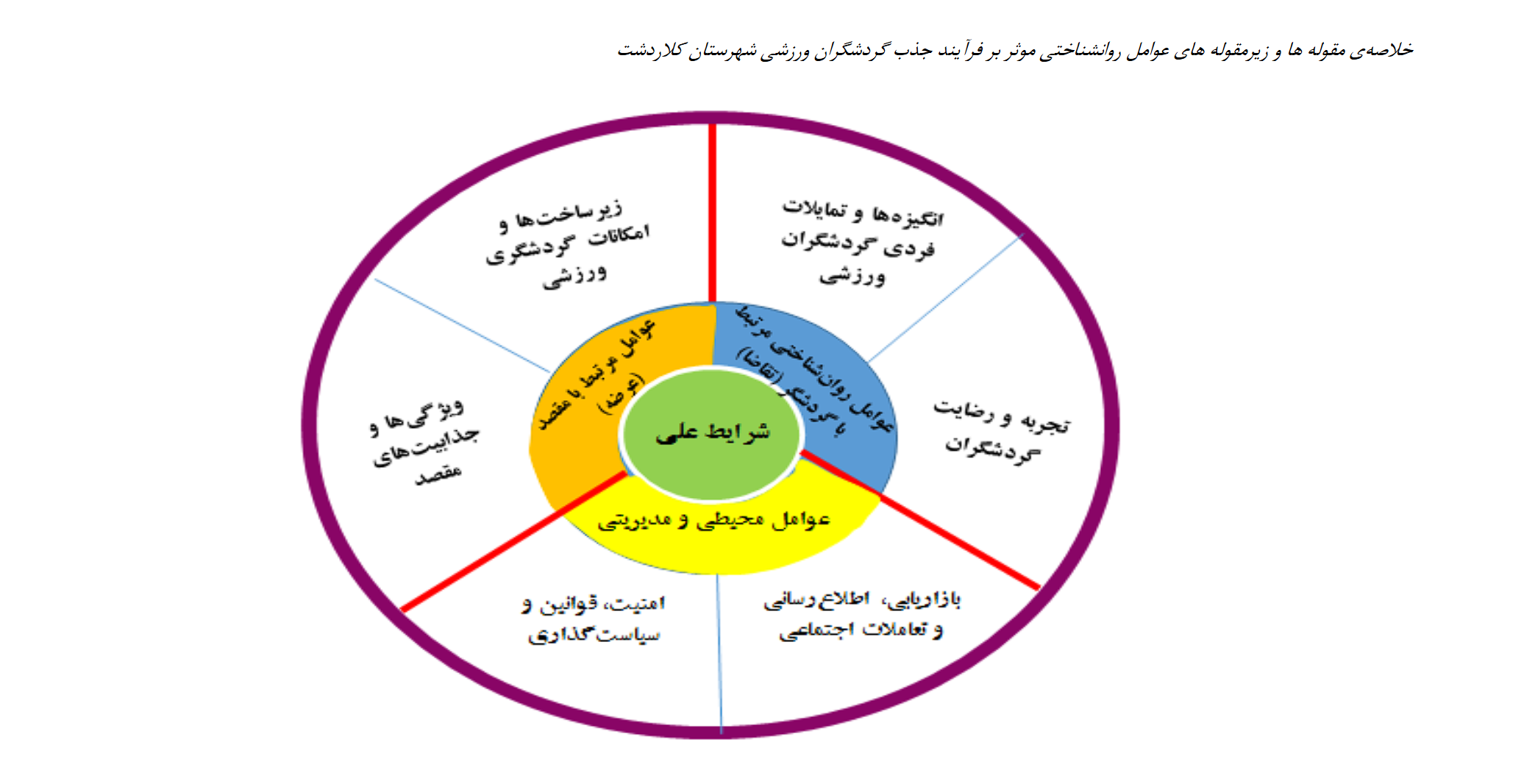
The present study aimed to analyze the psychological factors influencing the process of attracting sports tourists to Kelardasht County. This research adopted a qualitative approach and was conducted using thematic analysis. The participants consisted of 20 sports tourists, experts, and managers associated with sports tourism in Kelardasht, who were selected through purposive sampling until theoretical saturation was achieved. Data were collected through in-depth semi-structured interviews and analyzed using the six-phase approach proposed by Braun and Clarke (2006). The analysis resulted in the extraction of 126 initial concepts and the development of a three-dimensional model comprising: (1) tourist-related psychological factors (demand side), including tourists’ motivations and personal tendencies, as well as tourist experience and satisfaction; (2) destination-related factors (supply side), including sports tourism infrastructure and facilities, and destination characteristics and attractions; and (3) environmental and managerial factors, including marketing, information dissemination and social interactions, as well as security, regulations, and policymaking. These factors interact dynamically to shape the sports tourist attraction process. Based on the findings, sustainable attraction of sports tourists in Kelardasht requires a holistic and integrated perspective that simultaneously addresses tourists’ internal psychological dynamics, the quality of destination supply, and the supportive environmental-managerial framework. Accordingly, managers and planners can capitalize on the region’s unique potential by designing integrated sport–cultural experiences, strengthening soft (human) infrastructure, and implementing narrative-based communication strategies.
References
Ahmadi, A. (2023). The Effect Of Cognitive And Emotional Image On Loyalty According To The Mediating Role Of Tourist Satisfaction. Journal of Tourism and Development, 12(3), 263-281.
Alidoust Ghahfarrokhi, E., Dastgerdi, M., Ranjbar, N., & Khosromanesh, R. (2023). Strategic analysis of developing Iran's active sports tourism. Sports Marketing Studies, 4(1), 73-90.
Asheghi, B., Hematinezhād, M., Nazariān, A., Beyg Mohamadi, T., & Nasir Sālih, H. (2022). Investigating the effective components in attracting the sports tourists (Case study: Guilan province). Geographical Studies of Coastal Areas Journal, 2(4), 43-60. https://doi.org/10.22124/gscaj.2021.20193.1090
Braun, V., & Clarke, V. (2006). Using thematic analysis in psychology. Qualitative research in psychology, 3(2), 77-101.
Chen, Z., Li, S., Wu, Q., Wu, Z., & Xin, S. (2023). The decision-making determinants of sport tourists: a meta-analysis. Current Issues in Tourism, 26(12), 1894-1914.
Gibson, H. J. (1998). Sport tourism: a critical analysis of research. Sport management review, 1(1), 45-76.
Huang, Z., Kong, Y., & Zhou, C. (2018). A study on relationship between sports tourism motivation and tourists' re-visiting intention: Based on Logistic model. 2nd International Conference on Economics and Management, Education, Humanities and Social Sciences (EMEHSS 2018),
Iso-Ahola, S. E. (1982). Toward a social psychological theory of tourism motivation: A rejoinder. Annals of tourism research, 9(2), 256-262.
Jeong, Y. (2023). Exploring tourist behavior in active sports tourism: An analysis of the mediating role of emotions and moderating role of surfing identification. Sage Open, 13(3), 21582440231195486.
Kaplanidou, K., Jordan, J. S., Funk, D., & Ridinger, L. L. (2012). Recurring sport events and destination image perceptions: Impact on active sport tourist behavioral intentions and place attachment. Journal of Sport Management, 26(3), 237-248.
Kaplanidou, K., & Vogt, C. (2007). The interrelationship between sport event and destination image and sport tourists' behaviours. Journal of sport & tourism, 12(3-4), 183-206.
Londoño, M. d. P. L., Molero, R. T., Medina, F. X., Naudí, S. A., & Bergara, S. S. (2021). Turismo deportivo: Una oportunidad para los territorios locales en un contexto global. Un estudio Delphi (Sport tourism: an opportunity for local regions in a global context. A Delphi study). Retos, 42, 77.
Malchrowicz-Mośko, E., & Poczta, J. (2019). Motivations for running in men: A comparative analysis of local runners and sports tourists.
Marjan, S., & Erfan, M. (2018). Determining the Causal Relationship pull and push motivations on sports tourists behavior: Mediating role of satisfaction.
nazari, s., Karoubi, M., & karazmoudeh, l. (2021). The Role of Security on the Behavioral Intentions of Winter Sports Tourists (Case of Study: Tehran Ski Resorts) [orginal]. Social Welfare, 21(81), 241-286.
Oliver, R. L. (1980). A cognitive model of the antecedents and consequences of satisfaction decisions. Journal of marketing research, 17(4), 460-469.
Prayag, G., Hosany, S., Muskat, B., & Del Chiappa, G. (2017). Understanding the relationships between tourists’ emotional experiences, perceived overall image, satisfaction, and intention to recommend. Journal of travel research, 56(1), 41-54.
Seifpanahi Shabani, J., Dastgerdi, M., Ranjbar, N., & Khosromanesh, R. (2022). The strategic road map for the development of Iran's sports tourism under sanctions. Economic Geography Research, 3(9), 1-21.
SEONG, D.-H. (2025). The PRISMA Statement: Effect of International Sports Tourism on the Serious Leisure Attitude. East Asian Journal of Business Economics (EAJBE), 13(2), 15-21.
Shahbazi, R., Khodadadi, M. R., Badri Azarin, Y., & Heydari Chianeh, R. (2024). Identifying Factors Affecting the Performance Management of Sports Tourism Services. Geography and Human Relationships, 7(3), 337-354. https://doi.org/10.22034/gahr.2025.485029.2357
Tomik, R., Kosmala, G., & Ardenska, A. (2017). Active sport tourism in Poland: Environmental conditions and motivational aspects. European Journal of Geography, 8(1).
Zarotis, G. F. (2020). Recreational sport & cultural tourism. Saudi Journal of Business and Management Studies, 5(2), 146-153.
Zendehboodi, M., Shetab Bushehri, N., & Katibi, A. (2022). A Qualitative Model for Developing Adventure Sports Tourism in Khuzestan Province. Strategic Studies on Youth and Sports, 20(54), 193-212.
Downloads
Publication Timeline
- Submitted
- Revised
- Accepted
Issue
Section
License
Copyright (c) 2026 آتنا غرایاق زندی, داود حومنیان شریف آبادی, کیوان صالحی, محمود شیخ (نویسنده)

This work is licensed under a Creative Commons Attribution-NonCommercial 4.0 International License.